
How Leaders Align Vision with Changing Goals
Practical guidance for leaders to keep a clear organisational vision while adapting goals: craft concise vision statements, tell change stories, set measurable metrics and use feedback loops.

In a world where change is constant - whether driven by market shifts, internal restructuring, or evolving stakeholder demands - leaders must ensure their vision stays aligned with organisational goals. Misalignment can lead to disengaged employees, wasted resources, and missed opportunities. Here’s what you need to know:
- Why Alignment Matters: Organisations with a clear vision are four times more likely to thrive. Yet, only 22% of employees believe their leaders have a clear direction.
- The Challenge: Leaders face an average of 10 change initiatives annually, up fivefold from a decade ago. Long-term plans are no longer enough - visions must evolve continuously.
- Key Steps to Stay Aligned:
✓ Create a clear, concise vision that resonates emotionally and logically.
✓ Communicate the vision consistently through stories and tangible examples.
✓ Set measurable outcomes using frameworks like SMART goals or OKRs.
✓ Monitor progress dynamically with a mix of long-term reviews and frequent check-ins.
✓ Update metrics and refine the vision as goals shift, without losing focus.
Real-world examples, like Adobe’s shift to cloud subscriptions or Microsoft’s cultural overhaul under Satya Nadella, show how clear vision paired with agile execution can drive growth even during major transitions. The takeaway? Leaders must balance clarity with flexibility, ensuring their vision remains relevant while inspiring action.
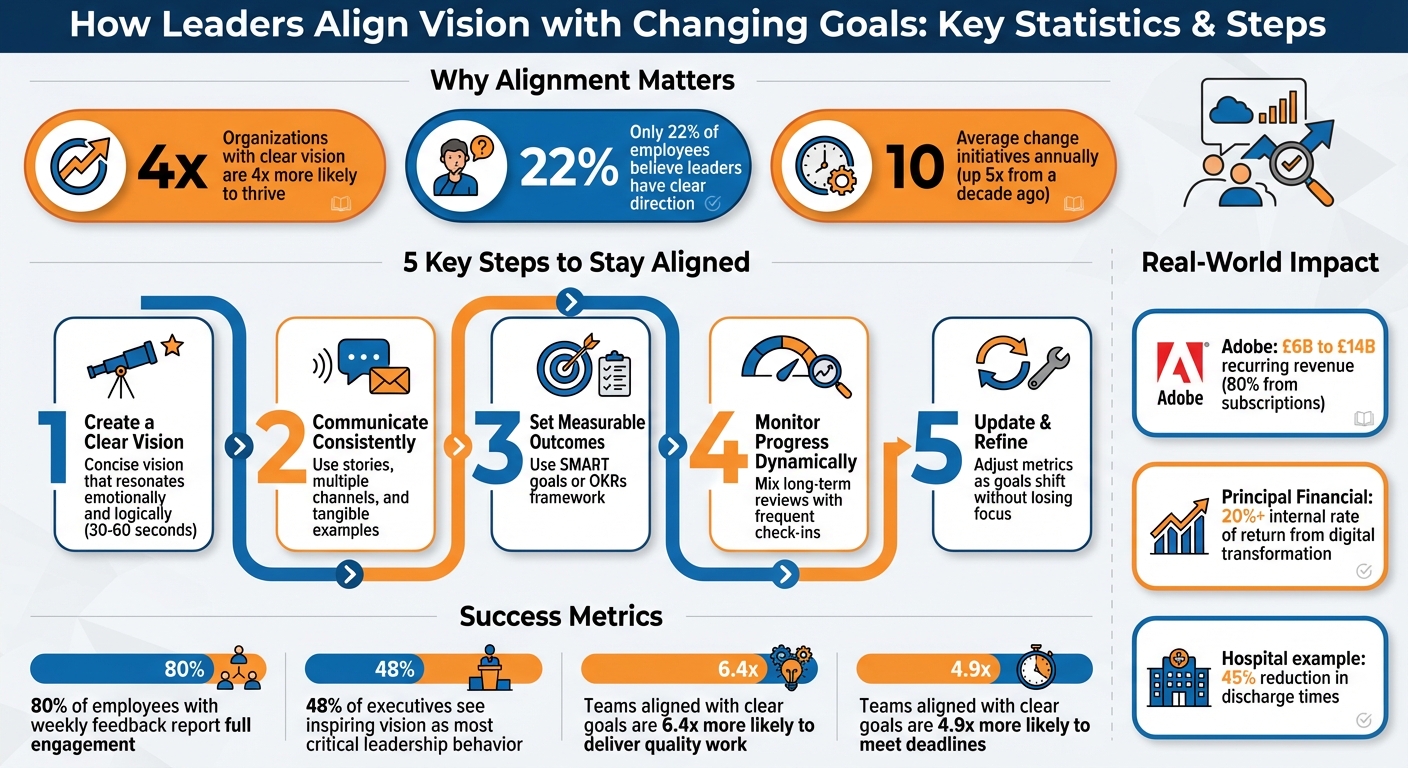
Vision-Goal Alignment Statistics and Key Steps for Leaders
Vision Alignment and Goal-Setting for 2025
Why Organisational Goals Change
Organisational goals often shift in response to three main factors: changes in the external market, internal restructuring, and evolving stakeholder demands.
Market and Industry Changes
External forces can push organisations to rethink their priorities. Market dynamics, such as fluctuations in supply and demand, often influence pricing and force companies to adapt. A prime example is Adobe's decision in 2013 to move from selling software licences to offering cloud-based subscriptions. Initially, this shift caused an 8% drop in revenue. However, by sticking to its long-term strategy, Adobe grew its recurring revenue to £6 billion by 2016, eventually reaching £14 billion, with 80% of its income coming from subscriptions.
Technology also plays a disruptive role, often reshaping entire industries. The rise of AI and renewable energy, for instance, has made some business models outdated, compelling organisations to redefine themselves. Philips is a case in point. By selling off its lightbulb and television divisions, the company pivoted to focus exclusively on healthcare technology, a move driven by global market trends and technological advancements. Other factors, such as regulatory changes, economic uncertainty, and competitive pressures, further complicate the landscape. As Sam Farley and Ketil Gjerstad of BCG note:
CEOs who wait for perfect clarity to initiate strategic and budget plans and deploy capital will lag the competition.
Internal Restructuring and Growth
Internal changes, such as scaling up or entering new markets, can also lead to a shift in organisational goals. This often involves reallocating resources from traditional core activities to new priorities. For example, under CEO Satya Nadella, Microsoft redefined its internal approach by fostering a "live site first" culture during the development of Microsoft Teams. This allowed engineers to tackle issues in real time, prioritising rapid learning over slower, traditional product cycles.
Restructuring can mean dismantling and rebuilding established processes, such as decision-making frameworks or budgeting systems, which often hold entrenched power dynamics. A striking example is Principal Financial Group's transformation under Gary Scholten, its former CIO. Starting in 2011, the company embarked on an 11-year journey to become a digital-first enterprise. By 2020, six digital initiatives had delivered an internal rate of return exceeding 20%, with two-thirds of the benefits coming from revenue growth.
Changing Stakeholder Expectations
Stakeholder expectations add another layer of complexity to organisational change. Shifts in goals and performance can create anxiety among investors, board members, and employees. Leaders who fail to anticipate and address these concerns risk increased scrutiny, which can derail transformation efforts and lead to a cycle of declining performance and heightened oversight. The stakes are high: 50% of professionals rank stakeholder engagement as the most critical factor in project success.
Investors and board members play a direct role in shaping strategic decisions and resource allocation, while employees need a clear vision that resonates with their understanding of challenges and opportunities. Without this, organisations risk disengagement and cynicism. Additionally, growing demands for environmental, social, and governance (ESG) commitments are pushing companies to rethink their value creation processes, going beyond basic compliance.
These external and internal pressures require leaders to not only adjust their vision but also refine how they communicate and measure progress. Effective leadership in this context means balancing strategic agility with clear, actionable communication.
How to Align Vision with Current Goals
Bringing your long-term vision into alignment with immediate goals requires a thoughtful approach that connects big-picture aspirations to everyday actions. The best leaders begin their planning with the vision itself, not just financial targets. This ensures that decisions about resources and daily tasks are guided by the desired future, not merely short-term results. Below, we outline practical steps to merge your overarching vision with evolving operational goals.
Creating a Clear Vision Statement
A well-defined vision is essential when navigating change. It must be broad yet specific - broad enough to resonate across the organisation, yet specific enough to set you apart from competitors. Keep it concise: aim for a single paragraph that can be conveyed in 30 to 60 seconds. This brevity forces clarity and makes it easier to share.
A vision that resonates with both logic and emotion has twice the chance of driving above-average performance. For example, one bank improved efficiency by 10% in just a year by framing its transformation around five key areas of meaning: the individual, the team, the customer, the organisation, and society.
Before finalising your vision, engage cross-functional teams and board members to gather diverse perspectives. This collaborative process not only strengthens the vision but also builds buy-in from the start. Focus on opportunities rather than problems - people are more inspired by what can be achieved than by what needs fixing. As goals shift, revisit your vision regularly to ensure it remains both relevant and actionable.
Communicating Your Vision
Crafting the vision is just the beginning; how you communicate it is crucial. Use multiple channels - digital tools, face-to-face conversations, and physical reminders - to keep the message alive. A multi-channel approach reinforces the connection between the vision and individual contributions.
Develop a concise version of your vision that you can share informally, whether in the cafeteria or during casual chats in the car park. Stories are far more memorable than formal statements, so use narratives to make your vision stick. Help employees see how their roles contribute to the broader goal by connecting the organisational vision to their specific work.
Since 1999, Salesforce CEO Marc Benioff has relied on a method called V2MOM (Vision, Values, Methods, Obstacles, and Measures). Each year, he creates a one-page document outlining the company’s vision and the steps to achieve it. This document cascades through the organisation, ensuring that every department aligns with the overarching goals. This structured method allows the vision to remain consistent while priorities adapt annually.
Consistency between what leaders say and do is non-negotiable. The Center for Creative Leadership emphasises:
If people see one thing and hear another, your credibility is shot and your vision is dead.
Leaders must "walk the talk." If actions contradict the stated vision, trust erodes, and the vision falters. Regular communication helps the vision evolve alongside changing goals but keeps its core intact.
Setting Measurable Outcomes
Turning an abstract vision into tangible progress requires measurable outcomes. The SMART framework is a useful tool: goals should be Specific, Measurable, Achievable, Relevant, and Time-bound. Start by asking: What defines success? Are we tracking it? Can we measure progress within the timeframe? Each outcome needs a clear target and a baseline to monitor improvement effectively.
For instance, a hospital aiming to enhance patient care focused its vision on safety. This led to new metrics assessing the quality and speed of patient discharges. The result? Discharge times dropped by 45% without increasing readmission rates. This example shows how the right metrics can drive meaningful progress towards a vision.
Instead of sticking to a rigid plan, embrace experimentation. Between 2011 and 2020, Gary Scholten at Principal Financial Group drove a digital transformation by testing dozens of initiatives and doubling down on six key areas, including AI-based investment research. By his 2020 retirement, these efforts delivered an internal rate of return exceeding 20%, with two-thirds of the gains coming from revenue growth. This adaptive approach allows organisations to identify what works, scale those successes, and stay flexible as priorities evolve.
Monitoring Vision-Goal Alignment Over Time
After defining your vision and aligning it with current objectives, the real test lies in maintaining that alignment as priorities evolve. This requires a balance between keeping an eye on long-term goals and being responsive to immediate changes. The trick is to adopt methods that suit your organisation’s pace of change, avoiding the pitfalls of rigid annual reviews or overly frequent adjustments. A flexible approach ensures your vision stays relevant amidst shifting priorities.
Static vs. Dynamic Monitoring Methods
When it comes to tracking progress, leaders often weigh the pros and cons of static versus dynamic monitoring. Static methods, like annual strategic reviews, provide consistency and a broader perspective. They work well for setting a clear direction - your "North Star" - and identifying major dependencies. However, these methods can be slow to adapt, potentially overlooking emerging issues or short-term trends that indicate misalignment.
Dynamic methods, on the other hand, focus on more frequent check-ins, such as quarterly OKR reviews, monthly scorecards, or even weekly updates. These approaches offer real-time insights, enabling quicker adjustments when risks or opportunities arise. That said, they can be resource-intensive and, if overused, may encourage short-term thinking at the expense of long-term goals.
| Method | Advantages | Disadvantages | Examples |
|---|---|---|---|
| Static Monitoring | Consistency, long-term perspective | Slow to adapt; misses short-term trends | Annual strategic reviews; appraisals |
| Dynamic Monitoring | Flexibility, real-time insights | Resource-heavy; risks short-term focus | Quarterly OKR reviews; weekly updates |
The most effective organisations combine both approaches. Annual planning provides the framework for vision and resource allocation, while quarterly reviews help recalibrate priorities through OKRs. Monthly scorecards keep track of key objectives and financial performance, and weekly check-ins ensure teams remain accountable. This multi-layered strategy strikes a balance, avoiding stagnation and knee-jerk reactions, while laying the groundwork for meaningful feedback loops.
Using Feedback Loops
Feedback loops elevate monitoring from a simple top-down process to an engaging, two-way dialogue. Research shows that 80% of employees who receive meaningful feedback weekly report being fully engaged, underscoring the importance of consistent communication. Encouraging employees to share their perspectives fosters a sense of ownership and alignment at all levels.
Frequent feedback also has a motivational edge, with daily feedback proving 3.6 times more effective than annual reviews. Weekly check-ins, in particular, play a crucial role in identifying risks before they escalate. They prompt essential questions: Is our vision still relevant given current challenges? Are there unresolved blockers hindering progress? By making monitoring a collaborative and proactive process, organisations turn it into a strategic advantage rather than a box-ticking exercise.
Updating Metrics as Goals Change
To keep your vision aligned with evolving goals, updating metrics is non-negotiable. Sticking to outdated KPIs can create a disconnect between what you measure and what truly matters. Adobe Systems serves as a prime example of this principle. When transitioning from a licence-based model to a cloud subscription service, the company shifted its focus to "recurring revenue" as a key metric. This allowed leadership to measure long-term success, even as short-term financial performance fluctuated.
The distinction between KPIs and OKRs becomes particularly important here. Dan Montgomery, Managing Director at Agile Strategies, explains:
"I define KPIs as things that you always need to pay attention to. They're like the lights on the dashboard of your car".
When a KPI indicates an issue - such as a drop in customer retention - it might trigger the creation of a targeted OKR to address the problem in the next quarter. This adaptability ensures that leaders can respond to changing priorities without losing sight of operational stability.
Consider the example of American Airlines during the COVID-19 pandemic. As the airline shifted its focus to creating a touchless travel experience, it introduced new metrics: a 25% target increase in terminal boarding pass scans and prepaid luggage transactions via its app. The results were striking - a 145% increase in scans and a 57% rise in prepaid luggage - validating the company’s pivot toward a more digital approach.
Adjusting Your Vision When Goals Shift
When organisational goals shift, your vision needs to adapt without creating confusion. The challenge lies in staying nimble enough to respond to new circumstances while still providing clear direction. Below are strategies to help you refine your vision as goals evolve.
Staying Flexible Without Losing Focus
To stay adaptable, keep your long-term goals steady while adjusting the path to get there. Salesforce CEO Marc Benioff has exemplified this approach with the V2MOM framework, which keeps the overarching vision consistent but revisits and revises implementation priorities annually.
When shifts in goals are driven by external threats, such as regulatory changes or competitive pressures, focus your vision on prevention - what must be protected. On the other hand, if the shift is driven by opportunity, adopt a promotion-focused vision that highlights potential growth and gains. This approach, known as regulatory fit, helps align your message with how your team views the change.
Adobe Systems offers a strong example of maintaining focus amid substantial shifts. Under CEO Shantanu Narayen, the company transitioned to a cloud-based subscription model, a move that initially caused revenue to decline. However, by staying committed to the long-term vision, Adobe eventually achieved significant recurring revenue growth.
To refine your vision, try the 12–18 month prompt: "Imagine it's 12–18 months from now. The change has been implemented. What do people see, hear, feel, and do differently?". This exercise helps transform abstract ideas into a clear, tangible vision that your team can rally behind.
Getting Input from Teams and Stakeholders
Adjusting your vision effectively requires collaboration. Engaging teams and stakeholders not only generates better insights but also fosters a sense of ownership, which is critical for successful execution. When people help shape the future, they are more committed to making it a reality.
Gary Scholten, former CIO of Principal Financial Group, demonstrated this collaborative approach during an 11-year digital transformation from 2011 to 2020. He established a digital strategy committee that reviewed ongoing experiments across the organisation. Instead of enforcing a top-down strategy, Scholten worked with teams to identify promising initiatives and focused on six key areas, including AI research and robo-advice. By the time he retired in 2020, these targeted investments delivered an internal rate of return exceeding 20%.
This method of targeted experimentation allows organisations to test revised visions through smaller projects before fully committing. It also ensures diverse perspectives are incorporated, making the final vision more relevant and effective.
Dr Mieko Nishimizu, Vice President for South Asia at the World Bank in the late 1990s, took stakeholder engagement even further. During a shift from top-down technical analysis to community-driven development, she introduced a "village immersion programme." Over 200 staff members lived with impoverished communities for two weeks, gaining first-hand understanding of the new vision and realigning their perspectives.
Communicating Vision Updates
How you communicate changes to your vision is just as important as the vision itself. Research indicates that 48% of executives see presenting an inspiring vision as the most critical leadership behaviour during a crisis, and 45% consider it equally vital afterward. Despite this, many leaders treat vision communication as a one-off announcement rather than an ongoing dialogue.
To ensure your updated vision resonates, use the "backstitch" technique: link every decision, success, or setback back to the vision. This consistent reinforcement helps your team connect their daily tasks to the broader goals and prevents the vision from being forgotten.
Before sharing the updated vision widely, brief your managers first. They serve as the primary communicators to their teams and need to feel confident explaining the vision in their own words. Clear communication at this level prevents misunderstandings and ensures alignment.
When presenting the vision update, focus on three key questions: What will change? Why is it important? What will people see, feel, and experience?. Avoid jargon or overly abstract language - if someone outside your leadership circle wouldn’t understand it, simplify further. Be honest about the challenges ahead. Acknowledging that the journey will take effort builds trust and credibility.
Finally, remember that actions speak louder than words. If your behaviour contradicts the vision you’re promoting, trust will erode quickly. Your team will observe what you do more closely than what you say, so ensure your decisions and actions consistently align with the direction you’re setting.
Tools and Resources for Vision-Goal Alignment
Bringing a vision to life and aligning it with actionable goals requires the right tools to connect day-to-day tasks with overarching objectives.
Digital Collaboration and Goal-Tracking Tools
Platforms like Jira and Asana are invaluable for centralising tasks and linking them to company-wide goals. This transparency is powerful: teams that align their work with clear goals are 6.4 times more likely to deliver high-quality work and 4.9 times more likely to meet deadlines.
To avoid the chaos of endless email threads and scattered slide decks, choose tools that make goal-tracking accessible and straightforward. Anu Bharadwaj, President of Atlassian, highlights the importance of visibility:
Goals are our North Star. Making our individual, team, and company goals visible to everyone is the first step in working in sync.
Real-time dashboards are especially helpful for tracking progress, spotting potential risks early, and ensuring accountability. Many platforms also offer templates for frameworks like OKRs and SMART goals, which simplify the process of setting and measuring targets. Larry Page, Co-founder of Google, once shared how OKRs helped drive exponential growth:
OKRs have helped lead us to 10x growth, many times over.
However, to maintain focus, it's wise to limit teams to 3–5 bold goals per year. Pair this with quarterly reviews to adapt goals to changing circumstances.
For communication, asynchronous tools like Loom offer a practical alternative to endless meetings. Leaders can record vision updates via video, which teams can watch at their convenience. This approach not only saves time but also strengthens connections - sales teams using Loom for personalised video messaging report 20% higher win rates.
While digital tools provide clarity on metrics and progress, they don’t always convey the deeper purpose behind the numbers. That’s where storytelling comes in.
Leadership Storytelling Platforms
Dashboards and metrics can show what needs to be done, but they rarely explain why it matters. Storytelling bridges this gap, connecting data to purpose. Senior leadership teams that craft and share a compelling "change story" are six times more likely to succeed in organisational transformations.
Platforms like Leadership Story Bank help transform abstract strategies into relatable, impactful narratives. These tools provide frameworks for creating stories that resonate emotionally and logically, making the vision feel real and achievable. As Harvard Professor Howard Gardner explains:
Stories constitute the single most powerful weapon in a leader's arsenal.
One effective technique offered by these platforms is the "backstitch" method - repeatedly revisiting and reinforcing the narrative throughout decision-making processes. This keeps the vision dynamic and relevant rather than a static idea. Leaders can also "zoom in and out", blending big-picture strategy with on-the-ground realities to make the vision relatable for everyone. By anchoring change in stories, leaders ensure that daily tasks remain connected to broader goals.
Workshops and Training for Adaptive Leadership
Aligning vision with goals also requires leaders to develop adaptive skills, enabling them to guide teams through change effectively.
Programmes like the Rapid Action Accelerator are designed to re-energise teams and refocus them on long-term objectives when circumstances shift. These sessions don’t just restart momentum - they help teams reconnect with their purpose and adjust without losing sight of the end goal.
For leaders looking to inspire and motivate, courses such as Storytelling for Influence (offered by IDEO U) teach how to craft narratives that combine data with emotion. Research supports this approach, showing that stories are far more effective than numbers alone in persuading people. Testing these narratives with small groups can refine the message and ensure it resonates.
Collaborative forums like the Strategy Peer Network (NPC) provide ongoing support for leaders in the charity sector. These spaces encourage discussions on navigating change, applying systems thinking, and maintaining impact despite shifting priorities. In today’s fast-changing world, fixed strategies often fall short. Adaptive strategy - focused on iterative planning and ongoing decision-making - has become essential.
Conclusion
Aligning a clear vision with evolving goals is a continuous process that requires balancing a stable foundation with flexible approaches. Great leaders keep this stable foundation intact while adapting their strategies, metrics, and short-term objectives to meet changing circumstances. This approach prevents teams from feeling lost in uncertainty and ensures the vision stays relevant rather than becoming outdated rhetoric.
The importance of this adaptability is supported by data. When employees understand and feel energised about the company's direction, the chances of achieving an above-median earnings margin double. This highlights why flexibility is critical - a rigid vision quickly loses relevance when external factors shift, whereas a dynamic vision evolves alongside progress.
Practical tools can help leaders achieve this balance. Frameworks like Salesforce's V2MOM show how a steadfast vision can work hand in hand with adaptable strategies. Experimenting on a small scale before expanding successful ideas provides a structured way to turn aspirations into tangible actions.
The Leadership Story Bank reinforces the need for a dynamic vision, one that is revisited regularly. Leaders should set aside 10–20% of their time each week to refine their vision and use the "backstitch" method to ensure every decision aligns with their core purpose. Updating the vision as goals evolve isn't a sign of weakness - it's a necessity. As Hooi Ling Tan, Co-founder of Grab, wisely notes:
It is important to clearly identify and believe in the one single factor that is the stable core of your initial and future success.
Ultimately, success hinges on providing clear direction while staying adaptable. In today's ever-changing world, this combination of steadfast purpose and responsive action isn't just helpful - it's essential. It’s the defining trait of effective leadership.
FAQs
How can leaders balance a clear vision with the need to adapt to change?
Leaders can maintain a steady vision while staying flexible by grounding their goals in the organisation's core mission and values. At the same time, they should view strategies as adaptable frameworks rather than fixed blueprints. A strong sense of purpose provides consistent direction, but strategies need to shift in response to changes in technology, market dynamics, or regulations.
The most effective leaders combine strategic agility - the ability to spot changes and adjust swiftly - with strategic consistency, ensuring that core values remain the foundation for decisions. Tools like scenario planning, regular staff engagement, and fostering a culture of continuous learning allow organisations to challenge assumptions without losing focus on their bigger picture.
By demonstrating calm confidence in long-term objectives and promoting teamwork during uncertain times, leaders can build trust and resilience within their teams. Resources such as Leadership Story Bank can support leaders in refining their vision, aligning it with organisational priorities, and communicating effectively to steer through change with assurance.
How does engaging stakeholders help leaders align their vision with changing goals?
Engaging stakeholders is a key step in aligning a leader's vision with the shifting goals of an organisation. By actively involving groups such as employees, customers, suppliers, regulators, and the broader community, leaders can craft a shared vision that genuinely reflects the priorities and concerns of those involved in bringing it to life. This collaborative effort ensures the vision feels inclusive and relevant, rather than being perceived as a directive imposed from above.
Stakeholder engagement is also fundamental to building trust and credibility, especially when organisational goals evolve. Open communication allows leaders to gather valuable feedback, address any concerns, and adjust objectives as needed. This approach not only minimises resistance to change but also keeps everyone motivated and on the same page, leading to better decisions and stronger outcomes.
Focusing strategically on stakeholders delivers practical advantages, such as lower risks, better decision-making, and a stronger reputation. By weaving these benefits into the goal-setting process, organisations can ensure that progress remains measurable and aligned with their overarching vision, keeping all efforts moving in a unified direction.
How does storytelling help leaders communicate their vision effectively?
Storytelling takes a leader's vision and turns it into a narrative that's easy to grasp, emotionally engaging, and memorable. By presenting the vision as a story with a beginning, middle, and end, leaders tap into both logic and emotion, making it easier to inspire teams and foster a shared sense of purpose.
A strong story doesn’t just inform - it builds trust, encourages dialogue, and helps individuals see their part in bringing the vision to life. Instead of leaning on dry facts or endless bullet points, leaders can use vivid examples, relatable metaphors, and concrete anecdotes to show what will change, why it matters, and how achieving the goals will feel. Sharing these stories consistently - whether in team meetings, presentations, or casual conversations - keeps the vision alive and relevant, even as organisational priorities shift.
Tools like Leadership Story Bank offer valuable support, helping leaders craft clear, impactful narratives that drive action and inspire their teams.