
Burning Platform Stories vs. Visionary Narratives
Use burning platform stories to create urgency and visionary narratives to sustain momentum—learn when and how to combine both to lead change effectively.

Leaders often grapple with a choice: should they ignite urgency with burning platform stories or inspire action with visionary narratives? Both approaches serve unique purposes, and knowing when to use each can make or break a change initiative.
- Burning platform stories highlight immediate risks, pushing teams to act by framing inaction as the riskiest option. These are best for crises where doing nothing guarantees failure.
- Visionary narratives focus on future possibilities, pulling teams towards a shared goal. These work well for long-term transformations that require optimism and alignment.
The key lies in timing and balance. Start with urgency to spark action, but quickly shift to a hopeful vision to sustain momentum. For example, LEGO and Microsoft successfully blended both approaches to navigate crises and drive transformational change.
Quick takeaway: Use burning platform stories to create urgency and visionary narratives to inspire direction. Together, they form a powerful framework for leading change effectively.
The Biggest Mistake I See: Strategy First, Urgency Second
What Are Burning Platform Stories?
A burning platform story is a narrative built around crisis and survival, designed to highlight a situation where sticking to the current course is no longer an option. The term comes from the tragic Piper Alpha oil rig disaster on 6 July 1988. In this catastrophic event, 167 men lost their lives, marking it as the largest offshore accident in the North Sea. Workers faced a harrowing choice: stay on the platform engulfed in flames soaring 90 metres high, or leap 15 storeys into icy water coated with burning oil. Two men survived the jump despite suffering severe injuries, while the one who stayed behind perished when rescue helicopters couldn’t reach him in time. This heartbreaking incident exemplifies the essence of burning platform stories: the urgency to act when the alternative is certain failure.
The core idea is that the fear of staying put must outweigh the fear of change. These stories serve as a wake-up call, cutting through complacency and denial. As Rosabeth Moss Kanter, former editor of Harvard Business Review, famously said:
Orchestrating pain messages throughout the institution is the first step in developing organisational commitment to (major) change.
By framing inaction as the riskiest option, these narratives compel immediate, bold decisions - even if the alternative is fraught with uncertainty.
Main Features of Burning Platform Stories
Certain key elements define these stories, ensuring that sticking with the status quo feels riskier than embracing change:
- Immediacy: The crisis demands urgent action.
- Limited options: Choices are few and often irreversible.
- High stakes: Every option carries risk, but doing nothing guarantees failure.
These stories create a sense of urgency by portraying the current situation as intolerable. While the proposed path forward may be risky, it’s presented as the only chance for survival. The emotional driver here is fear - not of what lies ahead, but of the consequences of standing still. Bernard Ross, Director of The Management Centre, puts it succinctly:
Staying the same – not going through the change – and hoping things will be better is to risk probable failure.
The power of these stories lies in their authenticity. They must avoid corporate jargon and resonate on a human level, passing what’s often called the "pub test" - the idea that they should sound like something you’d hear in a candid, real-world conversation rather than a polished corporate script. When done right, they foster a shared understanding that drastic action is both necessary and urgent.
Examples of Burning Platform Stories
A well-known example of a burning platform story comes from Nokia. In February 2011, CEO Stephen Elop issued a now-famous memo to employees, stating that the company was standing on a burning platform. With Apple, Google, and Samsung rapidly eroding Nokia’s market share, Elop argued that the company had no choice but to abandon its Symbian operating system. Instead, Nokia joined forces with Microsoft to adopt Windows Phone 8. While the decision was bold and risky, it was an attempt to address a competitive crisis threatening Nokia’s survival. Although the strategy ultimately led to Microsoft acquiring and later closing Nokia’s mobile phone business, it remains a striking example of a burning platform story driving radical change.
What Are Visionary Narratives?
A visionary narrative paints a clear and vivid picture of a successful future, offering a tangible glimpse into what lies ahead. Unlike "burning platform" stories, which highlight urgency and survival, visionary narratives inspire by focusing on aspirations, potential, and the advantages of achieving a new state.
The essence of these narratives is to provide clarity, helping people move from uncertainty to a shared understanding of the future. They focus entirely on the desired destination, describing specific behaviours - what people will see, hear, and feel in this envisioned future. As Leadership Story Bank aptly puts it:
People can't move towards fog... what your teams actually need is a future state they can see, understand, and imagine themselves in.
This clarity is crucial for guiding teams from doubt to purpose. Statistics reveal that between 50% and 75% of change initiatives fail, often because organisations lack a clear and specific vision of the end goal. However, when senior leaders align on a compelling change story and communicate it effectively, they can improve the chances of success by up to six times.
Main Features of Visionary Narratives
Visionary narratives are built on hope and possibility, steering clear of fear. Their standout features include a long-term perspective, emotionally resonant themes of aspiration, and vivid imagery to guide people through uncertain times. While burning platforms evoke urgency and conflict (e.g., "at a crossroads"), visionary narratives convey optimism and direction (e.g., "lighting the path" or "clear line of sight").
The timeline of a visionary narrative also matters. For senior leaders, it often spans 5–10 years into the future, while managers typically focus on a 2–4 year horizon to ensure practicality during implementation. Credibility is another cornerstone. For a visionary narrative to resonate, it must be realistic - acknowledging trade-offs - consistent with other organisational messages, and reflected in leaders' everyday actions.
Examples of Visionary Narratives
The Walt Disney Company offers a standout example, using storyboards to map out scenes from a guest’s perspective. Their language reinforces the vision: employees are "cast members", customers are "guests", and rides are "attractions." This approach creates a cohesive narrative of delivering a magical performance.
In a U.S. hospital emergency room, a multidisciplinary team aimed to improve patient transfers to the Intensive Care Unit. They imagined a future where ER and ICU nurses collaborated seamlessly, addressing each other by name and working together with ease. This clear vision of specific behaviours helped reduce transfer times and improved relationships between clinicians. These examples highlight how visionary narratives turn abstract goals into practical, observable steps that teams can work towards with confidence.
How These Two Approaches Differ
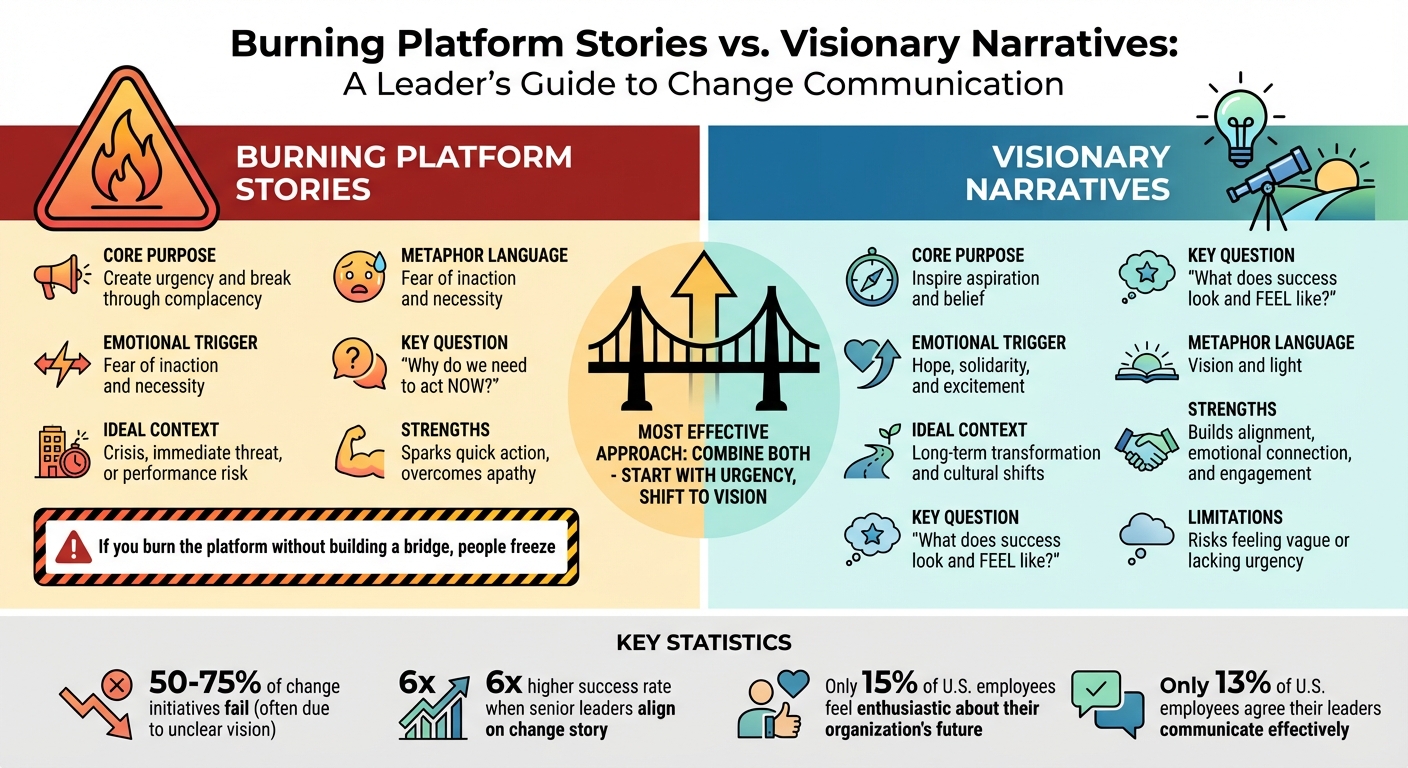
Burning Platform Stories vs Visionary Narratives: Key Differences for Leading Change
Burning platform stories and visionary narratives take very different routes to drive change. A burning platform story focuses on urgency, pointing out what no longer works and emphasising that the cost of doing nothing outweighs the risk of action. It answers the pressing question: "Why do we need to act now?" On the other hand, a visionary narrative paints a picture of a brighter future, offering a clear goal that helps teams focus and work together. It addresses a different question: "What does success look and feel like?" By understanding these differences, leaders can better choose the narrative that fits their situation.
The burning platform approach relies on the fear of inaction to spark movement, while visionary narratives aim to inspire hope, unity, and a sense of purpose. The language used in each approach reflects their intent. Burning platforms often use bold, urgent terms, with metaphors centred on "conflict and urgency." Visionary narratives, in contrast, lean on "vision and light" metaphors to foster emotional connection and a sense of possibility.
However, each method comes with its own risks. As Leadership Story Bank cautions, "If you burn the platform without building a bridge, people freeze". Fear-driven messaging without a clear way forward can leave people feeling stuck, while visionary narratives that are too abstract can be dismissed as unrealistic or disconnected from immediate challenges. The table below highlights the key differences between these two approaches.
Comparison Table: Burning Platform Stories vs. Visionary Narratives
| Attribute | Burning Platform Stories | Visionary Narratives |
|---|---|---|
| Core Purpose | Create urgency and break through complacency | Inspire aspiration and belief |
| Emotional Trigger | Fear of inaction and necessity | Hope, solidarity, and excitement |
| Ideal Change Context | Crisis, immediate threat, or performance risk | Long-term transformation and cultural shifts |
| Strengths | Sparks quick action and overcomes apathy | Builds alignment, emotional connection, and engagement |
| Limitations | May lead to anxiety, fatigue, or paralysis | Risks feeling vague or lacking urgency |
When to Use Burning Platform Stories
Burning platform stories are most effective when standing still is simply not an option, and the risks of inaction far outweigh those of making bold, decisive moves. These narratives shine in moments of significant upheaval - whether it’s external shocks like market disruptions, regulatory changes, or global crises such as pandemics, or internal turmoil like plummeting performance or organisational dysfunction. They work because they make one thing crystal clear: sticking with the status quo guarantees failure. This clarity is what makes them powerful tools during times of crisis.
A genuine burning platform scenario is defined by a real and immediate crisis, irreversible decisions, and high-risk stakes for every choice you face. Take Nokia, for instance. In February 2011, as the company’s market share was collapsing, CEO Stephen Elop issued his now-famous "burning platform" memo. He painted a stark picture, stating that Nokia had to abandon its own operating system and partner with Microsoft Windows. Elop framed this bold move not as a desperate measure but as a proactive choice to avoid inevitable decline. Similarly, LEGO faced its own existential crisis in 2003, posting a net loss of DKK 1.4 billion (around £160 million) and teetering on the edge of bankruptcy. CEO Jørgen Vig Knudstorp used a narrative to refocus the business, candidly explaining:
We had become too complex, too inward-looking, too driven by our own agenda rather than being driven by what the customer wanted. The company had lost its focus.
This clarity drove LEGO’s turnaround. The company slashed its product range by over 50% and went on to achieve revenue growth exceeding 600% between 2006 and 2016.
That said, burning platform narratives aren’t a one-size-fits-all solution. In acute, short-term crises - like a factory fire or a natural disaster - people tend to act instinctively. In such cases, the focus should shift from creating urgency to providing clear, stabilising guidance. Research indicates that around 70% of change initiatives fail, often because the need for change isn’t clearly defined from the start. This highlights the importance of being precise and transparent about why action is needed now and what the consequences of inaction are. Knowing when and how these narratives work - and when they don’t - is crucial for leaders aiming to use them effectively.
How to Apply Burning Platform Stories
Using burning platform stories effectively requires careful framing and clarity. Leaders need to make the case for change in ways that connect with their teams. This means using plain, relatable language and painting a vivid picture of the negative consequences of staying the course. For example, Jørgen Vig Knudstorp reinforced LEGO’s priorities by telling employees:
The brick is our main building block for the future. We need to protect the brick, protect the brand, and protect the people.
This approach made the crisis real and provided a clear sense of direction.
However, urgency alone isn’t enough. A burning platform narrative must also include a bridge - a clear way forward. Simply outlining the threat without offering a tangible plan can leave people paralysed by fear. During a crisis, it’s essential to provide what’s known as "institutional holding." This means offering practical reassurances about critical concerns like salaries, benefits, and working conditions. Involving employees in crafting solutions not only builds their commitment but also reinforces confidence in the organisation’s future.
To ensure the narrative resonates, test it with sceptical teams. Their feedback can help refine the message, making it more grounded and credible. Finally, leadership alignment is key. Mixed messages from the top can erode trust and undermine the urgency needed to drive meaningful change.
When to Use Visionary Narratives
While stories centred on urgency, often referred to as "burning platform" narratives, are designed to create immediate action, visionary narratives take a different approach. They focus on what lies ahead, inspiring people with a sense of future possibilities. These narratives are particularly effective when the aim is to shift an organisation's mindset from dwelling on current challenges to embracing solutions. They work well for long-term transformations, such as cultural changes, significant performance improvements, or collective goals that demand sustained effort over months or even years. Unlike urgency-driven stories, which often rely on fear of failure, visionary narratives connect emotionally by appealing to shared values, purpose, and a sense of meaning.
The distinction lies in the direction they provide. When navigating complex and multi-layered changes, teams benefit from having a clear goal - a vision to guide them forward. A visionary narrative offers this clarity, painting a vivid picture of what the organisation will look and feel like once the change is realised. This isn’t about catchy slogans or abstract ideals; it’s about creating a concrete and relatable image of the future. This approach is crucial, especially considering that only 15% of U.S. employees strongly agree their organisation’s leadership makes them feel enthusiastic about what lies ahead. Without a clear and compelling vision, change efforts can feel aimless and exhausting.
Take Microsoft, for example. When Satya Nadella stepped in as CEO in February 2014, he introduced a visionary narrative that reoriented the company towards a "mobile-first, cloud-first" future. This wasn’t just a shift in technology - it was a unifying story that aligned stakeholders and drove a significant transformation in both culture and technical focus, ultimately steering Microsoft towards cloud computing and enterprise services.
Visionary narratives are also indispensable when leadership alignment is lacking. Research shows that when senior leadership teams align on a shared change story and communicate it effectively, the chances of a successful transformation increase by six times. Yet, only 13% of U.S. employees strongly agree that their leaders communicate effectively. A well-crafted vision cuts through confusion, providing clarity, confidence, and a sense of purpose. It helps employees see where they fit into the bigger picture and understand how their contributions can bring the vision to life.
How to Apply Visionary Narratives
To make the most of visionary narratives, consider these practical steps:
Start with the 12–18 month exercise. Ask your leadership team to describe the organisation as it would look 12–18 months after the change has taken root. What will people be doing differently? What will they see, hear, and say? This exercise forces specificity, making the vision more concrete and relatable rather than abstract.
Next, zoom in and out. Communicate the vision on both strategic and tactical levels. This helps people connect the broader picture to their everyday work, making the change feel relevant and achievable.
Use relatable metaphors to make the narrative resonate. For example, "Vision and Light" metaphors, such as "lighting the path ahead", can help people find direction during uncertain times. Similarly, "Nature and Growth" metaphors, like "planting seeds for a new season", are effective for sensitive cultural changes. Test your narrative informally - if it wouldn’t make sense in a casual conversation, it’s not ready. This is often referred to as the "pub test". Amazon’s HR chief, Beth Galetti, uses six-page memos instead of PowerPoint slides to ensure clarity, requiring leaders to clearly articulate the "what" and "why" behind the change.
Involve leadership early in crafting the narrative. Their active participation ensures commitment and prevents fragmentation. For example, a heavy goods manufacturer implemented a three-step process to align leadership: establishing shared priorities, engaging in action-planning workshops, and co-creating a unified story. Within two years, this approach significantly improved organisational effectiveness, leading to increased sales growth, better financial outcomes, and fewer safety incidents.
Finally, adopt the "backstitch" technique. Don’t just share the vision once and move on. Keep weaving it into regular updates, team meetings, and project discussions. Frame every success, setback, and decision within the context of the future vision. This repetition reinforces the narrative, ensuring it remains front and centre as the organisation moves forward.
Combining Both Approaches
The most effective change stories don’t make you choose between urgency and inspiration - they blend both seamlessly. Think of it as a push–pull dynamic: the burning platform pushes by highlighting risks, while the visionary narrative pulls by painting a picture of what’s possible. Without the push, people might not see why change is necessary. Without the pull, they could feel paralysed by fear instead of motivated to act.
To make this work, timing is everything. Start with the burning platform to grab attention and shake off inertia, but don’t linger there too long. Quickly transition to the visionary narrative, offering a hopeful direction. After all, people can’t stay in crisis mode forever - it leads to burnout. The goal isn’t to swap one story for another but to connect them, creating a bridge. As Leadership Story Bank wisely puts it:
If you burn the platform without building a bridge, people freeze.
Take LEGO’s remarkable turnaround as an example. In 2003, the company was teetering on the edge of bankruptcy. CEO Jørgen Vig Knudstorp used a dual approach: the burning platform highlighted how LEGO had lost its way, while the vision focused on "protecting the brick" - a return to its core identity. By 2017, LEGO had become the world’s most valuable toy brand. This approach didn’t just acknowledge the crisis; it gave employees and stakeholders a clear, emotionally compelling path forward.
A similar strategy was evident when Satya Nadella became Microsoft’s CEO in 2014. Facing the decline of a PC-centred business model, he balanced the urgency of change with a bold "mobile-first, cloud-first" vision. This dual narrative shifted Microsoft’s focus to cloud computing and enterprise services, revitalising the company.
Tips for Using Both Approaches Together
Drawing from these examples, here are some practical ways leaders can combine urgency and inspiration effectively:
- Structure your narrative clearly: Start by setting the scene with the current reality (context), then emphasise the urgency (burning platform). Follow this by outlining the future vision, mapping out the path to get there, and explaining what it means for individuals (impact). This logical flow ensures clarity and avoids mixed messages.
- Build the bridge explicitly: Show the connection between crisis and vision with a simple formula: "If we do X, then Y; if we change to A, then B". This approach acknowledges the urgency while offering hope and a clear direction.
- Be honest about challenges: Avoid sugar-coating the journey. Acknowledge that the path forward will involve difficulties, trade-offs, and effort. People are more likely to trust leaders who are upfront about the obstacles rather than those who promise an easy ride.
- Stick to one core story: Ensure consistency across leadership. When different leaders tell conflicting versions of the change narrative, the message becomes fragmented and loses impact. Think of the core story as the spine - while individual leaders can adapt the delivery to their context, the main beats must remain the same. Research shows that when leadership teams align their messaging, the likelihood of successful transformation increases sixfold.
- Reinforce the narrative regularly: Don’t treat the story as a one-off announcement. Revisit it often, framing every success, setback, and decision through the lens of both the urgency and the vision. This repetition helps keep the message alive and relevant throughout the change process.
Choosing the Right Narrative for Change
Deciding whether to use a "burning platform" story or a forward-looking vision isn't about picking one over the other. It's about understanding where your organisation stands emotionally. Start by gauging what your team truly needs right now. If there's a sense of complacency, comfort, or even denial in the face of real threats, a burning platform story can cut through and highlight the urgency for action. On the other hand, if your team is already feeling stressed or overwhelmed, piling on more urgency could backfire. In such cases, a visionary narrative that inspires hope and provides clear direction is often more effective.
Your narrative must capture the emotional truth of the moment, not just present cold, strategic logic on a slide. Test it with people who are quick to reject corporate buzzwords - if it doesn’t hold up in a casual conversation, it’s not ready. Steer clear of jargon and mixed metaphors. Authenticity is key to crafting a story that can balance urgency with vision.
The most effective change initiatives combine both approaches. The burning platform sparks urgency, while the visionary narrative paints a clear picture of where you’re heading. This balance works best when leadership is aligned. Research shows that when senior leaders deliver a consistent message about change, the likelihood of success increases sixfold. However, if leaders send mixed messages or distance themselves by framing the change as something for "others" to deal with, trust can erode quickly.
Once leadership is aligned, grounding your narrative in specific, relatable details ensures it resonates. For example, only 13% of employees feel their leaders communicate well, and just 15% feel optimistic about the future. This isn’t because leaders don’t care - it’s often because their messages feel abstract or disconnected. To bridge this gap, anchor your story in tangible examples. Describe what a team meeting might look like 18 months from now - what people will see, hear, and do differently. Be upfront about the challenges and trade-offs involved. People are more likely to trust leaders who are honest about the effort required.
Finally, remember that a narrative isn’t a one-time announcement. It’s an ongoing conversation. Keep reinforcing it through town halls, one-on-one discussions, project updates, and team meetings. This approach, sometimes called "backstitching", ensures your story stays relevant and continues to resonate throughout the change process.
FAQs
How can leaders balance urgency with vision when driving change?
Leaders can effectively balance immediate urgency with long-term vision by weaving compelling stories that address both. A well-crafted narrative lays out what is changing, why it’s important, and how success will look, allowing people to emotionally connect with the need for action and the future goals.
Using relatable imagery, like comparing the effort to a journey or scaling a mountain, can simplify complex ideas and make them more engaging. It’s equally important to communicate with sincerity, ensuring your message reflects the organisation’s core values. By pointing out the risks of standing still alongside the rewards of moving forward, you can motivate teams to act while keeping their eyes on the broader mission.
When urgency and vision are seamlessly combined in your storytelling, you can inspire action, foster trust, and unite people around a shared purpose to navigate change with confidence.
What are the potential downsides of relying only on burning platform stories or visionary narratives?
Focusing solely on a burning platform story or a visionary narrative can make driving meaningful change more difficult than it needs to be.
A burning platform story, which emphasises immediate risks and the need for urgent action, can be effective in prompting quick decisions. However, relying too heavily on this approach can backfire, leading to fear, anxiety, or even resistance. People may feel overwhelmed or manipulated, which can result in a short-term reaction rather than lasting commitment.
In contrast, a visionary narrative paints an inspiring picture of the future, fostering hope and a sense of purpose. Yet, if it fails to address current issues or challenges, it risks feeling out of touch or overly idealistic. This disconnect can leave employees unsure about how to contribute or sceptical about the vision's feasibility.
The key to success lies in striking the right balance: combining the urgency of a burning platform with the optimism and clarity of a visionary narrative. This approach ensures your message connects on both an emotional and practical level, building trust and reducing confusion.
When is it the right time for a leader to shift from a burning platform story to a visionary narrative?
When a leader moves from a burning platform story to a visionary narrative, it signals a shift in focus from immediate urgency to long-term aspirations. This transition works best once the team fully grasps the critical need for action and the organisation has stabilised beyond the initial crisis phase.
Switching to a visionary narrative enables leaders to inspire through optimism and possibility rather than relying on fear or the urgency of a crisis. By vividly outlining a future filled with potential and success, they ignite belief and create alignment within the team. This approach not only sustains momentum but also steers the organisation towards lasting and meaningful change.