
Why Stories Drive Energy in Change Processes
Storytelling lifts energy in organisational change by building clarity, trust and emotional buy‑in, aligning teams and making employees the heroes.

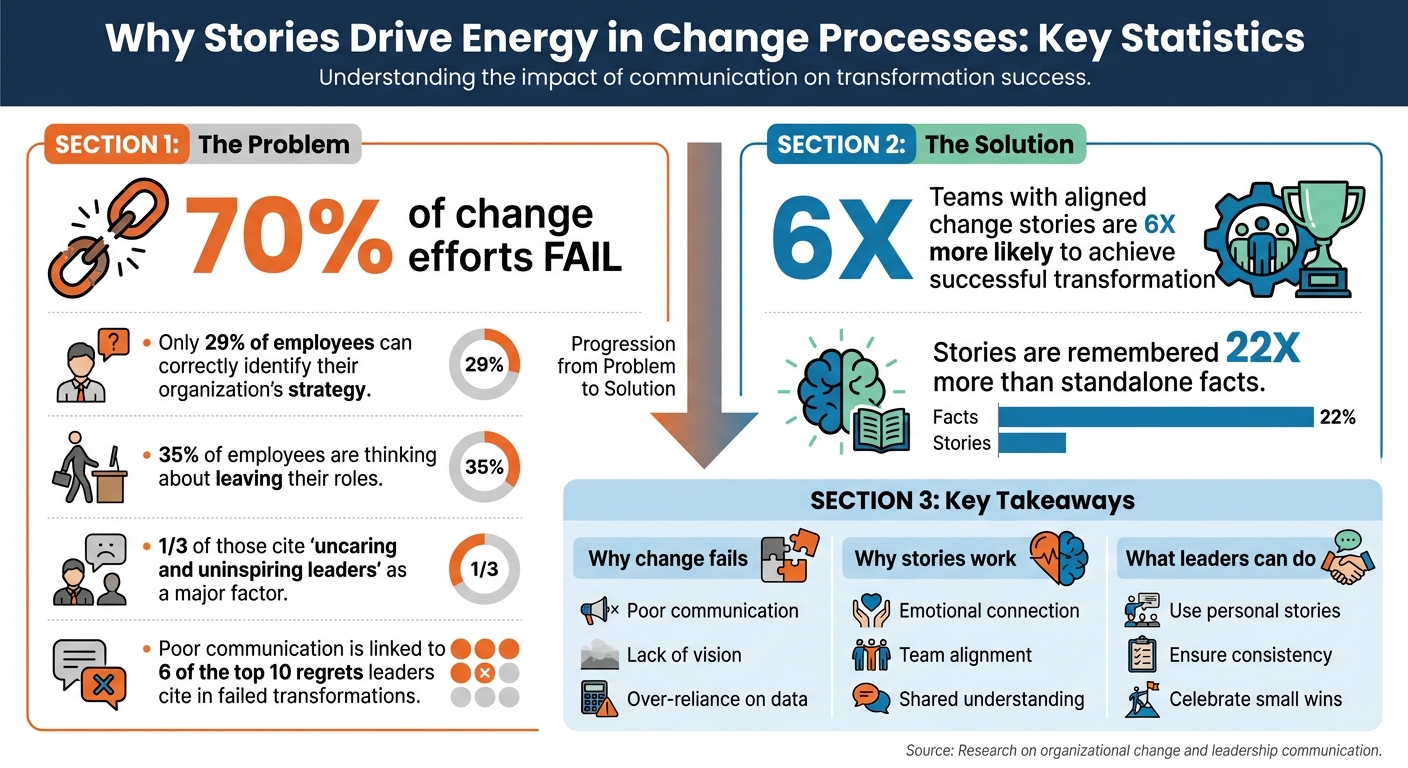
In change initiatives, success often depends on how well the story behind the transformation is communicated. Research shows that 70% of change efforts fail, largely due to poor communication. Employees face increasing disruptions, leading to "change fatigue" - a state of frustration and disengagement. Without a clear narrative, teams fill the gaps with speculation, creating resistance and mistrust.
Stories, however, provide clarity and emotional connection. Unlike data-heavy presentations, they resonate on a human level, making the message memorable and inspiring action. Leaders who craft and share unified, relatable stories can increase the chances of successful transformation by six times. Effective storytelling reframes challenges, builds trust, and positions employees as the heroes of change.
Key takeaways:
- Why change efforts fail: Poor communication, lack of vision, and over-reliance on data.
- Why stories work: They connect emotionally, align teams, and create shared understanding.
- What leaders can do: Use personal and team-focused stories, ensure consistency, and celebrate small wins to build momentum.
Why Change Initiatives Fail: Key Statistics and Success Factors
The Problem: Energy Loss During Change
Emotional Fatigue and Resistance
Change often stirs up anxiety, especially when people don’t have a clear understanding of what’s happening. Without a coherent explanation, employees may jump to conclusions, bracing themselves for the worst. This uncertainty saps energy, leaving teams feeling drained and overwhelmed. Take the case of an American technology company in October 2024. The organisation launched a transformation centred on "future growth" and a decentralised structure. Yet, many employees immediately equated the change with job cuts and the expectation of "doing more with less." As a result, the initiative quickly lost steam. The problem wasn’t the strategy itself; it was the lack of a narrative that addressed employees’ concerns. Without that clarity, fears took over, leading to misalignment and an overload of conflicting information.
When people don’t feel psychologically safe, change feels imposed rather than collaborative. This can lead to resistance and a lack of trust. Among the 35% of employees who are thinking about leaving their roles, a third cite "uncaring and uninspiring leaders" as a major factor. When leaders fail to communicate clearly or seem out of touch, employees fill the gaps with their own "corridor stories", often imagining worst-case scenarios. This atmosphere of scepticism can derail even the best-laid plans.
Lack of Vision and Alignment
Misalignment is another major hurdle. Even when leaders have a solid strategy, they often struggle to communicate it effectively. Research involving 20 high-performing companies found that only 29% of employees could correctly identify their organisation’s strategy from a list of options. This isn’t an issue of intelligence - it’s a breakdown in communication. When leaders share conflicting versions of the same story, trust erodes.
This lack of narrative cohesion can have serious consequences. Poor communication is linked to six of the top 10 regrets leaders cite when reflecting on failed transformations. When initiatives don’t align with an organisation’s core values or aspirations, they can quickly lose momentum. Ignoring what matters to employees not only lowers morale but also increases staff turnover and slows the adoption of new practices. This disconnect widens the gap between the organisation’s goals and the engagement needed to achieve them.
Over-Reliance on Data
Relying too heavily on data and strategy slides often backfires. While facts and figures are important, they rarely inspire action on their own. As Adam Gee, a BAFTA-winning commissioning editor and producer, explains:
"The bottom line is: it doesn't matter how good your facts, data, figures, information, how good your PowerPoint deck is - what will ultimately win and break through is actually the underlying emotion".
In other words, logic may inform decisions, but it’s emotion that drives people to act.
Neuroscience backs this up. Stories that centre on characters and emotions trigger the release of oxytocin, a chemical that builds trust, empathy, and cooperation. In contrast, raw data fails to create the same connection. Without a compelling narrative to tie the data together, messages can feel disjointed and fail to capture attention. While data outlines the need for change, it doesn’t provide the emotional push employees need to embrace new behaviours. Without a story to bring the data to life, even the most well-thought-out strategies can fall flat, leaving teams unmotivated and disengaged.
The Solution: Using Storytelling to Re-Energise Teams
Reframing Challenges Through Narrative
When faced with overwhelming change, how leaders frame challenges can transform how teams perceive them. Instead of presenting change as a series of problems, effective storytelling positions challenges as natural phases of growth. This shift encourages teams to view setbacks not as failures but as essential steps on a journey towards improvement. A well-crafted story acts as a "thread" for people to grasp when everything around them feels uncertain. Structuring stories in three acts - setup, confrontation, and resolution - helps illustrate that struggle is not only expected but also a crucial part of progress.
The science behind this approach is compelling. Stories with tension and resolution trigger a chemical response in the brain, releasing cortisol during challenging moments (to heighten focus) and endorphins during resolution (to offer relief and a sense of achievement). This physiological reaction helps individuals manage the stress and unpredictability that often accompany transformation. Take Jaipur Rugs, for instance. In 2023, the company transitioned from a B2B model to a global B2C brand by shifting its focus from dry product details to the emotional stories of its artisans. Under the guidance of founder Nand Kishore Chaudhary, the company used storytelling to achieve internal cultural change while showcasing the social impact of its work. This narrative-driven strategy supported the opening of 11 flagship stores and six franchise locations, significantly broadening their market presence.
Such reframing lays the groundwork for building the emotional connections necessary to navigate change.
Creating Emotional Connection
Stories have a unique power to create bonds that raw data simply cannot. When leaders share narratives centred on characters and emotions, they stimulate the release of oxytocin - a neurochemical linked to trust, empathy, and generosity. Paul J. Zak, Director of the Centre for Neuroeconomics Studies, puts it succinctly:
"Stories that are personal and emotionally compelling engage more of the [listener's] brain, and thus are better remembered than simply stating a set of facts".
This emotional engagement ensures the message sticks, boosting team connection and motivation.
The most impactful change stories cast employees, not leaders, as the heroes. When teams see themselves as the protagonists overcoming challenges and achieving victories, they feel a stronger sense of ownership over the transformation. For leaders, this approach requires a degree of vulnerability. Sharing personal setbacks, past failures, or honest accounts of their own experiences humanises leadership and fosters psychological safety. These candid moments help break down "us versus them" barriers, creating an atmosphere where people feel secure enough to embrace change rather than resist it.
Building Resilience Through Success Stories
In addition to reframing challenges and fostering emotional connections, success stories play a vital role in building resilience and maintaining momentum. Stories that celebrate heritage or past achievements remind teams of their ability to overcome difficulties, reinforcing their confidence in navigating current challenges. Similarly, highlighting small victories along the way makes large-scale change feel more manageable and keeps the momentum alive.
Consistency is key. If leaders share conflicting narratives, trust in the transformation can erode quickly. Stories also help teams imagine future success. By sharing real examples and relatable experiences, leaders allow employees to visualise themselves thriving in the "new" environment, easing fears of the unknown. This approach transforms abstract goals into something tangible, making what once seemed out of reach feel achievable.
The Art of Storytelling to Drive Organizational Change with TED Speaker and Author Karen Eber
Practical Storytelling Techniques for Leaders
Storytelling has the power to breathe life into abstract strategies, turning them into relatable and actionable narratives that can energise and unite teams.
Employee Achievement Narratives
The most impactful stories about change don’t elevate executives as heroes. Instead, they shine a light on everyday employees - those who’ve embraced transformation in meaningful ways. Think about the early adopters who’ve jumped into using new systems, the sceptics who’ve had a change of heart, or the quiet achievers who’ve overcome tough challenges. These stories resonate because they make change feel real and attainable for everyone else.
When crafting these narratives, use a simple three-act structure. Start by setting the stage with the challenge, then build tension by highlighting the obstacles faced, and finally resolve with the employee’s breakthrough moment. Include specific details - like actual conversations or precise hurdles they encountered - to make the story feel genuine and relatable.
Every story should answer a key question your team is likely asking: “What’s in it for me?”. If people can’t see themselves in the narrative or relate it to their own experiences, it won’t land. Use straightforward, conversational language to keep the story accessible and engaging.
Once you’ve crafted these personal stories, connect them to your larger goals by aligning individual achievements with the organisation’s strategic vision.
Vision Alignment Stories
When goals feel both inspiring and achievable, they can reignite momentum in stalled transformations. To create this connection, build a strategic narrative that includes the following elements: the context, the need for change, the vision, the pathway forward, the personal impact, and clear actions. This structure ensures your story appeals to both the mind and the heart.
Teams that align on a shared change story and consistently communicate it across the organisation are six times more likely to achieve successful transformations. However, alignment doesn’t mean sticking rigidly to a single script. Develop a core narrative - a “spine” - that remains consistent, but adapt it for different teams. This way, employees can see how the broader vision ties directly to their roles without losing sight of the bigger picture.
Make your employees the heroes of the story, not the leadership team. Frame them as the protagonists who will navigate challenges and drive transformation. This perspective fosters ownership and makes the vision feel achievable rather than imposed. As Harvard Professor Howard Gardner aptly put it:
"Stories constitute the single most powerful weapon in a leader's arsenal".
Consistent Communication Stories
Repetition is key to embedding a story into your team’s consciousness. Incorporate the narrative into every update, meeting, and communication. While it might feel repetitive to you, it’s essential for making the story stick. Research shows that stories are remembered up to 22 times more than standalone facts - but only if they’re reinforced consistently.
To amplify the message, involve a wide group of managers in both crafting and sharing the narrative. When multiple voices echo the same core story, each adding their own authentic touch, it creates a “band and choir” effect that resonates across the organisation. However, consistency is critical. Mixed messages or contradictions between leaders can quickly erode trust.
Pay special attention to the first 30 seconds of any story you tell. This is your chance to grab attention and establish a connection. Use a compelling question or an emotional hook to draw your audience in. With attention spans often limited to around 10 minutes, a strong opening is your best shot at making an impact.
Implementing Stories in Your Leadership Strategy
Knowing how to tell a compelling story is one thing. Embedding it into your leadership style day-to-day is quite another. Moving from theory to practice takes a deliberate approach, starting with what matters most to your organisation.
By weaving storytelling into your leadership, you can drive meaningful and lasting change.
Identifying Core Themes
Before you start crafting any narrative, it’s essential to identify the key themes that will underpin your storytelling. Begin by evaluating two main areas: performance (such as financial outcomes and operational efficiency) and health (how effectively your team collaborates and operates). This will help you spot the management practices that are most relevant to your organisation’s goals.
Your themes should directly support your organisation’s purpose or vision. Without this alignment, communicating the need for change becomes an uphill battle. Ask yourself, Why now? Are there external factors - like market shifts or growing competition - or internal challenges, such as performance gaps or skill shortages, that make this change necessary?.
Engage your teams early by hosting focus groups or forums to gather insights. This can help you uncover existing "sub-narratives" and values within your organisation’s culture, making it easier to introduce new ideas without resistance. Strong themes don’t just look ahead - they also acknowledge your organisation’s history and previous efforts, creating a credible link between past lessons and future goals.
Before sharing your story widely, ensure your leadership team is on the same page. If they don’t fully understand or believe in the narrative, it won’t resonate with others. A good rule of thumb is the "pub test": if your theme doesn’t sound natural in casual conversation, it’s likely too bogged down in corporate jargon to connect with your audience.
Crafting Narratives That Resonate
Once your themes are clear, the next step is to craft stories that engage both the heart and the mind. A strong change narrative should address several key elements: the current situation, the urgency to act, the vision for the future, the journey ahead, the personal impact on individuals, and a clear call to action.
Use the classic three-act structure - setup, confrontation, resolution - to create a narrative that sticks. Position employees as the heroes of the story, making the change relatable and empowering. Tailor your message to different groups, ensuring it answers the question, What’s in it for me?, for each audience.
Don’t shy away from vulnerability. Sharing personal challenges or honest accounts of past change efforts can help break down barriers and build trust. Test your narrative by presenting it to a sceptical audience first. This will help you refine the story and address any missing or unclear elements before rolling it out more broadly.
These principles lay the groundwork for using more structured storytelling tools effectively.
Using Leadership Story Bank
The Leadership Story Bank is a tool designed to help leaders create cohesive narratives that explain what’s changing, why it matters, what success looks like, and what specific actions are expected from the audience.
This platform focuses on building a strategic change narrative - a core story that guides people from uncertainty to clarity and action. It emphasises the importance of modular storytelling, where a central "spine" of the narrative remains consistent across the organisation but can be adapted for different teams or contexts without losing its essence.
The Story Bank also introduces specific storytelling frameworks, such as origin stories to establish credibility, overcoming-the-monster stories to highlight resilience during challenging times, and quest stories to inspire ambition and drive towards a major goal. These frameworks tap into the brain’s natural response to storytelling, releasing oxytocin and fostering feelings of trust, empathy, and generosity.
Measuring the Impact of Storytelling in Change
Once you’ve introduced storytelling to energise your team, the next step is figuring out if it’s actually making a difference. Measuring its impact isn’t about proving a point - it’s about understanding whether your stories are resonating, motivating your team, and pushing the change forward.
Tracking Engagement and Feedback
Start by keeping an eye on how your team is responding. Look for shifts in morale, participation, and the flow of ideas. Tools like the MSC (Most Significant Change) technique can help you capture real-life examples of the impact. For instance, ask employees in semi-structured interviews to describe the biggest change they’ve noticed in their work, team interactions, or client relationships since storytelling became part of the process.
Notice if your core message is being repeated in casual conversations. If people are naturally sharing your story with others, it’s a sign it’s hitting home. On the other hand, if informal "corridor stories" are contradicting your narrative, it’s a signal that more alignment is needed. Consider hosting sessions like "Story Cafés" to encourage open sharing. When team members feel comfortable enough to share their own stories in response to yours, it’s a strong indicator of trust and psychological safety.
These observations lay the groundwork for analysing how storytelling is influencing team behaviour.
Monitoring Team Dynamics and Behaviours
Go beyond traditional engagement surveys and observe how behaviours within your team are evolving. Are people using the language or ideas from your story? Are they taking the actions your narrative was designed to inspire? This concept, known as "action adoption", is one of the clearest signs that your story is driving momentum.
You can also assess team energy by looking at changes in how resources are allocated and how involved people are. Increased volunteering, collaboration, and proactive support for change are all signs that your storytelling is making an impact. Pay attention to narrative discipline too - are leaders across different departments sharing a consistent story, or is the message becoming fragmented? A fragmented narrative can weaken alignment and derail progress.
Comparing Before and After Metrics
To quantify the impact of storytelling, compare key performance indicators from before and after its introduction. Use the table below for guidance:
| Evaluation Area | Metric/Indicator | Method of Measurement |
|---|---|---|
| Personal Learning | Changes in attitudes, new skills, empathy | Semi-structured interviews, MSC technique |
| Team Dynamics | Communication quality, trust, shared vision | Story Cafés, feedback loops |
| Service Delivery | Efficiency, innovation, knowledge sharing | Performance indicators, incident reviews |
| Client Impact | Confidence, well-being, relationship trust | Social Return on Investment (SROI), testimonials |
| Organisational Health | Leadership alignment, role-modelling | Organisational Health Index, workshops |
When evaluating, focus on attention, understanding, memory, and persuasion. If your team is listening but not acting, it may mean your story needs a clearer call to action.
Senior leaders who align on a shared change narrative and communicate it consistently across the organisation can boost their chances of transformation success by six times. That’s not just a boost in morale - it’s a measurable advantage. Regularly tracking these metrics will show whether your storytelling is creating the energy and alignment needed to drive meaningful change.
Conclusion
Change often falters when its purpose becomes unclear, but storytelling has the power to close that gap. By transforming abstract strategies into relatable narratives, it replaces confusion with clarity and turns resistance into forward momentum.
The influence of storytelling isn’t just anecdotal; it’s measurable. Research shows that a cohesive narrative significantly boosts the success of transformation efforts. Stories are remembered up to 22 times more effectively than standalone facts, ensuring your message lingers long after spreadsheets and presentations are forgotten.
Good storytelling casts employees as the heroes of change, respects the past while paving the way for the future, and ensures consistency by equipping leaders to share the same message. It fills the gaps in communication, offering a way for teams to envision and even rehearse new behaviours, seeing potential outcomes before the change fully takes hold.
FAQs
How does storytelling help organisations overcome change fatigue?
Storytelling plays a powerful role in helping organisations navigate periods of change by cutting through the noise and connecting employees to the purpose behind the transformation. Change often brings confusion and resistance, which can slow progress, but a well-told story brings clarity, builds trust, and injects new energy into teams. By explaining why the change is necessary, outlining its benefits, and linking it to a shared vision, storytelling makes the process feel purposeful and inclusive.
Beyond just delivering information, stories resonate on an emotional level, making complex ideas easier to grasp and remember. Leaders who share genuine, relatable stories can inspire confidence, shift perspectives, and spark action. By recognising past efforts and painting a hopeful picture of the future, storytelling helps employees see change as a chance to grow rather than something to fear - transforming uncertainty into a sense of possibility.
How does emotional connection influence the success of change initiatives?
Creating an emotional connection is key to inspiring meaningful change, as it taps into people’s deeper motivations and fosters genuine engagement. One of the most effective ways to build this connection is through storytelling. Stories have a unique ability to resonate on an emotional level, helping individuals grasp the why behind a change and see the part they play in making it happen.
When leaders share genuine and relatable stories, they don’t just inform - they build trust, unite people around a common purpose, and spark action. A well-told narrative can transform doubt into belief and sustain commitment, even when the road ahead gets tough. By appealing to emotions, storytelling becomes a catalyst for behavioural shifts, aligning teams and driving progress. It’s a simple yet powerful way to create lasting impact within an organisation.
Why should leaders highlight employees as the heroes in change stories?
Leaders should position employees as the heroes in change narratives, as this approach strengthens engagement, fuels motivation, and fosters a sense of ownership. When employees see themselves as integral to the transformation, they’re more likely to connect with the vision and stay committed to its success.
Storytelling plays a crucial role here. It taps into emotions, making key messages easier to understand and remember. By recognising individual achievements and team contributions, leaders can build trust, ease resistance, and cultivate a shared purpose. This approach makes change feel personal, attainable, and meaningful, energising the organisation to move forward as a unified force.