
Why “Over-Communicating” Rarely Solves the Real Problem
Excess updates overwhelm teams and erode trust; focus on clear goals, audience needs and the right channels to make communication purposeful and effective.

Sending more emails or scheduling extra meetings might feel like the solution when communication breaks down, but it often misses the real issue. Over-communication can overwhelm teams, create confusion, and erode trust. The problem isn’t about how much you communicate, but whether your messages are clear, purposeful, and aligned with your team’s needs.
Key Takeaways:
- Quality over quantity: Research shows the clarity and timing of communication matter far more than its frequency.
- Over-communication backfires: It adds noise, undermines trust, and makes it harder for teams to focus on what’s important.
- Root causes of breakdowns: Leaders often over-share due to anxiety or unclear goals, but this doesn’t address mismatched objectives or poor messaging.
- Fixing the issue: Focus on clear goals, understanding your audience, and using the right channels at the right time.
Instead of flooding your team with information, aim for targeted, thoughtful communication that meets their needs and inspires action.
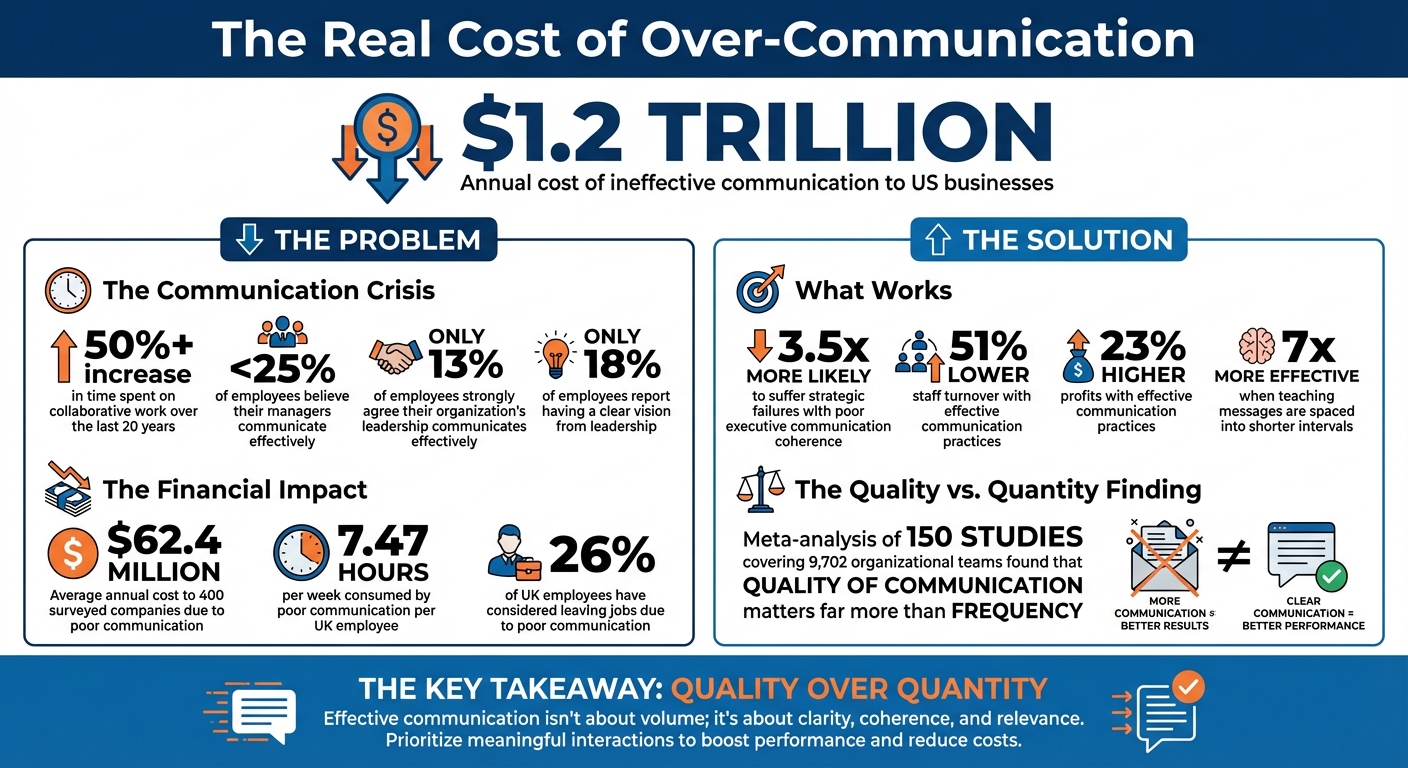
The Cost of Over-Communication: Key Statistics on Workplace Communication Effectiveness
7 Key Communication Strategies for Leadership and Managing Teams
The Problem with Over-Communication
When things feel uncertain, sending more messages or holding endless meetings doesn’t automatically lead to better outcomes. A meta-analysis of 150 studies, covering 9,702 organisational teams, revealed that the quality of communication is far more critical to team performance than its frequency. High-performing teams focus on sharing the right information at the right time, not just communicating for the sake of it.
Bombarding people with messages often creates confusion instead of clarity. Leaders who overload communication channels with updates, explanations, and justifications make it harder for teams to figure out what really matters. Over the last 20 years, time spent on collaborative work has risen by more than 50%, yet fewer than 25% of employees believe their managers communicate effectively. This leaves workplaces overwhelmed with messages but lacking direction. Let’s explore how too much communication can harm leadership.
Why Leaders Over-Communicate
Over-communication often stems from anxiety and a need for self-preservation. Organisational psychologist Dr Tasha Eurich explains that while self-awareness is invaluable for leaders, "over-sharing internal uncertainty can diminish perceived competence". Fearing they’ll be misunderstood, leaders try to preempt issues by overloading their teams with every detail, explanation, and caveat.
This behaviour can be seen as emotional micromanagement - an effort to control how others perceive the leader rather than to meet the team’s actual needs. By narrating every hesitation and consideration, leaders are managing their own discomfort instead of fostering genuine connection. This turns communication into a self-serving exercise, rather than a tool for supporting the team.
The Consequences of Excessive Communication
When leaders over-communicate, the organisational costs can be steep. Over-explaining weakens authority. As Jeremy from The Influence Journal points out, "The more a leader overexplains, the more their authority is quietly eroded". Constant justifications can make decisions seem less credible, as if they lack solid reasoning.
Teams also lose valuable time and focus. According to cognitive load theory, our working memory has limits. When messages are buried under unnecessary detail, people retain less of the core information. Instead of acting on clear instructions, teams are left sifting through excessive input.
Over-communication can also undermine trust. It unintentionally sends the message: "I don’t trust you to understand this without a detailed breakdown." While under-communication is often criticised as a lack of empathy, over-communication - though frustrating - is sometimes excused as a well-meaning mistake. However, this approach can infantilise teams, stifling their autonomy and confidence.
Finding the Root Causes of Communication Breakdowns
Leaders often need to dig deeper to understand why their messages aren't landing as intended. The root of the issue is rarely about how much communication occurs. Instead, it lies in mismatched goals and unclear messaging. Overloading communication won't fix these underlying problems.
Unclear Objectives and Messaging
When leaders fail to define their goals clearly, teams are left guessing. This lack of clarity forces employees to interpret intentions on their own, which can lead to confusion or missteps. For instance, only 18% of employees report having a clear vision from leadership, while 45% of those in SMEs often make decisions without crucial information. The issue isn't a lack of communication - it's communication without a well-defined purpose. As George Bernard Shaw aptly put it:
The single biggest problem in communication is the illusion it has taken place.
This confusion is further compounded when leaders try to compensate by communicating more. Instead of providing clarity, this approach floods teams with information but leaves them directionless.
A related challenge is that leaders frequently misjudge what their teams actually need to hear.
Misalignment Between Leaders and Teams
Communication falters when leaders fail to understand their audience's needs. Professor Francis Flynn from the Stanford Graduate School of Business highlights this issue:
More than just about any other leadership skill, people are fiercely criticized for poor communication. The higher up you get, the more brutal that criticism becomes.
This disconnect often stems from a phenomenon researchers call "communication calibration." It describes the gap between the information leaders share and what employees actually need. When leaders interpret silence as agreement or satisfaction, they miss the fact that silence often masks confusion or frustration. This misjudgement can have serious consequences: 26% of UK employees have considered leaving their jobs due to poor communication and a resulting lack of trust in senior leaders.
Rather than addressing these gaps, leaders often resort to increasing the volume of communication. Unfortunately, this approach only exacerbates the problem when it doesn't align with what employees genuinely require.
Wrong Channels and Formats
Even when messages are well-intentioned, they can fall flat if delivered through ineffective channels. In hierarchical organisations, information is often distorted as it moves upward or downward through layers. Researchers refer to this as "upward abstraction", where essential details are gradually stripped away. Leala Abbott, Assistant Professor of Strategic Management, explains:
By the time a decision reaches the individuals most affected, it usually lacks the important details needed to make it meaningful or actionable. Each step in the process alters the information, creating gaps in context, intent, and urgency.
The rise of digital communication tools has added another layer of complexity. With an estimated 347.3 billion emails sent and received daily in 2023, teams frequently experience "negative over-communication." This happens when employees tune out entirely to avoid feeling overwhelmed. In these cases, the channel itself becomes a barrier rather than a bridge, and simply adding more messages through the same ineffective platforms only deepens the disconnect.
Moving to Purposeful Communication
After examining how over-communication often muddles rather than clarifies, it's time for leaders to prioritise precision in their messaging. Instead of bombarding teams with excessive updates, the focus should shift to understanding the why behind each message, identifying the right audience, and selecting the most effective method and timing. This turns communication into a deliberate and impactful tool rather than a volume-driven exercise.
Setting Clear Communication Goals
To counter the confusion caused by too much communication, leaders need defined and strategic goals for every message. Each communication should align with broader priorities, as fragmented efforts can derail execution. Research highlights that organisations with poor executive communication coherence are 3.5 times more likely to suffer significant strategic failures during transitions. Additionally, poor communication practices cost 400 surveyed companies an average of $62.4 million annually.
A practical step is to clearly outline each team member's role in achieving strategic objectives. Assuming alignment without verifying it in practice risks missteps. Leaders must ensure clarity through operational actions and feedback loops, where team members confirm their understanding by repeating key points. As Jeremy, author of The Influence Journal, wisely puts it:
If you don't build communication intentionally, dysfunction builds itself automatically.
Understanding Your Audience
As discussed earlier, misalignment worsens when messages fail to address the audience's needs. Effective communication should spell out how each role contributes to the bigger picture, why it matters, and what success looks like. Leaders are nearly 10 times more likely to be criticised for under-communicating than over-communicating.
To bridge this gap, leaders should identify individual preferences early in a relationship or project. Simple questions about how team members prefer updates can go a long way. Offering more frequent check-ins or additional context can demonstrate support, while insufficient communication may be perceived as indifference or lack of care. Tailoring messages to fit these preferences ensures they land effectively.
Choosing the Right Channels and Timing
The how and when of communication are just as important as the message itself. Leaders should categorise messages based on their purpose - whether to inform, teach, drive action, or collaborate - and select the appropriate channels. For example:
- Push channels like email work well for urgent updates.
- Pull channels such as intranet pages are better suited for information employees can access at their convenience.
Timing also plays a crucial role. For messages aimed at teaching or fostering new habits, spacing information into shorter, staggered intervals can make it up to seven times more effective. Yet, only 13% of employees strongly agree that their organisation's leadership communicates effectively. This gap often arises when the chosen methods fail to align with the audience's needs and capacity to absorb information.
How to Communicate with Purpose
Purposeful communication isn’t just about speaking or writing - it’s about making every word count. Leaders who excel in this area strike a balance between saying too much and saying too little by focusing on three key principles: clarity, dialogue, and consistency.
Focus on Clarity and Specificity
When communication breaks down, it’s often because clarity is missing. Vague phrases like "focus on priorities" or "customers first" sound good but lack concrete meaning, leading to confusion and misalignment. To communicate effectively, leaders must define terms like accountability, loyalty, or results in practical terms. As Jennie Glazer, CEO of Coqual, puts it:
Clarity doesn't start with better messaging. It starts with better understanding.
Before crafting a message, leaders should ask themselves these four diagnostic questions: Is the purpose clear? What external factors are at play? What’s being left unsaid? Do we have the resources to act?. These questions help ensure that communication addresses actual needs rather than adding unnecessary noise. One tech executive shared their own learning curve:
I had the plan. I had the talking points. What I didn't have was proof that people understood what I was asking them to do.
Create Two-Way Communication
Gone are the days when top-down directives were enough. Today, effective communication is a two-way street - a conversation rather than a monologue. Leaders can foster this by shifting from simply giving feedback to actively seeking it. Asking employees about their preferred communication styles - such as how often they want updates or how much detail they need - can prevent misunderstandings and build stronger connections.
Under-communicating can come across as indifference, while over-communicating, though sometimes frustrating, is usually seen as well-meaning. By prioritising dialogue and ensuring transparency, leaders can build trust and engagement.
Maintain Consistency and Transparency
Consistency is about trust. It’s built through clear, transparent communication that focuses on what matters: tasks, outcomes, and responsibilities - not office gossip. When in doubt, err on the side of providing more task-related detail, whether through bullet points or extending a meeting briefly to clarify next steps.
Pay close attention to the unscripted moments: a pause after a directive, a puzzled expression, or a hesitant question. These are opportunities to reinforce clarity and ensure alignment. The goal isn’t to communicate more but to communicate with purpose - giving your team the information they need, when they need it, in a way they can act on. This approach transforms communication from noise into a tool for action and trust.
Measuring Communication Effectiveness
For communication to achieve its purpose, leaders need to assess its impact. This ties back to the earlier point about the importance of clear, targeted messaging. After all, how can you improve something if you don’t measure it? Unfortunately, many leaders focus on the wrong indicators, such as email open rates or page views, without considering whether the communication actually influenced behaviour or delivered results. While activity metrics (like email opens) show what happened, outcome metrics reveal whether the message prompted meaningful action.
The financial implications of poor communication are staggering. For instance, ineffective communication costs businesses in the US an estimated $1.2 trillion each year. In the UK, it consumes an average of 7.47 working hours per employee every week. On the flip side, organisations with effective communication practices report 51% lower staff turnover and 23% higher profits.
Key Metrics to Track
Start by establishing a baseline through surveys or audits. From there, focus on four core metrics: reach, engagement, comprehension, and action.
Consider these examples: In 2024, Estée Lauder introduced new communication and search tools, leading to a 300% improvement in search accuracy for employees seeking internal information. Similarly, Boston Consulting Group revamped its internal communication processes, saving the equivalent of 13 full-time positions in staff time. These cases highlight how metrics like search success rates and time-to-find information can directly connect communication efforts to organisational performance.
Another useful measure is the Employee Net Promoter Score (eNPS), which gauges how likely employees are to recommend the company as a workplace. Scores above 30 are generally seen as positive. Assess which channels - whether email, intranet, or mobile apps - generate the most engagement to allocate resources effectively. For critical updates, use features like acknowledgment buttons to track accountability and measure reductions in related incidents. As a benchmark, internal email open rates typically range from 65–75%, while click-through rates average 10–15%.
These metrics provide the foundation for refining and improving your communication strategy over time.
Using Feedback for Continuous Improvement
If open rates or attendance figures are underwhelming, follow up with surveys to identify the root causes. Issues like unclear subject lines or poor timing often emerge as barriers. Directly ask employees about their communication preferences: how frequently they want updates, the level of detail they need, and their preferred channels.
Close the feedback loop by acting on what you learn. For example, if comprehension scores are low, simplify the language in your communications. If text-heavy emails see poor engagement, try switching to video formats. To calculate the return on investment (ROI) of your communication efforts, link them to business outcomes. For instance, subtract the cost of a campaign from the value of reduced incidents or increased enrolments.
Jenni Field, Founder of Redefining Communications, offers a key insight:
Leaders don't care about communication metrics, they care about business results. When we lead with opens and clicks, we're speaking a language that positions our work as tactical rather than strategic.
Conclusion: Quality Over Quantity
Research shows that accuracy, precision, and timely communication have a far greater impact on team performance than simply increasing the frequency of interactions. Despite this, fewer than 25% of employees believe their managers are effective communicators.
Eduardo Salas, Professor of Psychology at Rice University, explains it well:
Effective teams are quiet. Effective teams share unique information. Effective teams engage in a pattern of information exchange that is accurate, precise, timely.
This doesn’t imply that leaders should communicate less - it’s about calibrating your communication to meet your audience’s needs. The evidence points to a thoughtful, intentional approach to every interaction.
Before sending your next update, consider: "Am I sharing this for clarity, or just for reassurance?". If it’s the latter, cut the unnecessary details. Start with the key message, provide only the essential context, and leave room for dialogue instead of filling every gap with explanations. Shifting from broadcasting information to fostering understanding helps build trust.
By prioritising clarity and intent, leaders can avoid the traps of over-communication. The way forward is simple: listen first, document for clarity, and focus on what truly matters. Use employee surveys to gauge preferences and adapt based on their feedback. Communication isn't about proving your care through sheer volume - it’s about showing respect by staying relevant.
Delivering the right message, at the right time, through the right channel - that’s what separates effective leadership from mere noise.
FAQs
How can leaders uncover the real reasons behind communication breakdowns?
To address communication breakdowns effectively, leaders need to delve beneath the surface and consider deeper organisational influences such as workplace culture, structural issues, or procedural inefficiencies. Often, what appears to be a communication failure is actually a symptom of these broader challenges.
A useful approach for identifying the root cause is the '5 Whys' technique. This method involves repeatedly asking "why" to trace a problem back to its origin. Additionally, leaders should assess whether they might be overloading their teams with information or, conversely, providing too little. Both extremes can result in confusion and misalignment. Examining organisational dynamics - such as overly complex communication channels or unclear role responsibilities - can also reveal areas needing attention.
By tackling these foundational and behavioural aspects, leaders can craft strategies that promote clearer, more intentional communication, ultimately leading to stronger outcomes.
How can leaders communicate effectively without overwhelming their teams?
To get your message across without overwhelming your team, aim for clarity and focus in your communication. Keep messages concise and to the point, sharing only the information that truly matters. When you overload people with unnecessary details, it can lead to confusion or even cause them to tune out.
Think about what’s essential before you send an update. Prioritise the key points and respect your team’s time by avoiding constant, excessive updates. Striking the right balance is crucial - communicate enough to keep everyone informed and engaged, but not so much that it becomes noise. This approach ensures your messages are impactful and well-received.
How can leaders communicate effectively to meet their team’s needs?
Leaders can communicate effectively by prioritising clarity and relevance over sheer volume. Bombarding teams with excessive information can muddy the waters, while under-communicating leaves room for uncertainty and misalignment. Striking the right balance is key to building trust and ensuring everyone is on the same page.
Here’s how leaders can achieve this:
- Know your audience: Tailor your messages to meet the specific needs and priorities of your team. Avoid generic updates that don’t add value.
- Keep it sharp and actionable: Focus on delivering concise, meaningful information that team members can immediately act on.
- Stay connected: Regularly engage with your team to clarify goals, address questions, and ensure alignment.
By focusing on purposeful and well-timed communication, leaders can create an environment where trust thrives, and teams work towards shared objectives with confidence.