
Why Internal Communication Fails in Matrix Organisations
Why internal communication breaks down in matrix organisations — and practical fixes: define roles with RASCI, set clear channels and use leadership storytelling.

Matrix organisations are designed to balance competing priorities by having employees report to multiple managers, but this structure often creates communication challenges. The overlapping authority and unclear roles lead to confusion, inefficiency, and missed opportunities. Key issues include:
✓ Conflicting demands: Employees often receive contradictory instructions from different managers.
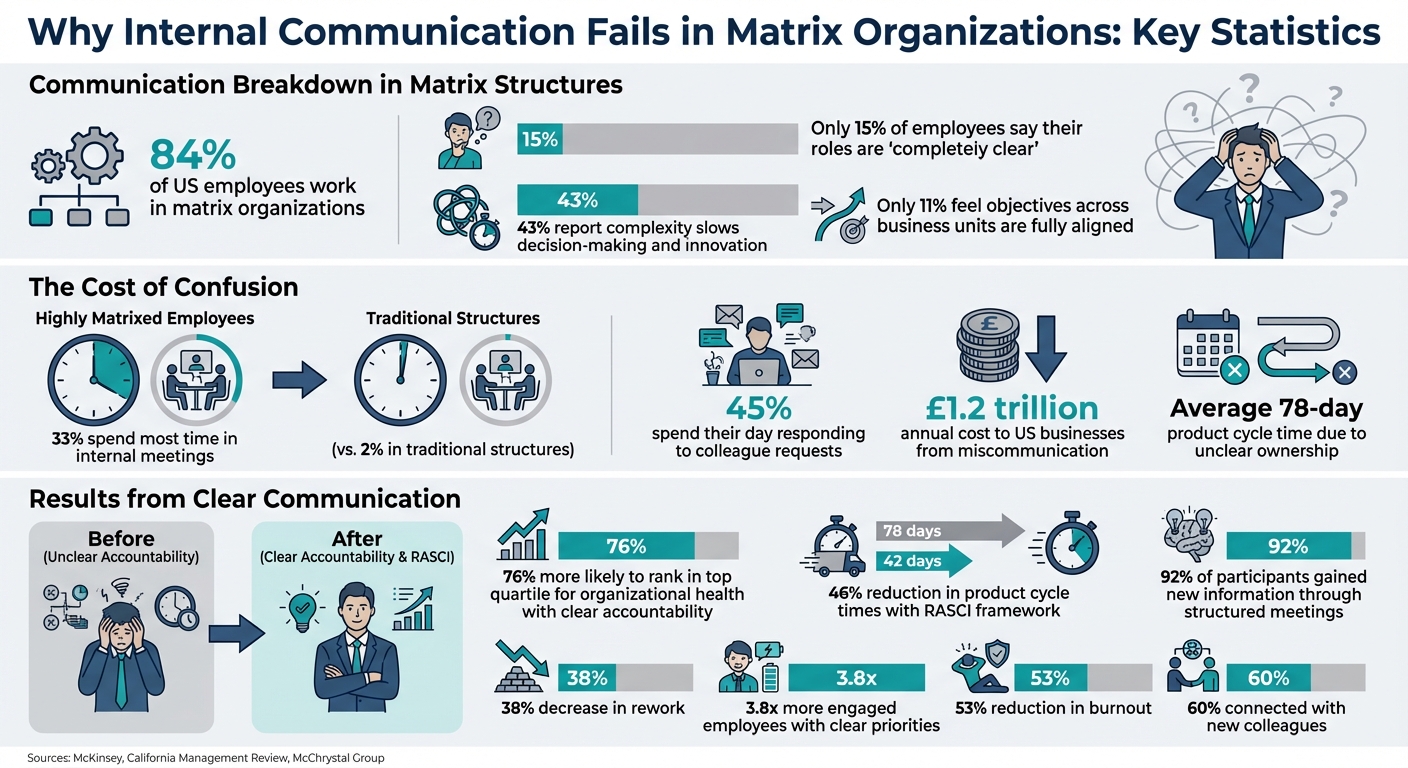
✓ Unclear roles: Only 15% of employees in matrix setups feel their responsibilities are fully clear.
✓ Information silos: Teams frequently work in isolation, despite the collaborative intent of matrix structures.
These problems result in wasted time, reduced productivity, and strained relationships. However, solutions like the RASCI framework, structured communication channels, and leadership storytelling can help organisations overcome these challenges. For example, defining clear roles reduced product cycle times by 46% for one company, while structured meetings improved team engagement in another.
The key takeaway? Communication in matrix organisations requires clarity, structure, and alignment to succeed.
Matrix Organization Communication Statistics and Impact
Why Internal Communication Fails in Matrix Organisations
Competing Demands from Multiple Managers
In matrix organisations, employees often report to more than one manager, which can lead to conflicting instructions. Take Juan at Atrium Health in 2022, for instance. Brenda, his enterprise-level manager, tasked him with setting up a new supplier network without altering the workforce. At the same time, Steve, a regional operations executive, insisted on workforce and supply cost adjustments to meet facility deadlines.
Such contradictions are common. Only a small fraction of employees in supermatrixed roles - those reporting to different managers for separate teams - feel confident about their responsibilities at work, compared to 60% of employees in traditional structures. This lack of clarity often paralyses decision-making, as noted by Jonathan Hughes and Ashley Hetrick in the California Management Review, who describe matrix organisations as places where "everyone can say 'no' and no one can say 'yes'".
The fallout on productivity is clear. A third of highly matrixed employees spend most of their time in internal meetings, compared to just 2% of their non-matrixed counterparts. On top of that, 45% spend their day responding to colleague requests, leaving little time for meaningful, focused work. Combined with conflicting directives, this creates a perfect storm for inefficiency.
Adding to the chaos, unclear roles and overlapping responsibilities further disrupt communication.
Unclear Roles and Overlapping Responsibilities
Ambiguity in reporting structures often leads to power struggles and confusion. Only 15% of employees in highly matrixed organisations say their roles and responsibilities are "completely clear". This lack of clarity fosters role conflict - where contradictory expectations arise - and role ambiguity, where employees don’t know who has decision-making authority.
When responsibilities overlap, critical initiatives often fall by the wayside because no single person or team assumes ownership. Nearly half (43%) of employees in highly matrixed organisations report that complexity slows both decision-making and innovation.
Clear roles, however, can make a significant difference. Organisations with well-defined accountability are 76% more likely to rank in the top quartile for organisational health. Yet, only 11% of employees in these structures feel that objectives and incentives across business units are fully aligned. This misalignment erodes trust and slows decisions, leaving teams stuck in a cycle of inefficiency.
Information Silos Between Teams
Matrix organisations are designed to encourage collaboration, but in practice, teams often work in isolation, focusing narrowly on their own objectives. This siloed approach traps critical knowledge within departments, leading to duplicated efforts and wasted resources.
The rise of remote and hybrid work has only exacerbated these challenges. Without the benefit of nonverbal cues or casual, in-person conversations, communication gaps widen.
Highly matrixed employees also face a unique cognitive load. They must juggle the needs, personalities, and expectations of a wide range of stakeholders across time zones and functions. This effort to maintain context and relationships - on top of their actual tasks - further complicates communication and drains mental energy.
#41 - Pitfalls To Avoid If You're Managing In A Matrixed Organization in 2024
How to Fix Communication Problems in Matrix Organisations
Matrix organisations often struggle with communication challenges, but these issues aren’t insurmountable. By adopting structured approaches and clear processes, leaders can bring clarity and efficiency to their teams.
Use the RASCI Framework to Define Roles
The RASCI framework is a practical tool for eliminating confusion about roles. It assigns five key responsibilities: Responsible (those doing the work), Accountable (the single decision-maker), Support (those providing resources), Consulted (advisers offering input), and Informed (stakeholders who need updates).
A crucial principle of the RASCI model is that only one person should be Accountable for each task. As Jenni Field, Founder of Redefining Communications, wisely notes:
"If everybody is doing it, nobody is doing it!"
This clarity prevents the indecision and back-and-forth that can plague matrix setups.
A case in point is MedNova, a med-tech company that faced a 78-day average cycle time for product changes due to unclear ownership across departments like Global Engineering, Regulatory Affairs, and IT. By introducing a RASCI matrix, their COO reduced cycle times to 42 days - a 46% improvement - and cut rework by 38%. This example highlights how clearly defined roles can directly address the inefficiencies caused by overlapping responsibilities.
When creating your own RASCI matrix, keep these tips in mind:
- Limit the "Consulted" column to two or three key individuals to avoid decision bottlenecks.
- Establish clear response-time agreements to ensure timely decisions.
- Use job titles instead of names so the matrix remains relevant even with staff changes.
- Aim for 8–25 rows - enough to provide clarity but not so many that it becomes overwhelming.
Set Up Clear Communication Channels
Role clarity is only part of the solution; well-structured communication channels are just as critical. A channel matrix - a document outlining the purpose, medium, frequency, and audience for each communication channel - can help ensure no information gets lost in the shuffle.
To further streamline communication:
- Define clear escalation paths so employees know where to take conflicting priorities.
- Set up regular cross-team meetings with specific agendas, making it clear who presents and who approves decisions.
- Integrate the RASCI matrix into digital workflow tools to embed role clarity into daily operations.
- Update the matrix at least twice a year or whenever organisational changes occur to keep it relevant.
Build Trust Through Leadership Storytelling
Matrix organisations thrive when employees focus on shared goals rather than departmental silos. Leadership storytelling can play a pivotal role in fostering this mindset.
Take PepsiCo’s merger of Gamesa and Sabritas to form PepsiCo Mexico Foods. Between 2010 and 2012, President Pedro Padierna used a compelling metaphor to unite two distinct company cultures. He likened the merger to the Amazon River, formed by the confluence of the Madeira and Rio Negro rivers, saying:
"We created a powerful image of two rivers coming together to form a new river".
Padierna also introduced a unified vocabulary, renaming "Human Resources" and "Human Capital" as "Talent and Culture" and bringing the sales teams together under a single PMF logo. This approach not only aligned the workforce but also earned PMF prestigious awards like the Donald M. Kendall Award and the Business Unit of the Year Award from PepsiCo.
Another example comes from Opsware, where CEO Ben Horowitz tackled a long-standing conflict between Customer Support and Sales Engineering by having the department heads swap roles permanently. This "Freaky Friday" exercise revealed the root causes of tensions and led to new processes that turned conflict into collaboration.
Leadership storytelling, supported by tools like the Leadership Story Bank, helps foster empathy, align priorities, and build a shared sense of purpose. Research shows that when employees see how their roles contribute to a larger mission, they are 3.8 times more likely to feel engaged.
Case Studies: How Organisations Fixed Matrix Communication
These examples highlight how structured strategies can clarify responsibilities, dismantle silos, and align teams effectively. They offer a glimpse into the tangible results organisations have achieved by addressing communication challenges in matrix structures.
Case Study: Clarifying Roles with RASCI
A med-tech company struggled with sluggish product development cycles due to unclear ownership among key departments like Global Engineering, Regulatory Affairs, and IT. To tackle this, the COO implemented a RASCI matrix, assigning clear roles for each task - Responsible, Accountable, Support, Consulted, and Informed. They also introduced the "Single A" rule, ensuring that only one person held ultimate accountability for decisions. This forced managers to define ownership more precisely, leading to a sharp reduction in cycle times from 78 days to 42 days - a 46% improvement. Additionally, rework decreased by 38%.
Case Study: Breaking Down Silos with Structured Meetings
Facing the dual challenges of rapid growth and remote work between 2020 and 2021, a global professional services firm collaborated with McChrystal Group to launch "The Forum." This structured communication framework was developed through workshops that identified employee pain points. Key features included tailored meeting agendas, role-specific facilitator training, and IT tools to enhance virtual collaboration. The results were striking: 92% of participants gained information they wouldn’t have otherwise, and 60% connected with colleagues they hadn’t met before. A Consulting division Director remarked:
"The forum has worked well to bring the cohort together. Our engagement scores are markedly above the other departments and our team is better connected to business outcomes."
Inspired by this success, other divisions adopted the model, demonstrating its adaptability.
Case Study: Using Stories to Align Teams
At Opsware, CEO Ben Horowitz introduced the "Freaky Friday" exercise, where department heads swapped roles temporarily to resolve conflicts. This practice evolved into a cultural mainstay, used for onboarding new leaders and addressing tensions as they arose. By creating a shared bank of experiences, the exercise fostered empathy and alignment, enabling leaders to draw on these insights when facing future disagreements. It showed how stepping into someone else’s shoes can strengthen cohesion in even the most complex organisational structures.
Conclusion: Improving Communication in Matrix Organisations
Matrix organisations are a common reality, with 84% of US employees working within these structures. The challenge isn't about avoiding this complexity, but about mastering it. Success hinges on three key practices: defining clear roles, creating structured communication channels, and fostering alignment through shared understanding.
Clarity around roles is a cornerstone of productivity. When responsibilities are well-defined, teams thrive. McKinsey research highlights that high accountability improves organisational health by 76%, while clear priorities make teams 3.8 times more engaged and reduce burnout by 53%. Frameworks like RASCI help eliminate confusion, enabling employees to focus on delivering results rather than navigating internal politics.
Equally important is establishing structured communication. Clear channels reduce the cognitive strain of managing competing demands and help avoid costly miscommunications, which collectively cost US businesses an estimated £1.2 trillion annually. Regularly auditing meetings to ensure they are purposeful can minimise unnecessary confusion and keep everyone on the same page.
Cross-functional collaboration thrives on empathy, and leadership storytelling or perspective-taking exercises can help build this. These techniques enable teams to connect across functions, ensuring that communication remains a driving force behind effective matrix management.
Choose one framework, implement it rigorously, and refine it as needed. By combining clear roles, structured communication, and empathetic leadership, matrix organisations can turn complexity into an opportunity for progress.
FAQs
How does the RASCI framework help clarify roles in matrix organisations?
The RASCI framework is a practical tool for clarifying roles in matrix organisations. It defines five key roles for each task or decision: Responsible, Accountable, Support, Consulted, and Informed. This structured method helps eliminate ambiguity, avoids overlapping responsibilities, and ensures accountability is appropriately assigned.
By clearly outlining these roles, teams can enhance communication, work together more effectively, and reduce delays caused by uncertain expectations. This is particularly useful in the intricate setups of matrix organisations, where priorities and reporting lines frequently overlap.
How can information silos be addressed in matrix organisations?
To address the challenge of information silos in matrix organisations, start by ensuring roles and responsibilities are clearly defined. When everyone knows who is accountable for what, decision-making becomes smoother, and collaboration across teams improves. A lack of clarity here often leads to confusion and inefficiencies.
Another key step is promoting regular cross-functional communication. This could take the form of structured meetings, collaborative initiatives, or shared digital platforms. These efforts help different departments stay aligned and work towards shared objectives, reducing the risk of miscommunication.
Lastly, building a culture of trust and openness is essential. When employees feel confident sharing information and ideas without fear, it breaks down barriers and encourages more cohesive teamwork. Together, these approaches can help matrix organisations minimise silos and create a more collaborative environment.
How can leadership storytelling improve communication and alignment in matrix organisations?
Leadership storytelling offers a dynamic way to enhance communication and alignment within matrix organisations. By sharing meaningful stories, leaders can articulate their vision, values, and priorities in a way that resonates, helping employees see how their efforts connect to the organisation's bigger picture. This sense of purpose and emotional connection becomes especially valuable in navigating the complexities of such structures.
Stories also have the power to break down complicated ideas, ensuring clear and consistent communication across various teams and reporting lines. In matrix organisations, where conflicting priorities and siloed information can create challenges, genuine narratives help bridge divides, encourage collaboration, and build trust. When done well, storytelling not only aligns teams but also fosters a unified culture, empowering everyone to move collectively towards common goals.