
What Leaders Need to Do Before They Ask Comms to “Get the Message Out”
Prepare before you brief Comms: set measurable goals, separate facts from emotion, map audiences, align with strategy and give a clear, concise brief.

Before you tell your comms team to "get the message out", pause. Effective communication starts long before a message is crafted or shared. Rushing to deliver without proper groundwork can lead to confusion, resistance, and wasted effort. Here's what you need to do first:
- Define clear goals: What specific outcome are you trying to achieve? Tie it to measurable business objectives.
- Separate facts from opinions: Ensure your message is accurate and free from emotional bias.
- Understand your audience: Different groups have different concerns and priorities. Tailor your message accordingly.
- Align with company goals: Your message should reflect organisational priorities and values.
- Structure for clarity: Use simple frameworks to organise your message and make it easy to understand.
- Choose the right channels: Match the delivery method to your audience's needs and the message's purpose.
- Brief your comms team properly: Share context, set expectations, and invite feedback to ensure alignment.
Preparation is key. By taking these steps, you’ll ensure your message is clear, meaningful, and action-oriented. Communication isn’t just about what you say - it’s about how it’s understood and acted upon.
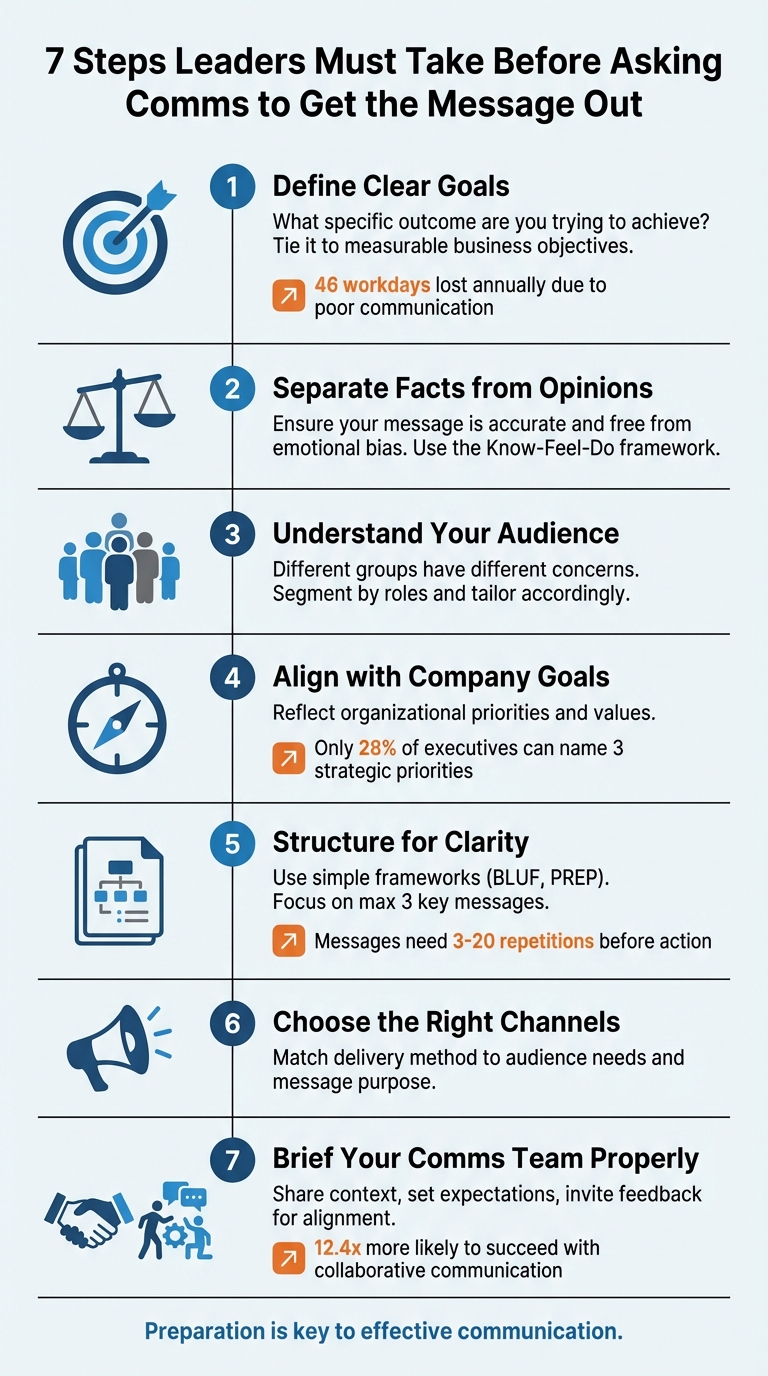
7-Step Leader's Checklist Before Communicating Messages
Communication Planning in 5 Slides // How to Create a Communication Plan
Define Your Goal and Expected Result
Before briefing your communications team, take a step back and ask yourself: what is the specific outcome this communication needs to achieve? This isn't about crafting clever or catchy messages. It's about pinpointing a measurable result that aligns with your business objectives. Without this clarity, you risk wasting time, losing focus, and damaging your credibility.
The cost of poor communication is staggering. Research shows that high-earning full-time employees lose 46 workdays annually due to ineffective communication practices. That’s nearly two months of lost productivity because the desired outcomes weren’t clearly defined from the outset.
Set Business and Communication Goals
It’s crucial to distinguish between your business goal and your communication goal. The business goal focuses on the "what" - such as launching a new product in Q3. Meanwhile, the communication goal addresses the "how" - for instance, ensuring employees understand the product’s benefits and feel confident explaining them to customers by launch day.
"Strategic planning for communication starts with defining the desired outcome and then planning the engagements that will bring about that outcome."
– Jesse Lahey, Founder, Workforce Communication
A common pitfall for leaders is the "tactics trap": diving straight into delivery methods - like emails, town halls, or brochures - without first identifying the strategic outcome. Start with the broader business objective, figure out what understanding or behavioural change is needed, and only then decide which communication tools will best deliver your message.
Determine How You'll Measure Success
Once your goals are clear, measuring progress becomes essential. Vague ambitions like "improve engagement" or "increase transparency" don’t count as goals - they’re more like hopeful aspirations. Instead, apply the SMART framework: goals should be Specific, Measurable, Achievable, Relevant, and Time-bound. For example, instead of saying "improve participation", aim for something concrete, like "increase town hall attendance from 60% to 80% within six months."
Use two types of metrics to track progress:
- Communication metrics: These measure immediate engagement, such as email open rates, click-throughs, or attendance figures.
- Impact metrics: These assess broader business outcomes, like the speed of project delivery, quality of decision-making, or employee retention rates.
While both types of metrics matter, the latter provides a deeper insight into whether your communication efforts are genuinely driving meaningful organisational change.
Common Goal-Setting Mistakes to Avoid
To ensure your goals lead to the desired impact, watch out for some common mistakes. A frequent error is assuming everyone shares the same understanding of key terms. Words like "accountability", "focus", or "customer relationships" can mean different things to different people. Be explicit. If you want employees to prioritise customer service, spell out what that looks like - whether it’s faster response times, clear escalation protocols, or specific quality benchmarks.
Another misstep is setting goals in isolation. Alarmingly, only 28% of executives and managers can name three of their organisation’s strategic priorities. If your communication goals don’t align with these priorities, they’re unlikely to get the attention or resources they need. Involve your communications team early in the process - they can flag unrealistic expectations and offer practical solutions before plans are finalised.
Lastly, avoid overwhelming your audience with too much information at once. Bombarding people with messages leads to disengagement. Focus on the most critical point, and save additional details for follow-up communications. Clear, concise messaging always wins.
Distinguish Facts from Opinion and Emotion
Once you've defined your goals, it's essential to ground your message in reality. Leaders can sometimes blur the lines between what they know, what they think, and how they feel. This mix-up can weaken credibility. Before passing your message to the communications team, take the time to separate hard facts from personal interpretations and emotional reactions.
Check Your Message for Accuracy
Start by separating verified facts from what is unknown or speculative. This step is crucial for maintaining credibility. A helpful tool here is the "Know, Feel, Do" framework, which breaks down your message into three parts: the raw facts (the "Know"), the emotional tone or intent (the "Feel"), and the desired action (the "Do"). For example, if you're announcing a company restructure, the facts might include specific changes to roles, timelines, and reporting lines. On the other hand, your interpretation might suggest the restructure will "encourage innovation" or "simplify decision-making." Keep these distinct in your initial draft, then evaluate which interpretations are backed by evidence.
Leaders often rely on mental models shaped by their experiences and values. While these models can provide useful shortcuts, they can also introduce biases. To counter this, ask yourself: "What assumptions am I making? How might someone with a different perspective view this?" This exercise can help identify blind spots or areas where opinions are mistaken for facts.
Once you've clarified the facts, it's time to address the emotions that can influence your communication.
Identify and Control Emotional Bias
After ensuring your message is factually accurate, turn your attention to emotional biases that might colour your interpretation.
Psychologist Daniel Kahneman explains that human thinking operates on two levels: System 1, which is fast, instinctive, and emotional, and System 2, which is slower and more deliberate. He notes, "System 1 is really the one that is the more influential … it is steering System 2 to a very large extent". This means your gut reactions often shape your reasoning without you even realising it. Developing self-awareness is key to managing these biases.
The Triple A Technique can help here: Accept the emotion, Acknowledge why it exists, and take Action to address it. For instance, if you're frustrated by delays in a project, recognise that frustration before drafting your message. If left unchecked, that emotion could seep into your communication, making it appear critical or dismissive.
Another useful approach is to name your emotions with precision. Instead of using broad terms like "angry" or "fine", aim for more specific labels such as "impatient", "anxious", or "disappointed". This clarity helps you better understand the root cause and keeps those feelings from distorting your message. Keep in mind that stress and fatigue can make it harder to manage these biases effectively.
Anticipate Emotional Responses
It's vital to remember that your audience will interpret your message through their own emotions, experiences, and concerns. Emotion plays a significant role in decision-making, even at the executive level. A message devoid of emotional resonance is unlikely to stick or inspire action.
Before briefing your communications team, take the time to anticipate how different groups might react. The "Think/Feel/Do" framework is a practical tool for this: map out the beliefs, emotions, and actions you hope to inspire. To test your message, try writing it from the audience's perspective: "If they were saying this themselves, how would it sound?".
During times of uncertainty or crisis, people often experience "mental freezing", where fear and stress make it difficult to process complex information. In such moments, acknowledging emotions upfront can help diffuse tension and make your audience more receptive to your message. As communication expert Rob Biesenbach explains:
"In essence, you have to win hearts to change minds - and, ultimately, people's behaviors and actions".
Know Your Audience's Point of View
You've separated the facts from emotions. Now, it’s time to step into your audience's shoes. A message that seems perfectly clear to you might land differently with your recipients. Bridging this gap requires a thoughtful approach to their perspectives, concerns, and existing knowledge.
Identify Different Audience Groups
Your audience is rarely a single, unified group. Start by segmenting them based on roles and relevance - think decision-makers, influencers, end users, and sceptics. For instance, a restructure announcement might appeal to senior executives focused on strategy, while frontline staff may be more concerned about job security. To deepen your understanding, use tools like on-site visits or data from HR, such as engagement surveys, demographics, or absence records.
Fill Knowledge Gaps and Address Concerns
Once you’ve identified your audience segments, evaluate what they already know versus what they need to understand. Dig into their beliefs, fears, and objections by consulting customer-facing teams like sales or frontline managers. If direct access is limited, these teams can help uncover recurring themes and concerns. Techniques like the "Five Whys" can reveal the root causes of resistance. Prepare objection-handling strategies and FAQs to address sceptics head-on. A well-structured message map - centred on one key idea supported by three points, each with three pieces of evidence - can ensure you’re thorough. Before rolling out broadly, pilot test your message with a small group of stakeholders to gather feedback and refine it.
Adjust Your Message for Different Stakeholders
Different stakeholders need varying levels of detail. A Chief Information Officer might prioritise technical specs and timelines, while an HR Director might focus on people-related implications and support for change management. Layer your messaging into formats like an elevator pitch, a concise summary, and a detailed version with supporting data.
| Communication Element | Technical Teams & End Users | Senior Executives |
|---|---|---|
| Primary Focus | Practicality, "how-to", and daily workflow impact | Strategic alignment, business outcomes, and ROI |
| Detail Level | High; includes technical specs and FAQs | Low to medium; high-level summaries and elevator pitches |
| Preferred Format | Documentation, training sessions, asynchronous resources | One-page summaries, visual charts, direct briefings |
Brief managers early in the process so they can localise your message for their teams. Managers play a vital role, as they need enough information to answer team-specific questions and adapt the broader message to their department’s context. The UK Government Communication Service highlights the importance of this approach:
"If you communicate the right message, to the right person, at the right time, using language they relate to, it's more likely to be heard, understood and acted on".
Finally, link your refined message to company goals to emphasise its strategic importance.
Connect the Message to Company Goals and Values
Once you’ve grasped your audience’s perspective, it’s time to anchor your message in your organisation’s strategic goals and core values. A message that drifts away from these priorities - or worse, contradicts them - risks confusing employees and wasting time. Alarmingly, only 28% of executives and managers can name three of their organisation’s strategic priorities. This highlights a widespread struggle with alignment even before communication efforts begin.
Tie the Message to Business Priorities
Ensure your message is directly linked to a core business outcome. Avoid vague statements like "customers come first" and instead focus on specific, measurable goals. Leadership expert John Hamm cautions against assuming everyone shares the same understanding of terms like vision, loyalty, or accountability. Such assumptions often lead to organisational confusion. Instead, define clear outcomes and use frameworks like the 5M Framework - Mission, Members, Messages, Media, and Manager support - to keep your message sharp and purposeful.
By grounding your communication in measurable outcomes, you also reinforce your organisation’s identity and leadership principles.
Stay Consistent with Brand and Culture
Your organisation’s tone and values should resonate clearly in every message. Terms like "teamwork" or "accountability" need a shared definition across the company. Any disconnect between what leaders say and what they do can quickly undermine trust. As noted in the UK Government Communication Service Internal Communication Strategy Guide:
"What your leaders say must align with what they do. Any gaps are quickly spotted, leading to employee cynicism and disaffection".
To maintain consistency, create a central repository for key messages and terminology. This ensures alignment across emails, intranet updates, and verbal communications. Regularly audit communication channels - monthly reviews can help identify outdated or conflicting messages before they cause confusion.
Once your message is aligned with both business priorities and brand values, its success depends on unified leadership.
Align with Other Leaders
Unified leadership plays a critical role in successful transformations - organisations with aligned leadership are 77% more likely to achieve their goals. Despite this, while 89% of UK organisations recognise communication as a vital leadership skill, only 18% rate their leadership’s communication abilities as "highly effective". Jesse Lahey, Founder of Workforce Communication, highlights the importance of involving managers early in the process:
"The best leaders go beyond simply providing managers with information to cascade along to employees. They engage with managers early, encourage their input, and help managers to take ownership of the communication".
Middle managers are particularly influential, accounting for two-thirds of the impact on employee attitudes. Without their alignment with senior leadership, messages risk being diluted or misunderstood. Encouraging open discussions about challenges fosters empathy and strengthens alignment. Structured leadership communication has measurable benefits: it improves strategic clarity by 64%, cross-functional alignment by 37%, and employee trust by 41%.
Organise the Message for Clarity
Once you've aligned your message with your business goals and your audience's needs, the next step is to ensure it’s presented in a way that’s easy to understand and impactful.
Even the most well-thought-out message can fall flat if it’s unclear. Poor communication costs businesses over £800 billion each year due to wasted time and missed opportunities. The key isn’t to provide more detail - it’s to structure your message effectively.
Use a Simple Message Framework
A strong structure is the foundation of clear leadership communication, helping your audience grasp the message exactly as you intend.
Start with the conclusion, not the context. The Bottom Line Up Front (BLUF) method puts your main point - whether it’s a decision, recommendation, or request - right at the beginning. This approach respects your audience's time, especially in today’s information-heavy world. Megan Pantelides, Senior Director at Board Intelligence, illustrates this perfectly:
"There is no value in giving your commander a detailed report of the situation on the front line and waiting until page 40 to reveal that you're under attack".
For persuasive communication, the PREP Framework works brilliantly. Begin with your Point, provide a Reason supported by evidence, follow with a relevant Example, and then restate your Point. This format is particularly effective for proposals and recommendations. To keep things digestible, focus on no more than three main points.
A clear structure doesn’t just organise your message - it also lays the groundwork for straightforward language and consistent delivery.
Write with Simplicity and Precision
Skip unnecessary backstory and get straight to the point. Ask yourself: "If my audience only reads one sentence, what must it be?" That sentence should go at the top. Arrange related ideas together so each paragraph centres on a single key point. Ensure your message answers the basics - Who, What, Where, When, Why, and How - for complete clarity.
Research shows that fewer than 33% of business leaders find management reports easy to read, which highlights the need for clearer, simpler language.
Develop Talking Points for Consistency
To ensure your message is consistent across all channels, craft talking points using the Five Cs:
- Clear: Easy to understand and remember
- Concise: Direct and to the point
- Credible: Supported by data or evidence
- Compelling: Inspires action
- Consistent: Repeatable across different platforms
Studies suggest that people need to hear a message between 3 and 20 times before they act on it, which makes consistency critical. For each key message, prepare supporting facts or figures to reinforce your point. Tailor these to your audience - for instance, use financial metrics for finance teams or user data for creative teams.
Select the Right Channels and Formats
Once your message is clear and well-structured, the next challenge is delivering it in a way that truly connects. Even the best-crafted message can fall flat if it’s shared through the wrong medium. As the Government Communication Service aptly states:
"Your channel is as important as your message, get it right if you want to make an impact".
Match Channels to Your Audience and Goals
Think about your audience’s needs and how they access information. For instance, frontline staff who lack regular computer access might benefit more from face-to-face briefings or physical notice boards than email updates. Sensitive topics, such as restructuring or office relocations, are best handled in person. This allows for immediate questions and provides emotional support. On the other hand, routine updates or straightforward instructions can be shared via email or posted on the intranet.
For complex messages that could be misunderstood, richer channels like team meetings or video calls work better, as they let you clarify points and check understanding in real time. If your message invites questions or requires engagement, opt for interactive formats. Town hall meetings, web chats, or blogs with comment sections are great options. Finally, stick to channels your team already trusts and engages with frequently. This careful selection of channels will guide how you adapt the message format next.
Tailor the Format for Each Channel
Once you’ve picked the right channels, customise your message to suit each one. For example, blogs might call for a conversational tone, while official letters should remain formal. Digital platforms often benefit from concise messages paired with strong visuals. To keep your audience engaged, repeat your message in different ways. As the Government Communication Service wisely notes:
"Familiarity can breed liking, over-familiarity tends to breed contempt".
After tailoring your format, ensure your communication plan includes ways to keep the conversation alive through follow-up efforts.
Plan Follow-Up Communications
One announcement is rarely enough to drive change. Research suggests that hearing a message 3–5 times helps build confidence in it. Develop a series of follow-ups using various formats to maintain interest and momentum. Create a centralised messaging document to ensure consistency. This should include an elevator pitch (a one-sentence summary), a short version (a paragraph), and a detailed version with supporting data.
Schedule reminders, such as desk leaflets or quick instant messages, especially before major changes or deadlines. To measure impact and understanding, include feedback mechanisms like pulse surveys or open office hours right after announcements. These strategies will prepare you for the next step: effective team briefings.
Give Your Communications Team a Proper Brief
Once you’ve nailed down a clear and structured message, the next step is ensuring your communications team is fully in the loop. A strong brief transforms your team from task-doers into strategic allies. As Kari Matalone, Senior Director of Corporate and Executive Communications at Snowflake, aptly put it:
"The words 'Where's the briefing document?' would be etched on my tombstone."
Share Context and Background
Your brief should go beyond surface-level instructions. It needs to provide the context and background that shape the message. Start by explaining why this message matters - what’s the purpose behind it? Be clear about your business goals, such as boosting product adoption or helping employees understand the reasons behind a change.
Include insights about your audience: What are their main concerns? What do they already know? Then, outline what you want them to think, feel, and do after engaging with your message.
Stick to no more than three key messages. The PR Association offers a simple yet powerful reminder:
"Say nine things – they remember none; Say three things – they remember one; Say three things three times – they remember all three."
Back up your key points with solid facts, figures, or even anecdotes. Aim for brevity - keep your brief to 2–3 pages, ensuring the most important details are on the first page.
Set Clear Expectations and Deadlines
Avoid ambiguity by setting clear expectations from the start. Instead of relying on a single deadline, establish multiple checkpoints to track progress. Specify which stakeholders need to be involved at each stage, and lay out the technical requirements - file sizes, formats, aspect ratios, and so on. Include success metrics to ensure the team’s efforts align with your desired outcomes.
Welcome Feedback and Input
Make collaboration a priority. Give your team the opportunity to share ideas and provide input early on. This helps identify any potential blind spots in your brief and fosters a sense of ownership among team members. Encouraging constructive feedback not only builds trust but also elevates the role of your communications team to that of a strategic partner.
Research supports this collaborative approach: enterprise-wide transformations are 12.4 times more likely to succeed when senior managers engage in continuous and collaborative communication.
Conclusion
Before handing off the responsibility of "getting the message out", take a moment to assess your preparation. The effort you invest beforehand determines whether your message resonates or misses the mark. Start by defining clear objectives, separating facts from emotions, understanding your audience's viewpoint, and aligning your message with your organisation's priorities. Once this foundation is in place, craft your message with clarity and select the most effective channels to reach your audience.
Research highlights that communication quality, not quantity, is what predicts a team's success. By tying your message to strategic objectives, you create a framework for impactful communication. Engaging your communications team early and providing them with a clear brief turns them into strategic collaborators, helping you shape perceptions and inspire action.
As Leadership Storybank aptly puts it:
"People don't change because they're told to. They change when they understand why, believe it matters, and know what it means for them."
With thoughtful preparation, every message you send contributes to building understanding, fostering alignment, and encouraging the actions your organisation needs to thrive. These steps emphasise the importance of groundwork in achieving effective communication.
Preparation isn't just a step in the process - it’s the foundation of success. Dedicate the time and effort to work closely with your communications team, ensuring your message not only reaches but resonates with your audience. This commitment is what drives meaningful leadership communication.
FAQs
What should I do before asking Comms to share a message?
Before bringing Communications into the mix, take the time to define your objectives clearly. Ensure your message aligns with your organisation's broader goals and develop a strategy that keeps your audience at the forefront. Think about the context, the core messages you want to convey, and which channels will best deliver those messages effectively, ensuring they connect with your audience in a meaningful way.
How do I measure whether a message actually worked?
To determine if a message has been effective, assess its influence on engagement, behaviour shifts, and measurable business outcomes. Prioritise results that align with your organisation's goals rather than relying on surface-level metrics like open rates or impressions. This ensures your communication efforts drive meaningful progress and contribute to broader objectives.
What should a proper Comms brief include?
A well-crafted communications brief serves as a roadmap for effective messaging. It should clearly lay out the objectives, offer essential background information, and pinpoint the core messages to be conveyed. Knowing your target audience is crucial - who they are, what they care about, and how best to reach them. The brief should also specify the communication channels to be used and include criteria for measuring success. Finally, addressing audience needs and including a strong call to action ensures the message connects with its audience and drives the desired outcome.