
What Happens Between Decisions and Messages (And Why It Matters)
How leaders bridge the gap between decisions and messages: clarity, timing, audience, the 4-part framework and storytelling to build trust and drive action.

When leaders make decisions, the gap between their reasoning and how they communicate it can create confusion, resistance, or even mistrust. This disconnect often stems from internalised thinking, rushed communication, or overly polished messages that lack transparency. Poor communication costs businesses billions annually, with nearly half of managers unable to clearly explain their organisation’s strategy.
To bridge this gap, leaders must focus on:
- Clarity: Explain the "why" behind decisions to reduce uncertainty.
- Audience needs: Tailor messages for different groups, ensuring relevance.
- Timing and context: Share information early to prevent speculation.
- Trust-building: Use frameworks like the 4-Part Lens (Context, Intent, Impact, Ownership) to structure messages.
Real-life examples highlight the risks of poor communication, from employee backlash to reputational damage. By prioritising clarity, encouraging feedback, and using storytelling to connect decisions to action, leaders can foster trust and alignment across their teams. Communication isn’t just a final step - it’s integral to effective leadership.
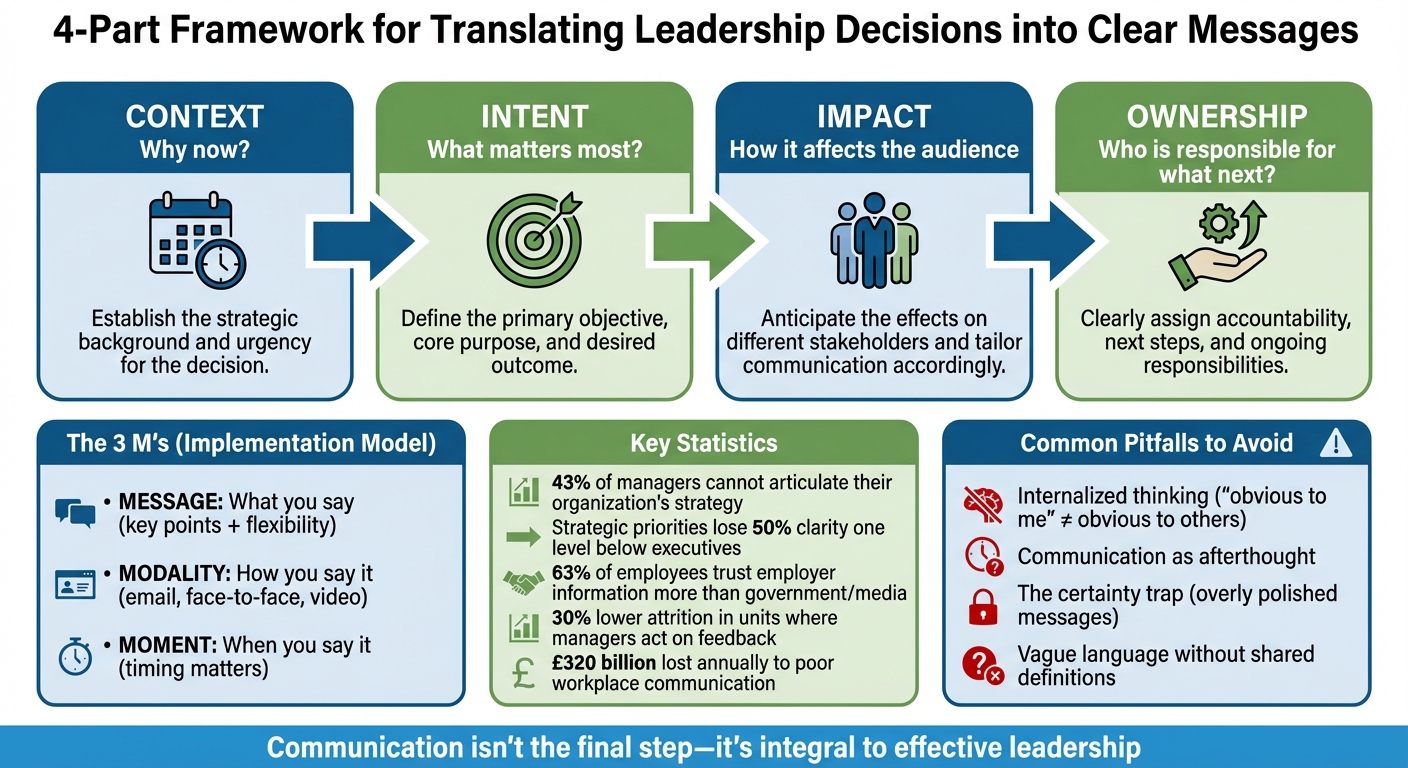
4-Part Framework for Translating Leadership Decisions into Clear Messages
Why Leadership Communication Fails and Three Strategies to Fix It | Humanizing Work Show
Why Decisions and Messages Often Misalign
The disconnect between decisions and communication isn’t usually due to bad intentions. More often, it arises from subtle, hidden challenges that leaders may not notice until the fallout becomes unavoidable. These unseen barriers create fertile ground for miscommunication, which we'll unpack here.
Common Causes of Misalignment
One major issue is internalised thinking. Leaders often spend weeks or months refining a decision, making the logic feel obvious to them - but not necessarily to others. As Bobbie Goheen, CEO of Synthesis Management Group, explains:
"I'm clear in my own head… but somehow it doesn't always land the way I intend".
This relates to what’s often called the "balcony" versus "ground floor" gap. Leaders tend to communicate from a broad, organisational perspective, while employees interpret those messages through the lens of their daily responsibilities. For example, a high-level directive might be seen by team members as a threat to job security or a disruption to their routines.
Another common pitfall is treating communication as an afterthought. When messaging is tacked on at the end of a project, it often feels like damage control rather than a natural part of the decision-making process.
Then there’s the certainty trap. In an effort to appear confident, leaders may deliver overly polished, simplified messages. While this approach might project control, teams often respond better to transparency - communication that acknowledges complexity and shares the reasoning behind decisions.
These issues don’t exist in isolation; they tend to amplify each other, creating a ripple effect that erodes clarity and trust across the organisation.
The Price of Poor Communication
When decisions and communication fail to align, the consequences are both tangible and far-reaching. For instance, nearly 43% of managers report being unable to articulate their organisation’s strategy.
The fallout extends beyond statistics. Vague language breeds confusion. Words like "accountability", "priority", or "vision" may sound straightforward in the boardroom, but without shared definitions, they can mean entirely different things to different people. Leadership expert John Hamm captures this perfectly:
"If you want to know why so many organisations sink into chaos, look no further than their leaders' mouths".
The human impact is equally significant. Without proper context, employees often resort to speculation, which undermines morale and engagement. Consider the example of Yahoo in 2013, when CEO Marissa Mayer announced a remote work ban through an HR memo. The lack of a clear explanation led to global backlash and months of corrective messaging. That same year, AOL CEO Tim Armstrong fired a creative director during a company-wide call. The absence of strategic context turned this into a public relations disaster, forcing a public apology and further damaging leadership credibility.
Ultimately, the gap between decisions and communication is where trust either flourishes or crumbles. In the next section, we’ll examine how to bridge this divide and craft messages that resonate.
Key Principles for Translating Decisions into Messages
Turning decisions into effective communication requires a focus on audience, timing, and purpose.
Shaping Messages for Different Audiences
Every audience has distinct needs, so tailor your message accordingly. Senior stakeholders often need concise overviews that emphasise strategic goals, while frontline teams benefit from actionable details and practical guidance for implementation. This isn't about oversimplifying - it's about making the message resonate with its intended audience.
Leaders can shift between six communication styles depending on the situation: Direct versus Supportive, High-Level versus Detailed, Formal versus Conversational, Decisive versus Collaborative, Calm versus Urgent, and Logical versus Empathetic. For instance, in a crisis, a firm and clear tone is essential, but a coaching session might call for a more empathetic and supportive approach.
Understand what your audience needs - whether it's direction, reassurance, context, or clear next steps. Interestingly, 63% of employees trust information from their employer more than government or media sources, particularly during uncertain times. This trust hinges on delivering messages that feel relevant and specific, not generic.
Equally important is how and when you deliver the message.
Timing and Context are Crucial
Getting the timing and context right is just as important as adapting the message. Providing context isn't optional - it's a core responsibility of leadership. Bobbie Goheen, CEO of Synthesis Management Group, highlights this well:
"People don't push back on decisions as much as they push back on missing context".
Sharing information early, even if all the details aren't finalised, helps prevent rumours and speculation. During uncertain periods, 63% of employees have indicated they prefer daily updates from leadership. Silence can fuel anxiety, while transparency fosters confidence.
A lack of empathy or poorly timed comments can have severe consequences. Consider BP CEO Tony Hayward's infamous remark during the Deepwater Horizon crisis in April 2010: "I'd like my life back." This comment, made while families were mourning, lacked both sensitivity and context, worsening the company's reputational damage. The delivery method also matters - use email for routine updates, but save face-to-face or video communication for more significant or formal announcements.
Building Trust Through Clarity and Rationale
Explaining the reasoning behind decisions helps reduce uncertainty and strengthens trust. Leaders should openly share the values and priorities that guided their choices.
Craft messages with positive language. For example, instead of saying, "Don't miss the deadline", you might say, "Submit your work by 17:00 on Friday to keep the project on track". This subtle shift encourages action without sounding punitive.
Use a four-part framework to structure messages:
- Context (why now)
- Intent (what matters most)
- Impact (how it affects the audience)
- Ownership (who is responsible for what next)
This approach connects decisions to clear communication, fostering trust and understanding. It's worth noting that strategic priorities often become murky outside the executive team, with 43% of managers unable to articulate their organisation's strategy. Achieving clarity isn't a one-time effort - it requires ongoing reinforcement and discipline.
How to Turn Decisions into Clear Messages
To communicate decisions effectively, use a structured approach combining the 3 M's and a feedback loop. These frameworks help transform decisions into messages that connect with your audience.
The 3 M's: Message, Modality, Moment
The 3 M's break communication into three parts: Message (what you say), Modality (how you say it), and Moment (when you say it).
Start with the Message. Pin down the key points and identify areas where flexibility is possible. For instance, when announcing a return-to-office policy, clearly outline mandatory days while allowing teams some leeway to adjust other details. Before sharing the decision, run it through these filters:
• Context: Why is this happening now?
• Intent: What values or priorities are driving this decision?
• Impact: How will this affect individuals?
• Ownership: Who is responsible for what happens next?
These filters ensure your message anticipates and answers the audience’s likely questions.
Next, pick the right Modality. For straightforward updates, email may suffice. However, major or sensitive announcements are better suited to face-to-face meetings or video calls. As Marshall McLuhan famously said:
"The medium is the message".
The channel you choose reflects the importance and tone of your message. Poor communication can be costly - businesses lose nearly £320 billion annually due to unclear workplace writing.
Finally, think about the Moment. Timing can dramatically influence how your message is received. Share information promptly, as delays often lead to damaging speculation. Once rumours spread, they’re much harder to correct than if you had communicated earlier. Avoid delivering difficult news late on a Friday, when follow-up support may not be immediately available.
By addressing these three elements, your message will be structured and ready for delivery. But clarity doesn’t stop there - it requires ongoing dialogue.
Creating a Two-Way Feedback Loop
Sharing a message is just the start; effective communication thrives on conversation. Clarity and transparency help build trust, but inviting feedback ensures your message resonates and evolves as needed. Listening actively is key. Use routine meetings as opportunities to gather insights, focusing on potential barriers to implementation. This helps you check whether your message was understood and identify areas where the decision itself might need adjustment.
Research highlights the risks of unclear communication: strategic priorities lose 50% of their clarity just one level below the executive team, and 43% of managers struggle to articulate their organisation's strategy. To combat this, establish checkpoints at different levels of the organisation to catch misunderstandings early. Ask direct questions like, "What does this mean for your team?" or "What’s unclear?" to uncover gaps in understanding and address them on the spot.
Employees who feel connected to their company’s strategy are 90% more likely to understand what success looks like. Regular dialogue strengthens this connection, ensuring alignment and trust. By making space for feedback, you not only refine your message but also reinforce the relationship behind it.
Using Storytelling to Strengthen Your Messages
Numbers alone rarely inspire action; stories bring decisions to life by connecting them to emotions. Research shows that data-driven arguments are less effective at persuading people than narratives that help them envision themselves in the outcome. By framing decisions as stories, you help your audience grasp the purpose behind them and see their role in what comes next.
When combined with structured messaging, storytelling adds a personal and engaging layer to leadership decisions.
Building Your Core Story
Every strong story needs structure. The best narratives follow a clear arc, addressing key elements: what is changing, why it matters, what success looks like, the steps to achieve it, how it affects employees personally, and what specific actions are required. This framework, known as the Strategic Change Narrative, ensures you're not just sharing information but creating a cohesive and relatable message.
To craft a compelling story, focus on four key lenses - Context, Intent, Impact, and Ownership - to clarify why the change is meaningful. A great example comes from TUI UK & Ireland, which introduced a new company story and strategy between 2021 and 2023. Instead of relying on dull corporate presentations, Marc Whittingham and his team built a visually engaging website featuring gamification, QR codes, and competitions with holiday prizes. They also held a leaders' conference and organised local team activities, making the strategy feel real and relevant for employees.
Keep it conversational and avoid corporate jargon. Use the "Pub Test": if your story wouldn’t sound natural in a casual chat, it’s not ready. Stories thrive on specifics - clear examples and concrete details resonate far more than abstract concepts.
Linking Vision to Action
A good story must inspire action. To transform a narrative into meaningful results, apply the Sensemaking–Alignment–Activation Model. This approach ensures your story helps people understand the "why", aligns them around a shared goal, and activates the behaviours needed to make it happen. Without this final step - what Leadership Story Bank calls "behavioural activation" - your narrative risks being just another piece of information.
Always conclude with a clear call to action. Be explicit about the behaviours that matter most and what people need to do differently right away. For instance, rather than saying, "We're redefining success", outline the practical steps - such as new check-in routines, updated customer metrics, or fresh team rituals - that will bring the vision to life. Specificity not only reduces uncertainty but also empowers individuals to take ownership. As Bobbie Goheen, CEO of Synthesis Management Group, explains:
"Ownership turns understanding into momentum".
When your story connects leadership decisions to actionable steps, it becomes more than just a message. It helps people see where they fit and gives them the clarity to move forward. This approach bridges the gap between high-level vision and day-to-day action, making change both relatable and achievable.
Measuring Message Effectiveness
Focusing on a two-way feedback process is a great start, but to ensure your communication strategy delivers results, you also need to measure how effective your messaging truly is.
Crafting a message is just one part of the equation. The real test lies in whether people understand it, trust it, and take action. Without evaluating the impact, even the best communication efforts can fall flat.
Tracking Trust and Engagement
Measuring effectiveness goes beyond surface-level metrics like email open rates or attendance figures. While these show reach, they don’t tell the full story of behavioural change. It’s the outcomes - like shifts in behaviour or tangible business results - that matter most. As Penny Swift points out, skilled communicators focus on driving behaviour change, not just increasing reach.
Start by setting a baseline before rolling out new initiatives. Gary Moss, Director of Internal Communication at Gallagher, describes communication audits as "gold dust" for recalibrating your approach. This baseline ties into the feedback loop, providing actionable insights that close the circle from decision-making to measurable impact. Once you know where you stand, assess progress through three lenses: Sensemaking (do people understand the purpose?), Alignment (are leaders delivering a unified message?), and Activation (are behaviours shifting in response?). For example, business units where managers act on feedback see 30% lower attrition rates, proving the value of completing the feedback loop.
To capture the full picture, combine quantitative metrics (like participation or productivity rates) with qualitative data, such as sentiment analysis or focus group feedback. The PROOF principle offers a practical way to integrate feedback into your planning: keep it Pragmatic (within budget), Realistic (focus on what you can prove), Open (share results transparently), Objective (acknowledge shortcomings), and Fully integrated into your strategy. Another tool, the 1-2-3 Rule, helps guide action: pick one focus area, take two decisive actions, and check progress at least three times. Without visible follow-through, "feedback fatigue" can set in, discouraging people from sharing their thoughts in the future.
Clarity vs Consistency: Trade-Offs in Leadership Messaging
Once you’ve established how to collect and act on feedback, it’s crucial to navigate the balance between clarity and consistency in your messaging.
Every message involves a choice: should you aim for clarity or consistency? Each has its strengths and challenges. Clarity ensures people immediately understand what’s required, while consistency builds trust over time by aligning words with actions. The key is knowing when to prioritise one over the other.
| Feature | Prioritising Clarity | Prioritising Consistency |
|---|---|---|
| Advantage | Provides immediate understanding of what to do and why | Builds trust through aligned, predictable messaging |
| Disadvantage | May sacrifice context for brevity, losing the "why" | Risks falling into "the certainty trap" if leaders resist adapting to new information |
| Risk | Oversimplification could miss the human impact | May lead to "change fatigue" if overused |
| Best For | Crisis situations or urgent decisions | Long-term strategies needing sustained support |
This comparison highlights that neither clarity nor consistency works in isolation. Instead, they complement each other - clarity gives meaning to consistency, while consistency reinforces clarity. The most effective leaders adapt their approach based on the situation, ensuring their words and actions remain aligned while responding to evolving needs.
Conclusion
Pulling together the frameworks discussed earlier, the final piece of the puzzle is refining your messaging strategy. The gap between decision-making and clear communication is a critical leadership challenge, directly influencing trust, efficiency, and alignment. Consider this: when 43% of managers struggle to articulate their organisation's strategy, and strategic priorities lose 50% of their clarity below the executive level, the knock-on effect on productivity is immense.
To close this gap, it’s crucial to treat communication as an intelligence system rather than a simple broadcast channel. The tools outlined in this guide - from the 4-Part Lens (Context, Intent, Impact, Ownership) to the 3 M’s (Message, Modality, Moment) - are designed to help you clarify your reasoning and ensure it resonates all the way to the frontline. As Bobbie Goheen, CEO of Synthesis Management Group, aptly puts it:
"People don't push back on decisions as much as they push back on missing context".
Great leaders approach clarity as a habit, not a one-off effort. This means consistently checking for understanding and inviting feedback. Whether you’re managing a crisis like Domino’s in 2009, where tailored messaging to different stakeholders was key, or using Amazon's six-page memos to minimise misunderstandings, the core idea holds: the quality of your communication shapes how fast and effectively your team executes. It’s a reminder that follow-through is just as critical as the initial message.
FAQs
How can leaders clearly communicate their decisions across the organisation?
To share decisions effectively, leaders should prioritise clarity, context, and alignment. Start by clearly outlining the reasoning behind the decision to help your team grasp the why. This not only fosters understanding but also cultivates a shared sense of purpose. Make sure the message reflects organisational values and is consistent with actions. This approach builds trust and avoids unnecessary confusion.
Adapt your communication to suit different audiences by considering their roles and viewpoints. Timing is also key - delivering the message at the right moment can significantly enhance its impact. For difficult decisions, being transparent and showing empathy can help ease concerns and lower resistance. Thoughtful communication connects decisions to actions, ensuring everyone stays aligned and committed to the organisation’s goals.
What are the common mistakes in leadership communication, and how can they be avoided?
Leadership communication often stumbles when messages are unclear, inconsistent, or fail to resonate with the audience. Poorly timed or context-free communication can leave people confused or disengaged, especially if it seems disconnected from what leaders are actually doing. Likewise, when leaders’ words don’t match their actions, trust can quickly erode, taking morale down with it.
To steer clear of these common issues, focus on crafting messages that are clear, concise, and relevant to the situation. Consistency is key - ensure your communication aligns with the organisation’s goals and values. Speak to the audience’s needs, keeping it straightforward and avoiding unnecessary complexity that might distract or overwhelm. When leaders get this balance right, they build trust, encourage engagement, and create a sense of shared purpose.
How does storytelling help turn decisions into effective communication?
Storytelling serves as a compelling way to turn decisions into meaningful communication because it bridges facts with emotion, making messages easier to connect with and remember. When leaders present decisions as narratives, they can break down complex ideas, promote shared understanding, and build trust.
By using storytelling effectively, leaders can align teams and stakeholders, transforming intentions into messages that motivate action. It fosters engagement, minimises confusion, and garners support by making leadership decisions resonate with the audience. In short, storytelling ensures decisions are not just shared but genuinely understood and accepted.