
Using Stories to Drive Change Vision
Use character-driven stories to make change tangible, build trust and motivate teams — practical tips to craft, deliver and sustain a clear change vision.

Hook: Facts and figures might inform, but they rarely inspire. Stories? They connect, engage, and drive action.
Key Value: Storytelling is a powerful tool for leaders navigating change. It turns abstract strategies into relatable, memorable narratives that help teams understand the "why" behind the change, see their role in it, and feel motivated to act. Research shows stories are remembered up to 22 times more than raw data, making them essential for communicating complex ideas and building trust.
Quick Overview:
- Why stories work: They create emotional connections, simplify complex ideas, and inspire action.
- Key techniques: Use relatable characters, clear challenges, and vivid resolutions to make your vision tangible.
- Practical tips: Tailor your stories for different audiences, revisit them regularly, and share real-life examples to maintain momentum.
Bridge: Let’s explore how to craft and deliver stories that bring your change vision to life.
How to Use Storytelling to Accelerate Change with John Saunders, Coach, Author, Optimizer
Why Stories Matter for Change Leadership
When organisations undergo transformation, relying purely on spreadsheets and timelines often falls short. Data might inform, but it rarely inspires. Stories, on the other hand, create emotional connections that numbers simply can't. Research shows that character-driven narratives trigger the release of oxytocin, a hormone linked to empathy, compassion, and trust. This biological response helps explain why stories linger in our minds, while facts often fade away.
Building Emotional Connection and Trust
Sharing personal stories can spark what’s known as a "Trust Loop". When leaders open up about their own struggles or vulnerabilities, they signal trustworthiness. This, in turn, encourages employees to respond with trust, fostering a sense of psychological safety. Instead of seeing an untouchable authority figure, teams connect with someone who has faced challenges and uncertainties just like they have.
This openness can also break down the "us versus them" mentality that often emerges during periods of change. Take, for example, Nand Kishore Chaudhary, founder of Jaipur Rugs. When he transitioned his company from a B2B model to a global B2C brand, he moved away from technical product descriptions. Instead, his team began sharing the personal stories of the artisans behind each rug. By embedding storytelling into both internal and external communications, the company grew to include 11 flagship stores and six franchises. This narrative approach united employees around a shared, customer-focused mission. By fostering personal engagement, storytelling also makes it easier to communicate complex changes effectively.
Simplifying Complex Change Messages
Stories do more than build trust - they help simplify complicated ideas. Abstract strategies can feel overwhelming, like trying to navigate through fog. Without a clear picture of where they’re headed, people struggle to move forward. Stories act as a kind of "mental simulation", helping teams visualise how new processes or systems might work in practice.
A classic narrative structure - setup, struggle, and resolution - works particularly well here. Act 1 introduces the current situation and the challenges at hand. Act 2 builds tension by outlining obstacles, and Act 3 resolves the story with a hopeful outcome. By framing change as a journey with a clear arc, leaders can make even the most complex transitions feel more tangible and easier to grasp.
Inspiring Action Through Meaningful Narratives
Beyond fostering understanding, stories motivate people to act. When employees see themselves as the heroes of the story, rather than just supporting characters in the leader’s vision, they’re more likely to take ownership of the change process.
Barack Obama demonstrated this powerfully in his "Fired up, ready to go" speech. By shifting the focus from "I" to "we", he transformed a personal anecdote into a shared vision that galvanised a national movement. This approach shows how storytelling can inspire collective action, turning abstract ideas into a shared mission that everyone feels part of.
Crafting Stories That Align with the Change Vision
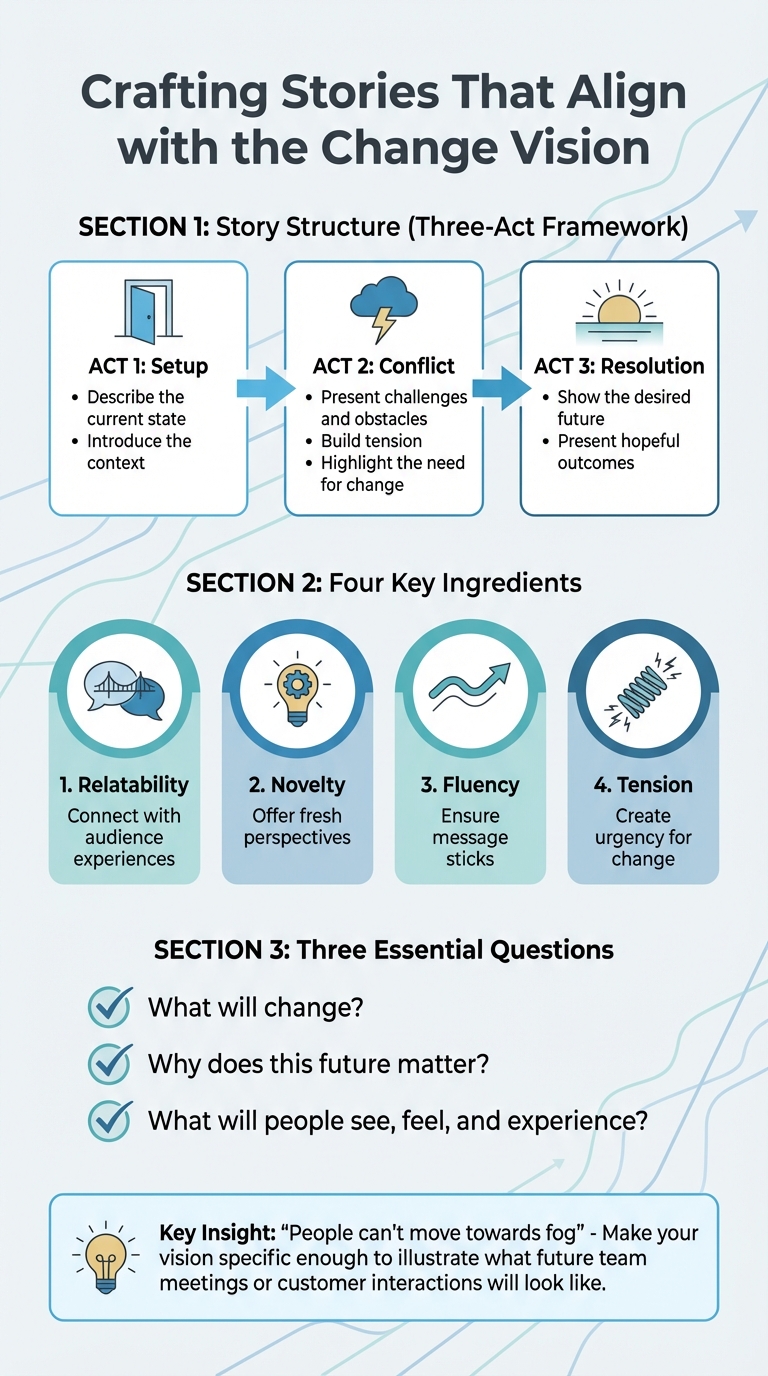
How to Craft Effective Change Stories: A Leader's Framework
Once you grasp why stories are essential, the next step is to create clear, genuine narratives. This isn’t about sugar-coating reality or telling feel-good tales - it’s about painting a vivid picture of where your organisation is heading and why it matters.
Key Elements of an Effective Change Story
A strong change story often follows a familiar structure. Think of it as a three-act play: Act 1 sets the stage by describing the current state, Act 2 introduces the challenges or conflict, and Act 3 resolves the tension by presenting the desired future.
For your story to resonate, it needs four key ingredients: relatability, novelty, fluency, and tension. Tension is crucial - it highlights the need for change - while fluency ensures your message sticks. Without these, your story risks falling flat.
Your vision should address three essential questions:
- What will change?
- Why does this future matter?
- What will people see, feel, and experience?
If your explanation requires an entire slide of bullet points, it’s likely too vague. As Joan Didion famously said, "We tell ourselves stories in order to live" - but those stories must be clear and actionable to inspire movement.
Making the Vision Personal and Relatable
Your team should be at the heart of the story. When employees see themselves as active participants in the transformation, they’re more likely to take ownership rather than passively waiting for direction. This means addressing the all-important “what’s in it for me?” for every stakeholder.
Avoid abstract phrases like “driving innovation” or “becoming customer-focused.” Instead, paint a detailed picture of the future. Imagine your organisation 12–18 months after the change takes hold. What does a typical day look like? What are people doing, saying, and experiencing differently? By shifting between the big-picture strategy and everyday realities, you help individuals see how their roles contribute to the broader vision. As the Leadership Story Bank notes, "People can't move towards fog."
Ground your vision in relatable, everyday scenarios. These personal narratives will serve as the foundation for illustrating what real change looks like.
Using Examples to Build Credibility
Once you’ve laid out the core elements and made the vision relatable, it’s time to anchor your story with real-life examples. Honest accounts of past missteps or challenges can quickly build trust. When leaders openly share their vulnerabilities, they signal authenticity, encouraging teams to engage more deeply with the change.
The “before and after” approach can be particularly effective. Highlight the contrast between the current state and the desired future, emphasising the benefits of the change. This creates a sense of urgency without relying on fear.
Repetition is also key. Don’t deliver your story once and leave it behind. Use what’s known as the “backstitch” technique - regularly revisiting the core narrative during updates, milestones, and even setbacks. Each time you announce progress or make a decision, tie it back to the overarching story. Far from being redundant, this consistent reinforcement is vital for embedding the change vision into your organisation’s mindset and daily operations.
Delivering Stories to Engage and Inspire
Creating a well-crafted change story is an achievement, but ensuring it resonates with diverse audiences is where the real challenge lies. The same narrative won't land equally with frontline teams and senior leaders, and the way you deliver it can make all the difference.
Tailoring Stories for Different Stakeholders
People absorb stories in different ways. Some thrive on detail, others focus on collective achievements, while some prefer the big picture. To connect with each group, your approach must adapt. For those who focus on specifics, craft detailed narratives featuring relatable characters overcoming clear obstacles. When speaking to team-oriented groups, highlight shared milestones and collective wins. For strategic thinkers, tie the change into the broader organisational goals and market trends.
The CATS Framework provides a practical way to structure your story. It emphasises four key elements: Characters (relatable figures), Actions (practical and emotional steps), Time (the pace and duration of the journey), and Setting (the broader context). By weaving together personal experiences, team dynamics, and the organisation's overall direction, you create a layered narrative that feels relevant to everyone, regardless of their role.
Before presenting your story, be clear on what you want your audience to think, feel, and do afterwards. This clarity will shape everything, from your tone to the platform you choose for delivery.
Selecting the Right Platform to Share Your Story
The platform you choose to share your message is just as important as the story itself. Different mediums serve different purposes:
- Town halls: These are ideal for addressing uncertainty and fostering a sense of shared purpose during the early stages of change. Use the first 30 seconds to build an emotional connection, as attention spans for stories rarely exceed 10 minutes.
- Team meetings: These work well for translating the vision into actionable steps. Sharing real stories from employees who’ve embraced the change can provide relatable examples and help reduce resistance.
- Intranet or company website: These platforms act as a continuous resource for visual storytelling, such as videos and infographics, to keep the momentum alive.
- Email updates: Instead of overwhelming employees with data, integrate narrative elements to make updates more engaging.
- One-on-one conversations: These personal interactions are invaluable for building trust. Sharing candid, honest stories - complete with challenges and imperfections - can significantly enhance your credibility.
The key is to match the medium to the message and the audience, ensuring your story reaches them in the most impactful way.
Striking a Balance Between Consistency and Flexibility
While your core narrative - the "why" behind the change - should remain consistent across all platforms, it’s crucial to adapt the delivery to suit different audiences. A unified message builds trust, but if your story contradicts other organisational strategies, it can quickly erode credibility. As EY UK aptly puts it, "In the absence of coherent and well-communicated storytelling from leadership, it is natural for narratives to be made up". Without a clear and consistent story, employees may fill the gaps with their own, often negative, interpretations.
Consistency doesn’t mean rigidity, though. Tailor your language and examples to suit each group. For instance, frontline teams will need practical, relatable examples, while executives might prefer a more strategic focus. Middle managers, in particular, need to be briefed early, as they are often the primary storytellers for their teams. Giving them the tools and confidence to adapt the narrative is vital.
A credible story doesn’t shy away from challenges. Acknowledging the effort and trade-offs required for success makes your vision more relatable and believable. Your narrative should be simple enough to repeat but specific enough to illustrate what future team meetings or customer interactions might look like. This balance of consistency and adaptability strengthens the emotional connection and clarity you've worked to establish.
Sustaining Momentum with Storytelling
Change initiatives often stumble not at the starting line but midway through the journey. The initial buzz fades, other priorities take centre stage, and without consistent reinforcement, even the most compelling vision can lose its impact. Storytelling isn’t just a launch tool - it’s how you keep the spark alive, ensuring your vision continues to resonate and drive action.
Recognising and Sharing Success Stories
Once your vision is in motion, the challenge shifts to maintaining its momentum. Some of the most impactful stories during a change process aren’t centred on sweeping transformations but on the everyday contributions of individuals. Seek out those "unexpected heroes" - team members who may have started as sceptics but became champions after seeing results. Highlight departments or branches that embraced new tools or processes early on; their experiences can serve as practical examples for others to follow.
When sharing these achievements, use a simple three-act structure for your narrative: Setup (the initial challenge), Confrontation (the obstacles faced), and Resolution (how the change addressed the issue). Keep these stories concise - five minutes or less - to ensure your audience stays engaged. Research backs this up, showing that stories are far more memorable than raw data. Every success story shared strengthens the vision in a way that no spreadsheet or status update ever could.
Embedding Stories into Organisational Culture
To sustain enthusiasm, storytelling should become a natural part of your organisation’s communication rhythm. One effective approach is the "backstitch" method - regularly weaving your core narrative into every update, whether it’s a win or a challenge. Make storytelling a fixture in town halls, team meetings, newsletters, intranet posts, and even casual conversations. Middle managers, in particular, play a key role here, as they are often the closest link to their teams. Providing them with the tools and confidence to adapt and share the narrative is critical.
Leaders also need to embody the story. When their actions align with the vision, it becomes more than just words - it feels real. Being honest about challenges, trade-offs, and even setbacks fosters trust and helps break down the "us versus them" mentality that can emerge during times of change.
Keep your vision fluid. As Leadership Story Bank puts it, "Visions should evolve as progress is made. Keep it live – not laminated". Refresh your stories to reflect current milestones and the ongoing journey, celebrating progress while acknowledging the work still ahead.
Using Leadership Story Bank to Develop Your Skills
Mastering the art of storytelling is essential for keeping your vision alive. Platforms like Leadership Story Bank are designed to help leaders refine their communication skills, enabling them to craft compelling narratives and connect with their teams more effectively. Whether you’re identifying success stories, tailoring your message for different audiences, or ensuring consistency across communication channels, Leadership Story Bank offers practical frameworks to guide you.
Tools like the "Sound & Signal Review" help evaluate which aspects of your vision are resonating and where adjustments might be needed. Meanwhile, resources such as the "Rapid Action Accelerator" provide strategies to reignite commitment when enthusiasm starts to wane.
Leading change isn’t about having all the answers - it’s about painting a vision that others can see themselves in and keeping that vision alive through authentic, consistent storytelling. Leadership Story Bank equips you with the skills to make that happen.
Conclusion
Change doesn’t thrive because of lengthy strategy documents or meticulously crafted plans - it takes root when people understand, believe in, and feel part of the journey. Storytelling acts as the vital link between vision and action, turning abstract concepts into something your team can truly connect with and rally behind. Dr. Jennifer Aaker’s research highlights this power, showing that stories are remembered up to 22 times more effectively than standalone facts. For leaders steering transformation, storytelling isn’t just helpful - it’s essential.
The best change leaders don’t stop at telling the story once. They weave it into every interaction - whether it’s a team update, a decision-making discussion, or a casual conversation. They honour the organisation’s history while painting a compelling picture of the future. They celebrate unexpected heroes, share their own moments of vulnerability, and tailor their message to resonate with different audiences. Above all, they live the story themselves, ensuring their actions consistently reflect the vision they’re asking others to embrace.
Your change story doesn’t have to be flawless from the outset. Start by defining what success will look like 12 to 18 months down the line. Reflect on why this change is important and make your team the central heroes of the narrative. Reinforce your vision regularly - it’s not a one-and-done effort. Use the backstitch method to keep the story dynamic and evolving, ensuring it grows alongside your progress, rather than becoming a static, forgotten plan.
FAQs
How can storytelling help build trust during organisational change?
Storytelling holds immense power in fostering trust during periods of organisational change, as it turns uncertainty into a narrative that people can connect with. When leaders share a genuine and relatable story about the change, they provide more than just information - they offer clarity and an emotional anchor. This transparency helps to reduce speculation, creating an atmosphere of psychological safety that nurtures trust.
A compelling story also brings people together by framing the change as a shared experience. Using inclusive language like “we” instead of “you” reinforces a sense of belonging and mutual purpose. This approach helps employees feel seen and valued, boosting their confidence in the leader’s motives. By tapping into emotions, leaders can inspire trust and motivate employees to engage with the change wholeheartedly.
For those keen to sharpen their storytelling skills, the Leadership Story Bank offers practical tools and guidance. It equips leaders with the ability to craft and deliver stories that not only resonate but also build trust and unity within the workplace.
What makes a change story effective for inspiring teams?
An effective change story blends a clear vision for the future with an emotional connection that strikes a chord with your team. It should paint a vivid picture of the future - what’s going to change, why it matters, and how it will positively affect the people within the organisation.
The story needs to be genuine and relatable, rooted in the organisation’s history and values, while offering a strong reason for the change. It should also lay out a positive, actionable path, giving people clarity on their part in the transformation and a clear sense of purpose.
To inspire on a deeper level, include emotional touches like personal anecdotes or vivid examples that spark curiosity and foster trust. A great change story should also be easy to share, enabling team members to pass it on and spread its message throughout the organisation. By balancing logic with emotion, a well-crafted story can build momentum and bring everyone together around a shared vision for the future.
How can leaders adapt stories to connect with different audiences during change initiatives?
To communicate effectively during periods of change, leaders must craft their stories to address the specific concerns and motivations of each audience. For instance, senior leaders might be more interested in the strategic outcomes or financial implications, while front-line staff are likely to focus on how the changes will affect their daily routines or job security. By answering questions like 'What will change?', 'Why does it matter?', and 'How will it feel?' in a way that resonates with each group, leaders can make their vision feel both relevant and personal.
Some practical steps include: understanding what drives the audience, choosing an appropriate tone - be it uplifting or cautionary - and using language and examples that feel familiar to them. Structuring the message clearly, with a strong opening, relatable anecdotes, and a hopeful outlook, helps ensure it sticks. Stories that are genuine and emotionally engaging often have a greater impact than a list of facts, as they inspire action and are more likely to be shared naturally in conversations. By developing and practising these tailored narratives, leaders can communicate with greater confidence and clarity.