
Predictions 2026 - How leadership, communications and the workplace will change in 2026
AI as a teammate, flatter hierarchies and human-centred leadership will reshape communication, feedback and wellbeing by 2026.
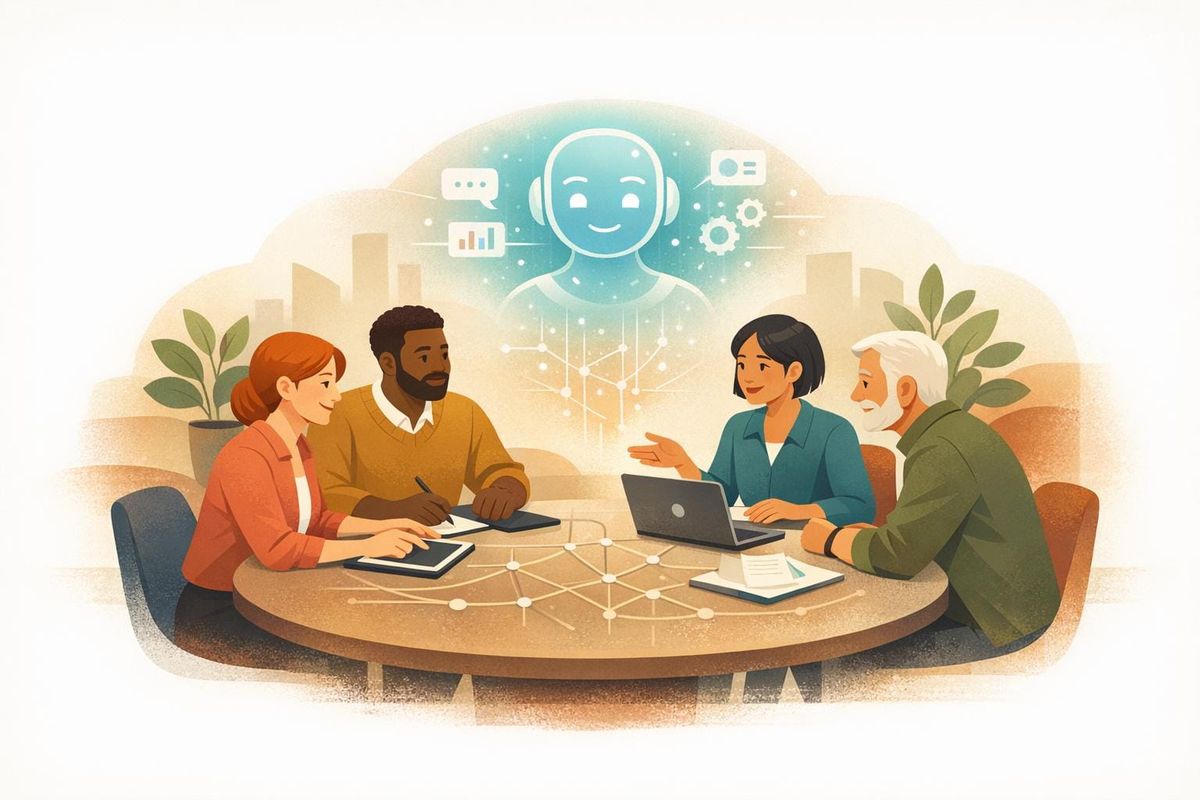
The way we work is shifting fast. By 2026, three major trends will reshape leadership, communication, and workplace dynamics:
- AI as a teammate: AI will move from being a tool to a collaborative digital worker, managing complex tasks alongside humans.
- Flatter structures: Organisations will reduce hierarchy, focusing on influence and relationships instead of titles.
- Human-centred leadership: Empathy and emotional intelligence will become essential as burnout and "quiet cracking" challenge workplace morale.
Key stats to watch:
- 71% of leaders report higher stress, and 40% are considering leaving their roles.
- Employee engagement has fallen from 88% to 64%, with 83% citing burnout.
- Only 21% of organisations feel ready for AI disruption, and 77% of CHROs lack confidence in their leadership pipeline.
To succeed, leaders must balance AI-driven efficiency with human connection, embrace real-time feedback over annual reviews, and rethink communication to ensure clarity in an increasingly decentralised workplace.
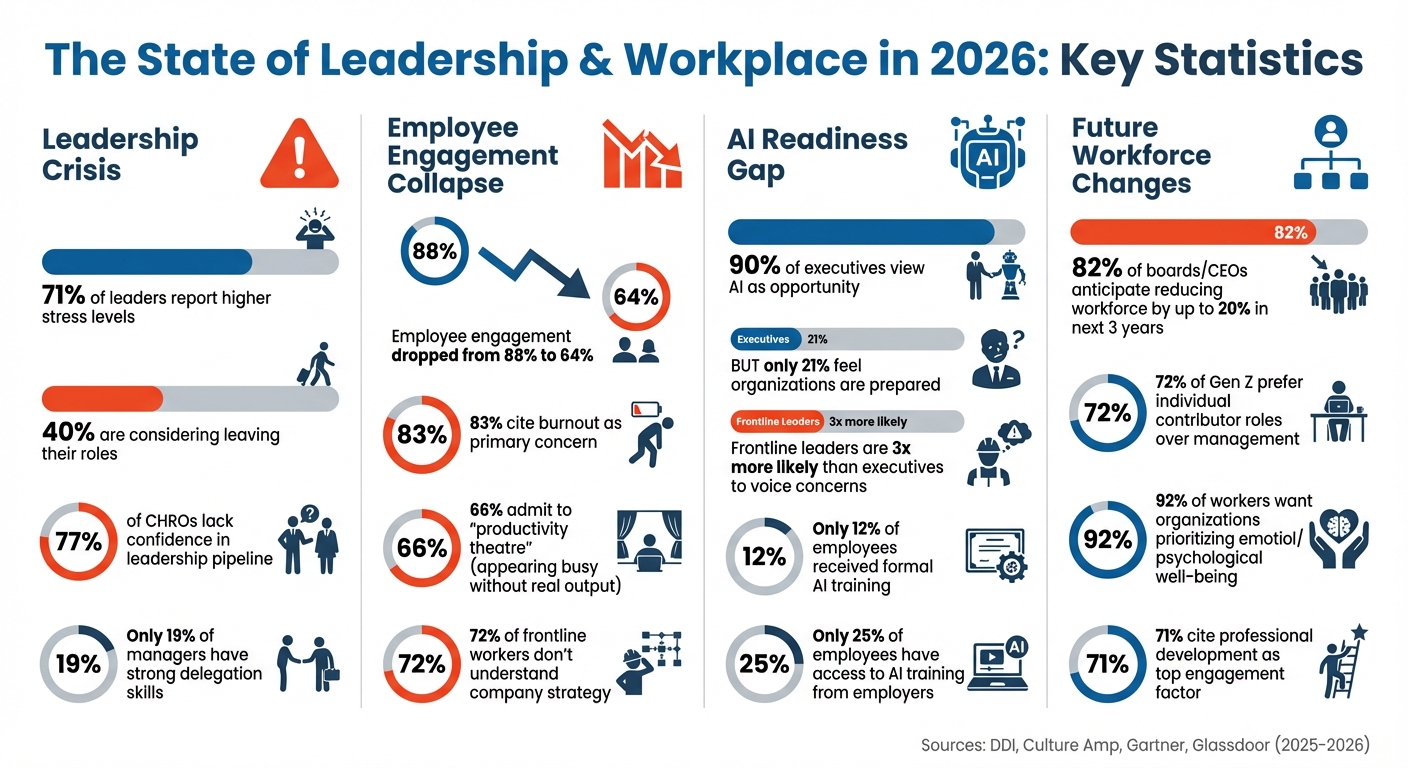
2026 Workplace Leadership Statistics: AI Readiness, Burnout, and Engagement Crisis
The Top 7 Workplace Trends In 2026
Human-Centred Leadership Takes Priority
With AI stepping into roles like data analysis and workflow management, the qualities that set leaders apart are evolving. Traits like empathy, emotional intelligence, and creating psychological safety are no longer optional - they're becoming the foundation of effective leadership. These human skills are what distinguish leaders who hold their teams together from those whose teams crumble under stress. With 71% of leaders feeling overwhelmed and 40% considering leaving their roles, the stakes are high. To thrive, leaders must balance AI-driven efficiency with a deeply human approach.
The challenges go beyond traditional burnout. A phenomenon known as "quiet cracking" is emerging - where employees stay in their roles, often due to economic pressures, but their motivation quietly erodes. Unlike "quiet quitting", this disengagement is harder to spot until it significantly impacts performance. At the same time, workplace conflicts have risen by nearly 10%, as external social and political tensions seep into teams. This growing "empathy recession" creates hidden fractures that leaders need to bridge to maintain team harmony.
The role of a leader is shifting from problem-solver to facilitator. Instead of attempting to resolve every issue, successful leaders will focus on fostering open conversations, openly addressing uncertainties, and creating a space where employees feel comfortable voicing concerns early. Stephanie Neal, Director of the Center for Analytics and Behavioural Research at DDI, explains:
"The more stressed and burnt out leaders become, the more tempting it will be to hit the 'easy button' with AI tools. But what truly sustains teams is the irreplaceable human edge of trust, empathy, and authentic presence".
This shift in leadership style isn't just about boosting morale - it directly affects outcomes. Research highlights that 92% of workers want to be part of organisations that prioritise their emotional and psychological well-being. Additionally, employees who can manage their emotions effectively are 20–30% more productive. By blending accountability with compassion, leaders can create the psychological safety necessary for the innovation required in an AI-driven world.
Why Empathy Matters More Than Ever
Empathy is becoming a critical skill in leadership, particularly in addressing challenges that technology can't solve. For example, the earlier-mentioned "quiet cracking" signals the silent disengagement of employees. This is compounded by "productivity theatre", where 66% of workers admit to appearing busy without producing meaningful results - often because they feel their genuine efforts go unnoticed by leadership. Empathetic leaders can identify these subtle signs and shift the focus from superficial activity tracking to meaningful outcomes and team sentiment.
In hybrid work settings, recognising digital cues becomes even more crucial. Delayed responses or missed deadlines might indicate deeper disengagement. Yet, only 19% of managers report having strong delegation skills, leaving many teams overwhelmed with unsustainable workloads. Leaders who show empathy can spot these imbalances and take steps to address them.
Empathy also plays a vital role in tackling the "empathy recession" by focusing on conflict resolution and guiding teams through change. When external pressures create rifts within teams, leaders who acknowledge challenges and frustrations - while maintaining clear expectations - build trust and cohesion. This isn't about avoiding tough conversations but creating an environment where it's safe to have them.
Building Psychological Safety in Remote Teams
Psychological safety is just as important in remote teams, but achieving it requires deliberate effort. Every interaction must consider the recipient's time and mental energy. Frontline workers, for instance, lose the equivalent of 10 workweeks annually due to inaccessible information, leading to frustration and eroded trust.
To address this, leaders should hold pre-briefs with managers before major announcements. This allows managers to anticipate tough questions and provide honest answers. Without this preparation, the "broken middle" effect can occur, where information becomes distorted or withheld as it moves through the organisation. The rise in terms like "misaligned" (up 149%) and "distrust" (up 26%) on platforms like Glassdoor reflects these growing transparency gaps.
Hybrid meetings also need rethinking to give remote workers equal footing. When some team members are in the room and others join virtually, the in-person participants often dominate. Simple adjustments, like requiring all questions to be submitted via chat or rotating who leads each segment, can ensure everyone has an equal voice.
Regular culture health checks are another essential tool. Quarterly anonymous surveys asking whether employees feel they can "speak truth to power" without fear of retaliation can highlight emerging issues. Leaders can also implement "reverse town halls", where executives respond to anonymous, pre-submitted questions, bypassing layers of management that might filter out uncomfortable truths.
| Leadership Challenge 2026 | Empathetic Leadership Response |
|---|---|
| Quiet Cracking | Encourage open dialogues and spot subtle burnout cues |
| Empathy Recession | Focus on conflict resolution and supporting teams through change |
| Performance Theatre | Shift from activity-based metrics to value-driven outcomes |
| AI Integration | Use AI for routine tasks, reserving personal interactions for critical moments |
| Job Hugging | Reframe lateral moves and development opportunities as secure growth paths |
How AI Is Changing Leadership and Communication
By 2026, AI is expected to step into a more active role within teams. This concept of "Parallel Intelligence" envisions humans and machines working side by side, combining human judgement with machine-driven insights to boost productivity and solve complex problems. AI will act as a "digital worker", capable of planning, executing, and refining intricate tasks in collaboration with human colleagues.
This shift, however, brings challenges. While 90% of executives view AI as an opportunity, only 21% feel their organisations are prepared for the disruption it may bring. Frontline leaders, in particular, are three times more likely than executives to voice concerns about this transformation. This readiness gap is significant, especially as 77% of Chief Human Resources Officers (CHROs) lack confidence in their leadership pipeline for critical roles during this period of change.
The leaders of 2026 won’t necessarily need coding skills but will require "AI fluency" - the ability to critically evaluate AI outputs, spot biases, and align machine-generated recommendations with ethical and contextual considerations. This shift supports the growing emphasis on human-centred leadership, where strategic and ethical judgement remain essential. Chris Child, VP of Product at Snowflake, highlights this balance:
"AI models will have a deep understanding of your data. But you'll still have to know when to doubt, when to ask deep follow-up questions before taking action".
This evolving partnership between humans and AI is reshaping how decisions are made.
Using AI to Support Better Decisions
AI’s strength lies in its ability to quickly analyse large datasets and identify patterns. To harness this effectively, leaders are creating verification frameworks - systems that define when human intervention is necessary to add the ethical and contextual layers that machines lack.
One practical approach is the "30-minute rule": dedicate 30 minutes each week to testing generative AI for scenario planning, followed by team discussions to challenge the system’s assumptions. This method builds familiarity with AI tools without overwhelming already-busy leaders - 71% of whom report heightened stress as 2026 approaches. Starting with structured, lower-risk tasks allows leaders to build confidence before tackling more complex decision-making as governance and data systems improve.
Modern leaders are increasingly taking on roles akin to "AI COOs," coordinating workflows that blend human and digital labour. Routine analyses can be delegated to AI, while humans focus on nuanced decisions. To ensure accountability, organisations are implementing strict audit trails to track and explain every action taken by AI agents.
Ethical Guidelines for AI in Leadership
Ethical integration of AI is critical to maintaining trust and authenticity in leadership. As AI begins to handle tasks such as check-ins and initial coaching sessions, there’s a risk that over-reliance on automation could make communication feel impersonal, undermining the psychological safety essential for strong teamwork. Striking a balance between AI-driven efficiency and human empathy is key to maintaining effective communication. Leaders should leverage AI for data-heavy and routine tasks while reserving emotionally sensitive and high-stakes interactions for human involvement.
Two pressing concerns are data privacy and algorithmic bias. AI systems are only as reliable as the data they’re trained on, making it vital for leaders to ensure datasets are diverse and representative to avoid biased outputs. To address "data hallucinations" - instances where AI confidently provides incorrect information - organisations need robust verification processes with human oversight at critical stages.
Transparency is another cornerstone of ethical AI use. Tools like "explainable AI" and automated audit trails help clarify how AI-driven decisions are made and communicated. Leading enterprise software providers such as SAP, Microsoft, and Oracle are rolling out modules with real-time compliance monitoring to reduce the risk of AI errors. Additionally, the Model Context Protocol (MCP), an open-source standard, is gaining traction. It allows AI systems to securely share data while maintaining strict access controls.
Leaders should also consider creating "secure sandboxes" - safe spaces where teams can experiment with AI without fear of making mistakes. These environments foster learning and adaptability, which are crucial given that only 12% of employees have received formal training on using AI effectively in their roles.
| AI Risk | Description | Mitigation Strategy |
|---|---|---|
| Data Hallucination | AI generates false information with confidence | Ensure human oversight at key decision points |
| AI Bias | Outputs reflect biases in training data | Use diverse and representative datasets |
| Third-Party Service Risks | Vulnerabilities in external AI tools | Conduct thorough due diligence and enforce contracts |
| Loss of Authenticity | Over-automating leadership tasks | Reserve critical communication for human interaction |
Flatter Structures and Continuous Feedback Replace Old Models
By 2026, the traditional corporate hierarchy is being reshaped. Economic pressures and advancements in AI are driving organisations to cut down layers of middle management, a trend experts have dubbed "The Great Flattening". For instance, in May 2025, Microsoft made a strategic decision to reduce its workforce by 6%, specifically targeting management roles to streamline decision-making. This shift isn’t a short-term fix. A striking 82% of boards and CEOs anticipate reducing their workforces by as much as 20% in the next three years due to AI advancements.
While flatter structures enhance agility, they also dismantle the traditional career ladder. Career progression is no longer about climbing vertically but about gaining "breadth" through lateral moves and cross-functional roles. Interestingly, 72% of Gen Z employees show a preference for individual contributor roles over management positions, reflecting the rise of "conscious unbossing". However, this shift isn’t without challenges. Roger Philby of Korn Ferry cautions:
"Eliminating middle managers and entry-level roles looks attractive on a spreadsheet, but it quietly destroys your future leadership bench".
In this evolving landscape, leadership and performance management require a fresh approach. Traditional annual reviews and rigid hierarchies no longer align with organisations where formal reporting lines blur, and teams work across multiple functions.
Leading Without Hierarchy: Building Influence Across Teams
In a flatter organisation, positional authority takes a backseat. Leaders now need to cultivate relational capital - trust, credibility, and influence - to drive results in decentralised, cross-functional teams. Leadership experts Stephanie Neal and Rosey Rhyne explain:
"In flatter structures, each cross-functional project tests credibility, trust, and adaptability".
This shift redefines the manager’s role, moving away from task supervision to becoming a strategic enabler. Yet, only 19% of managers report having strong delegation skills, a crucial ability to avoid burnout in environments where leaders must empower rather than control. Sean McPheat, CEO of MTD Training, encapsulates this transformation:
"Leadership is no longer about what the manager does. It is about what the team becomes capable of doing".
Developing influence without relying on formal authority requires intentional effort. Leaders should approach every cross-functional project as a chance to build trust through small but visible actions - meeting deadlines, seeking input before offering solutions, and acknowledging team contributions.
| Leadership Shift | Old Model (Hierarchical) | New Model (Flatter/2026) |
|---|---|---|
| Primary Power | Positional Authority | Relational Capital & Influence |
| Career Growth | Vertical Promotions | Lateral Breadth & Skill Acquisition |
| Manager Role | Command and Control | Facilitator & Strategic Enabler |
| Team Structure | Siloed Departments | Matrixed & Cross-functional Teams |
Why Real-Time Feedback Works Better
Annual performance reviews are increasingly out of place in flatter organisations. These reviews fail to capture the full scope of contributions in settings where employees work across multiple teams and projects. Additionally, two-thirds of employees admit to engaging in "productivity theatre" - doing work that looks busy but lacks real impact - because traditional feedback systems don’t offer timely guidance.
To address this, continuous feedback cultures are emerging as the solution, offering regular coaching and real-time insights. Eleni Teichmann, Lead People Scientist at Culture Amp, highlights the limitations of traditional data-driven approaches:
"Data from employee monitoring only gets a company to the point of knowing something is wrong. It doesn't provide direction as to how to solve that problem, which is considerably more important. Leaders need data that dips into the 'why' for that".
Real-time feedback systems, such as 360-degree reviews, upward feedback, and frequent one-on-ones, allow managers to address issues and celebrate achievements as they happen. This is especially vital as 71% of leaders report heightened stress levels, with 40% considering leaving their roles. Regular check-ins not only create opportunities to address challenges but also foster psychological safety - a key foundation for influence-based leadership.
For organisations embracing continuous feedback, the focus should be on systems that gather insights from peers and subordinates, not just top-down evaluations. AI tools can play a role by analysing feedback patterns and suggesting initial action plans, freeing managers to engage in meaningful conversations. This is particularly important as 71% of employees cite professional development as the top factor driving their engagement.
Communication Strategies for Clarity and Alignment
As organisations flatten their hierarchies and teams become more distributed, the focus is shifting. It’s no longer just about stopping misinformation; it’s about ensuring people genuinely understand what’s being communicated. Ryan Darling, VP of Corporate Communications at Gallagher, captures this perfectly:
"The biggest risk to organisations in 2026 isn't misinformation - it's misunderstanding".
While leaders are sending more messages than ever, employees are often left struggling to make sense of them. A striking 72% of frontline workers currently report they don’t fully grasp their company’s strategy. The issue isn’t a lack of communication - it’s a lack of clarity. By 2026, the organisations that succeed will be those that shift from bombarding employees with data and dashboards to offering actionable insights that guide decisions. Leaders will need to assess their communication channels, not by how much information they deliver, but by how effectively they help employees understand what needs to happen next. Stephanie Cornell, Head of People Communications & Marketing at WPP, explains:
"In 2026, success won't be measured by clicks but by confidence, connection and resilience. In a world moving faster than ever, IC's role is to create meaning".
This focus on clarity underscores the importance of streamlining communication to inform rather than overwhelm.
Streamlining Communication Channels
Today’s employees juggle a variety of tools - email, Slack, Teams, and project management platforms - leading to fragmented communication. When critical information is scattered across multiple systems, employees are left to piece things together themselves, often resulting in confusion and inconsistent execution.
The solution lies in embracing Connected Intelligence. This approach integrates people, data, and AI agents, ensuring insights are delivered in context rather than requiring employees to search across platforms. Aruna Ravichandran, SVP & CMO for AI, Networking, and Collaboration at Cisco, highlights this shift:
"By 2026, the workplace won't evolve through more apps or digital assistants, but through Connected Intelligence - where people, data, and digital workers work together side by side".
Practically speaking, this means organisations should prioritise technology that supports open-source standards like Model Context Protocol (MCP). This framework enables AI agents to securely connect and draw insights from disparate enterprise systems. Instead of adding yet another tool, the goal should be to create a seamless "phygital" experience, where physical and digital interactions blend so smoothly that the technology itself becomes almost invisible.
Another critical principle is "cognitive respect" - ensuring every message respects employees’ time and attention. This involves simplifying updates, consolidating communication channels, and replacing lengthy announcements with concise summaries and detailed FAQs. Jennifer George, Director of Internal Comms at The Austin Group, advises:
"Cut the main content of messages in half and replace the saved space with detailed FAQs that address 'what your team will ask you'".
Once communication channels are streamlined, the next step is ensuring managers deliver these insights effectively.
Why Managers Should Lead Communication
The traditional "cascade" model, where messages flow from executives through layers of middle management, is becoming less effective. As organisations flatten their structures, middle managers - already under pressure - are often left as a weak link in the chain. This has created what experts call the "Broken Middle": a gap where messages either fail to reach frontline teams or arrive distorted.
Despite these challenges, managers remain employees’ most trusted source of information. However, only 19% of managers feel confident in their delegation skills, and 71% report being under increasing stress - with 40% considering leaving their roles. To succeed in 2026, managers need to shift their focus. Instead of acting as "fixers", they should become "facilitators", using one-on-one conversations to build trust and address concerns early.
Organisations can support this shift by holding manager pre-briefs before major updates are shared. Jennifer George explains:
"Assume your managers don't believe you either. Before anything, do a manager pre-brief where they can say 'my team is going to ask X and I have no good answer'".
This approach ensures managers aren’t just repeating corporate messages but are equipped to provide meaningful, context-specific guidance.
AI can play a helpful role here by handling administrative tasks like drafting summaries or analysing feedback. This frees managers to focus on human-centred tasks like building trust and explaining the reasoning behind decisions. As Laura McGann, CPO at Prosci, notes:
"AI coaches are a way to unburden managers so they can direct energy towards what matters most".
However, it’s crucial that AI remains a tool for support, not replacement. Managers must retain responsibility for the human aspects of communication, such as fostering dialogue and addressing concerns. This is especially important given the "AI leadership gap" - while 69% of C-suite leaders believe they’ve communicated clearly about AI, only 12% of entry-level staff agree.
To bridge these gaps, organisations should also explore direct communication methods that bypass the "Broken Middle." Ideas include "reverse town halls", where executives answer anonymous employee questions, or small-group coffee chats with randomly selected staff. These initiatives ensure that communication flows both ways, allowing leaders to hear unfiltered feedback and build stronger connections across the organisation.
How to Prepare: A Framework for Leaders
The changes on the horizon demand immediate and decisive updates to leadership approaches. The gap between current practices and the demands of 2026 is growing fast. Consider this: 77% of CHROs lack confidence in their leadership pipeline, and only 25% of employees receive formal AI training from their employers. Leaders cannot afford to wait for organisational programmes to catch up - they need to take charge of their own growth.
This framework builds on earlier trends like human-centred leadership and the integration of AI. It highlights the skills leaders must develop to tackle future challenges. Leadership now isn’t just about adding new skills; it’s about rethinking roles entirely. As David Brown, CEO USA at Hays, succinctly puts it:
"The command-and-control style of leadership is over".
Leaders who thrive in 2026 will be those who start preparing today, blending human insight with technological expertise. The challenges ahead signal a major transformation in leadership competencies.
Leadership Skills: What's Changing by 2026
The table below illustrates how leadership skills are evolving. These aren’t small tweaks - they represent a fundamental shift in how leaders approach their roles:
| Competency | Pre-2026 Practice | 2026 Requirement |
|---|---|---|
| AI Interaction | Using AI as a tool for tasks | Collaborating with AI as a teammate |
| Authority | Positional power and hierarchy | Relational influence and peer networks |
| Decision-Making | Relying on data-driven analysis | Incorporating ethical considerations |
| Career Pathing | Climbing vertical hierarchies | Exploring lateral and varied experiences |
| Well-being | Fixing issues reactively | Creating psychological safety proactively |
| Workplace Metrics | Tracking occupancy or capacity | Measuring human connection and sentiment |
| Communication | Sharing information top-down | Engaging in adaptive, cross-functional dialogue |
One of the most striking changes is how leaders will interact with AI. James Milligan, Global Head of Technology, Engineering, and Contracting at Hays, emphasises:
"You will be left behind if you don't embrace new technologies like AI".
This isn’t just about using AI - it’s about developing the ability to question its outputs, recognise biases, and apply human judgement to its insights. With these shifts in mind, the next step is figuring out how to build and refine these critical skills.
How to Build the Skills You'll Need
To develop AI fluency, dedicate 30 minutes a week to using generative AI for scenario planning. Experiment with the technology, then discuss the results with your team to identify where human judgement enhances AI outputs.
For horizontal leadership, move your focus from relying on positional authority to building relational influence. Tools like 360-degree feedback can help track your progress in collaborating across functions and leading without formal power. This is especially important as organisations adopt flatter structures, where leadership often spans teams without direct authority.
Strengthen your interpersonal and narrative skills by developing the "5Cs": Connection, Conscience, Creativity, Clarity, and Curiosity. These qualities give you an edge over AI in areas where human input is irreplaceable. Resources like Leadership Story Bank are great for honing these abilities.
Finally, embrace a "learn-it-all" mindset instead of a "know-it-all" one. Be open about challenges, balancing accountability with compassion. This approach not only normalises uncertainty but also helps combat "quiet cracking" - a subtle but harmful form of burnout where employees stay in their roles but lose motivation. Transitioning from being a "fixer" to a "facilitator" means treating resilience as a core skill, not an afterthought.
Conclusion: Getting Ready for 2026 and Beyond
Workplace dynamics are shifting rapidly. With 77% of CHROs expressing doubts about their leadership pipelines and only 25% of employees having access to formal AI training, the gap between current capabilities and future needs is growing. Leaders who wait for organisational initiatives to bridge this gap risk falling behind.
To navigate this evolving landscape, leaders must focus on developing AI fluency, cultivating influence beyond formal authority, and creating environments where psychological safety thrives. These priorities reflect the leadership skills and real-time feedback systems previously discussed.
Stephanie Neal, Director of the Centre for Analytics and Behavioural Research at DDI, highlights this perfectly:
"The most future-ready leaders will define their value not by what can be automated, but by the human impact they create."
This underscores a critical truth: while technology will take on more tasks, human qualities like judgement, empathy, and connection will remain irreplaceable.
Start small - dedicate 30 minutes each week to experimenting with AI tools, practise leading through influence rather than hierarchy, and normalise conversations about uncertainty. These habits, though simple, can build momentum over time, equipping you with the skills needed for the workplace of tomorrow. As we've seen throughout, the future belongs to those who can balance technological advancements with human insight.
Leaders who embrace adaptability and leave behind outdated command-and-control approaches will be the ones who truly thrive.
FAQs
How can leaders integrate AI while maintaining a human connection?
Leaders can make the most of AI by viewing it as a tool that supports and strengthens human connections, rather than one that replaces them. AI excels at simplifying repetitive tasks, offering useful insights, and acting as a reliable assistant. However, its real value lies in how it enables leaders to prioritise people-focused outcomes - like fostering collaboration, mentoring, and tackling creative challenges.
To preserve and enhance human connection, it’s essential that leaders bring employees into the conversation about AI. This means involving them in shaping how AI is used, being clear about its purpose and limitations, and ensuring it supports trust and empathy rather than undermining them. For instance, AI can take on data-heavy tasks, such as summarising reports, freeing leaders to invest time in meaningful activities like one-on-one discussions and team-building.
When AI is used to complement human efforts and leaders prioritise openness and trust, technology becomes a tool for building stronger relationships, not a barrier to them.
How can organisations address 'quiet cracking' and support employee wellbeing?
Preventing 'quiet cracking', where employees withdraw or face mental pressure without outward signs, calls for a thoughtful and empathetic strategy. Organisations should create an environment where conversations about stress and mental health are normalised. This can be achieved through regular check-ins, anonymous feedback channels, and access to confidential counselling services, ensuring employees feel genuinely supported.
Building real human connections is key to addressing feelings of isolation. By encouraging team bonding, creating welcoming spaces, and establishing rituals that foster a sense of belonging, companies can boost morale and strengthen workplace relationships. Offering flexible working options, whether through hybrid schedules or adjustable hours, also allows employees to balance their responsibilities more effectively, reducing the likelihood of burnout.
On top of this, integrating smart technologies like AI tools to handle repetitive tasks can relieve employees of mundane duties, enabling them to focus on more meaningful and engaging work. By blending these approaches, organisations can cultivate a workplace where employees feel appreciated, connected, and better equipped to handle challenges, lowering the risk of disengagement and stress.
How can organisations simplify communication to improve clarity and understanding?
To make communication more effective, organisations should consider merging various tools into a single, purpose-built platform. This centralised hub enables employees to view the full context of conversations, avoiding the disorganisation that often comes from juggling emails, chats, and project boards. A unified system promotes smoother collaboration and minimises misunderstandings.
Incorporating AI-powered tools into such a platform can take things a step further. These tools can summarise lengthy discussions, extract key action points, and simplify complex language into plain English. This helps ensure everyone remains on the same page and focused on the priorities that matter most.
Organisations should also streamline their dashboards and data feeds by cutting out unnecessary clutter. Instead, they can provide curated insights and concise updates. By focusing on delivering the most relevant information and designing systems with employees in mind, businesses can foster an environment where communication is clearer, decision-making is sharper, and teamwork thrives.