
Pixar Story Spine for Leaders
Apply the six-step Pixar Story Spine to craft clear leadership narratives that simplify change, engage teams and drive action.

The Pixar Story Spine is a simple yet powerful framework to help leaders craft clear, engaging narratives. Originally designed for storytelling at Pixar, it’s now a tool leaders can use to communicate ideas, inspire teams, and drive action. By following its six-step structure, you can turn complex concepts into memorable stories that resonate.
Key Takeaways:
-
The Structure:
- Once upon a time... (Set the scene)
- Every day... (Describe the norm)
- Until one day... (Introduce a disruption)
- Because of that... (Show the ripple effects)
- Until finally... (Reach the climax)
- And ever since then... (Establish the new normal)
- Why It Works: Stories engage emotions and memory, making them more impactful than facts alone. The cause-and-effect flow ensures clarity and persuasiveness.
- Practical Use: Apply it to scenarios like organisational change, strategy alignment, or team reflections. For example, frame a change initiative as a journey, showing how challenges led to growth and improvement.
-
Tips for Leaders:
✓ Define your objective and audience.
✓ Use relatable examples and evidence.
✓ Keep the story focused and aligned with a central message.
This framework isn’t just for presentations - it’s a mindset shift. With practice, you’ll naturally spot and shape stories that connect with your audience, whether you’re leading through change or celebrating a team’s success.
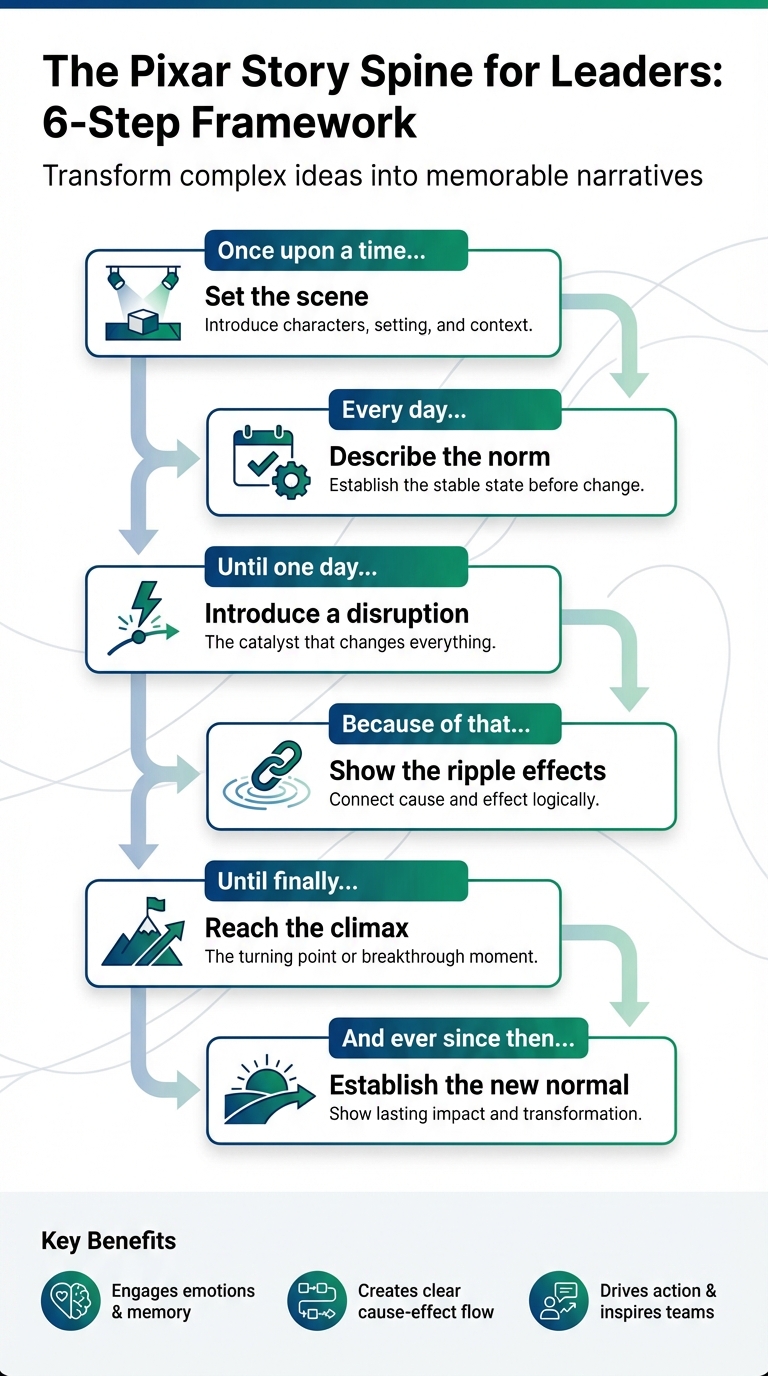
Pixar Story Spine Framework: 6-Step Leadership Storytelling Structure
Story Telling In Business - Pixar Story Teller Mathew Luhn at CIMC / Marwick Marketing

Preparation Checklist for Using the Story Spine
Before diving into the Story Spine framework, it’s essential to lay the groundwork. These steps will help ensure your narrative resonates with your audience and drives the desired impact.
Define Your Objective
Start by pinpointing what you want to achieve. What emotion or action do you want to inspire? Leadership stories aren’t just about recounting events - they’re about sparking change and action. Your goal could be anything from securing funding to motivating a team through tough times or influencing stakeholder opinions.
Gavin McMahon, Co-founder at fassforward, highlights an important principle:
"The person you are talking to is the hero of your story".
This means your objective must connect with your audience’s priorities, not just your own. For example, if you’re presenting to the Bank of England, frame your solution around how it addresses their specific issues.
Once you’ve defined your goal, determine who will drive the story and what central message ties it together.
Identify the Protagonist and Core Message
Decide who takes centre stage in your narrative. Is it you, your team, or - most effectively - your audience? Great leadership stories often position the audience as the hero, fostering empathy and engagement. Every character in your story should have a clear goal that moves the plot forward.
Boil your story down to one essential takeaway. Ask yourself: what’s the one line you want your audience to remember? Prime Minister Narendra Modi’s framing of India’s Mars mission in 2014 is a masterclass in this:
"We sent a mission to Mars, for less than it cost to make the movie Gravity."
By comparing the £55 million mission cost to the £75 million film budget, he conveyed India’s technological prowess and cost-efficiency in just one sentence.
Gather Context and Evidence
Strong narratives are rooted in evidence and context. Build credibility by gathering concrete details - dates, decisions, metrics, and pivotal moments. For example, Maya, a UX researcher, once persuaded senior stakeholders of the importance of fixing minor usability issues. She focused on a single user who spent 30 seconds in frustration before abandoning a purchase. Framing her research as "an investment, not a cost", she secured immediate executive support.
When preparing your story, map out the key elements: the starting condition (the ‘platform’), the disruption (the ‘tilt’), and the transformation that follows. For maximum impact, the tilt should often highlight the moment your product, service, or insight comes into play. By anchoring your story in real, relatable details, you create momentum and tension that keeps your audience engaged.
Crafting Your Leadership Story Spine
Now that you’ve laid the groundwork, it’s time to shape your narrative using the five key stages of the Story Spine. Each step adds structure and flow to your story.
Once Upon a Time – Setting the Scene
Start by painting a vivid picture of the beginning: who the main character is, where the story takes place, and what life was like before things changed. This is your chance to connect with your audience by tying the story to a shared experience or challenge. Author and filmmaker Brian McDonald captures the importance of this step perfectly:
"Our first responsibility as storytellers is to introduce our characters and setting – i.e., to anchor the story in time and place".
Leadership coach Erica Marx also highlights the emotional pull of this stage:
"People are compelled by emotions and contrast. We want to see a story of transformation".
If your aim is to showcase success, begin with a period of struggle or uncertainty. Highlighting this contrast makes the eventual transformation all the more compelling. For instance, if you’re addressing concerns about a company reorganisation, you might open with: "I know many of us feel uneasy about the reorganisation. It reminds me of when our team faced a similar moment three years ago." This kind of personal, relatable introduction builds trust and sets the stage for your story.
Be honest and share genuine experiences, including challenges or missteps. Avoid presenting an overly polished version of events - it’s the imperfections that make the story relatable. Once the scene is set, move on to the event that disrupted the routine.
One Day – The Inciting Incident
Next, identify the event that shook things up and made the old way of doing things unsustainable. This is the pivotal moment that drives the story forward. Leadership coach Erica Marx explains it well:
"Make your pivot clear. What ONE change led to all the other changes?".
This event needs to be significant - a market disruption, an unexpected crisis, a critical customer complaint, or an unforeseen opportunity. It should naturally follow from the routine you’ve just described but stand out as a clear break from it. This is the moment that forces action, prompting you, your team, or your organisation to adapt or rethink your approach.
Because of That – Connecting the Dots
Now, trace the ripple effects of that initial disruption. Each "Because of that" moment should logically follow from the one before, creating a clear progression of events. Use two or three steps to show how the stakes grew or the challenges deepened. Don’t stop at just one consequence - build a chain of events that leads to your story’s turning point.
As author Jason notes:
"The Story Spine naturally creates strong causality in your narrative. Each segment builds on the previous one, creating a logical chain of events".
This is where you outline both the external events and the internal shifts that followed the inciting incident. If your story feels disjointed, try working backwards from the resolution to ensure every step connects logically. Each "Because of that" moment should lead naturally to the climax of your story.
Until Finally – The Turning Point
This is the moment where everything changes - the climax of your story. It’s the point where the central challenge is addressed, the critical decision is made, or the breakthrough occurs. Be specific about what changed and why it mattered.
This turning point should feel like the natural result of everything that came before. In leadership stories, this often involves a tough decision, a collaborative effort, or the moment when a new strategy finally paid off. The key is to show how the resolution was earned through effort, adaptation, and persistence.
And Ever Since Then – The New Normal
Finally, show how things have evolved since the turning point. What’s different now? What new skills, mindsets, or practices have emerged? End with insights that tie the story’s lessons to your audience’s current challenges or opportunities. Highlight how the changes continue to shape the future.
Refining and Delivering Your Leadership Narrative
Sharpen your story by cutting out distractions and ensuring every element reinforces your central message.
Ensure Clarity and Alignment
Once your story is outlined, the next step is refining it for maximum clarity and impact. Every detail should contribute to a clear and unified purpose. Laia Tremosa from the Interaction Design Foundation captures this perfectly:
"A clear story has one heartbeat. Everything else should support it".
By following this "one heartbeat" rule, you’ll be able to strip away anything that doesn’t directly support your message. It’s about being selective and intentional with what stays in your story.
Stick to simple, everyday language. Swap complex words like "utilise" for "use" and make your actions tangible and easy to understand. Gavin McMahon, Founder and Chief Content Officer at fassforward, reminds us:
"Simple is not easy. It requires time and thought".
Clear language not only grabs attention but also ensures your story is more memorable. Use vivid, action-oriented words to keep your audience engaged.
To test your story’s clarity, try summarising it in an ABT (And, But, Therefore) sentence. For instance: "Our team was performing well, but customer complaints were rising; therefore, we restructured our support process, reducing response times by 40%".
Balance Data and Human Impact
Data tells the story of results, but it’s the human element that inspires action. The best leadership narratives combine both seamlessly. Start by setting the scene - don’t dive straight into numbers. Use the "Once Upon a Time" approach to explain who the story is about and why it matters before introducing data.
Bring your metrics to life by tying them to real people or teams. Instead of saying "Customer satisfaction improved by 25%", describe how a specific customer’s experience was transformed. Highlight the challenges behind the numbers - what obstacles or missed opportunities did they represent? As Tremosa points out:
"It's not the information you share that changes people. It's the meaning you create".
End by showing how the solution, supported by data, made a difference in human terms. For example, in December 2014, Indian Prime Minister Narendra Modi framed India’s Mars mission by comparing its cost ($74 million) to that of the Hollywood film Gravity ($100 million). This single sentence resonated globally, blending technical prowess with relatable context.
Adapt for Time and Context
Tailor your story to fit your audience and the time available. In a two-minute pitch, focus on the key turning point. For longer presentations, expand on the details and provide more context. The structure stays the same, but the depth varies.
Make your audience the focal point of the story. Frame it around their priorities and how your message connects to their goals. Choose the right narrative style for the situation: "Quest" stories for setting a vision, "Overcoming the Monster" for tackling external challenges, or "Rebirth" for major transformations. For example, at Société Générale, Morgane Peng advised a team member to streamline their presentation by cutting over half the technical slides and focusing on a simple timeline. This shift secured executive support without overcomplicating the message.
Applying the Pixar Story Spine in Common Leadership Scenarios
The Pixar Story Spine isn’t just a tool for crafting films; it’s a practical framework for tackling leadership challenges. Whether you’re steering through organisational change, introducing yourself to a new team, or celebrating your team’s accomplishments, this structure can help you bring clarity and focus to complex situations.
Let’s explore how the Story Spine can be used in real-world leadership scenarios.
Communicating Organisational Change
Change often stirs uncertainty, leaving people anxious about what it means for them personally. The Story Spine transforms abstract strategies into relatable stories that connect with employees on a human level.
Start with the "Once upon a time" phase to describe the organisation’s stable state before the change. Follow this with "Until one day" to spotlight the key event that disrupted the status quo.
The "Because of that" sections are where you replace fear with possibility. Instead of simply announcing, "We’re introducing new software", paint a vivid picture of the benefits. For instance, explain how the new processes will reduce a team member’s daily admin time from two hours to just thirty minutes.
"The best change stories resonate most when ordinary workers become the protagonists. Their actions, reactions, and growth reveal how transformation impacts roles." – Oliver Wight EAME
A well-crafted narrative fosters trust and reduces the spread of rumours, often referred to as "corridor stories", which can emerge when leadership fails to provide a clear narrative. This approach not only informs but also reassures by addressing concerns with relatable examples.
Wrap up with "And ever since then", describing the new normal. Be specific about how daily work has improved and the tangible benefits realised. Remember, a single story may not suit everyone. Tailor your narrative to resonate with different teams and their unique roles.
| Story Spine Element | Leadership Application in Change |
|---|---|
| Once upon a time... | Describe the organisation’s original state and its core values |
| Every day... | Highlight the old routines and challenges that were considered "normal" |
| Until one day... | Introduce the catalyst for change, such as a market shift or new technology |
| Because of that... | Explain the immediate actions taken and their impact on the team |
| Because of that... | Detail the challenges faced and the lessons learned along the way |
| Until finally... | Share the moment when the change was fully realised or a major milestone was achieved |
| And ever since then... | Depict the new reality, showcasing the benefits and the "new normal" |
Sharing Your Leadership Journey
Your own leadership journey is a powerful way to connect with others. By sharing your values, growth, and vision, you can inspire your team and convey your leadership philosophy. The key is to show genuine transformation - how you’ve evolved over time.
Begin with your "Once upon a time", reflecting on a past version of yourself. For instance, if you’re now known for empowering teams, you might recall a time when you leaned heavily on micromanagement.
The "Until one day" moment marks the turning point. Perhaps it was a failed project, critical feedback, or a mentor’s challenge that forced you to rethink your approach. Be specific about what happened and how it shook up your routine.
Use the "Because of that" sections to illustrate your growth. Focus on your internal journey - what you felt, the assumptions you questioned, and the skills you developed. This makes your story relatable and shows your willingness to adapt.
"Until finally" represents the breakthrough moment when you made a decisive change in your leadership style. Conclude with "And ever since then", explaining how this shift has shaped your leadership approach today and hinting at your future vision.
You could even create two versions of your story: one reflecting your past journey to show how you arrived at your current leadership style, and another outlining your vision for the future and the challenges ahead.
Reflecting on Team or Project Outcomes
The Story Spine can also transform routine project reviews into engaging stories that celebrate your team’s achievements. By structuring the review as a narrative, you can highlight the team’s resilience and problem-solving abilities.
Start by working backwards from the successful outcome. Identify the pivotal moment ("Until one day") and the steps ("Because of that") that led to it. This approach naturally showcases the team’s adaptability and teamwork.
The "Until finally" phase captures the turning point - the moment when the team overcame its biggest challenge. Whether it was a technical breakthrough, a tough decision, or a collaborative effort, share the stakes and emotions involved.
The "And ever since then" phase reflects on the lasting impact. Instead of just saying, "We delivered the project on time", describe how the organisation has grown. Perhaps new capabilities were developed, processes improved, or team dynamics strengthened.
Consider adding an extra step: "And the moral of the story is...". This explicitly highlights the lessons learned, ensuring they stick with the team. By framing the project as a journey - from a stable beginning, through disruption, to a new normal - you reinforce a sense of progress and achievement.
To make the story more compelling, emphasise the emotional journey. Contrast the frustrations and challenges of the "Every day" and "Because of that" phases with the relief and pride that came with overcoming them. This emotional arc not only makes the story memorable but also strengthens team cohesion.
Conclusion
The Pixar Story Spine offers a straightforward framework for shaping leadership communication into compelling narratives. By organising ideas with a clear cause-and-effect flow, it helps transform abstract information into stories that resonate. As Laia Tremosa from the Interaction Design Foundation aptly says:
"It's not the information you share that changes people. It's the meaning you create."
The real magic of the Story Spine lies in consistent use. Whether you're delivering a team update, announcing a big change, or reflecting on your leadership experiences, this tool helps you craft stories that stick. It's not about memorising lines but about training yourself to structure thoughts quickly and effectively - even on the fly.
Start small. Think of one conversation where you can apply it. What’s your “Once upon a time” opening? What’s the “Until one day” turning point? How does it lead to “And ever since then”? With practice, spotting and shaping these arcs becomes second nature, turning ordinary moments into opportunities for meaningful leadership.
For those eager to refine their storytelling and organise their narratives, Leadership Story Bank offers resources to help professionals craft their stories with purpose and clarity. In leadership, your voice carries your vision.
The Story Spine gives you the structure - now it’s time to let your leadership voice shine.
FAQs
How can leaders use the Pixar Story Spine to communicate organisational change effectively?
The Pixar Story Spine offers a straightforward seven-step framework for crafting narratives that make organisational change feel more relatable and engaging. Its structure – Once upon a time… Every day… Until one day… And because of that… Until finally… And ever since then… – mirrors the arc of transformation, turning strategy into a story that connects with teams on a deeper level.
This approach allows leaders to:
✓ Set the stage: Lay out the organisation’s current state and everyday routines (Once upon a time… Every day…).
✓ Highlight the need for change: Introduce the catalyst for transformation, whether it’s market shifts, new challenges, or opportunities (Until one day…).
✓ Map the journey: Detail the steps, milestones, and actions required to navigate the change (And because of that…).
✓ Share the vision: Paint a clear picture of the desired outcome and the benefits of the new way forward (Until finally… And ever since then…).
By weaving change initiatives into a story with this framework, leaders can deliver a message that resonates emotionally while providing clarity. It helps employees not only understand the changes but also feel motivated to be part of the journey. Leadership Story Bank offers tools and coaching to help leaders fine-tune their narratives, ensuring they align with strategic goals and leave a lasting impact.
What should leaders focus on when defining the protagonist in their story?
To craft a compelling leadership story, begin by introducing the protagonist - clearly outlining who they are and their current circumstances. Start with the beginning: think of it as the "Once upon a time…" moment, where you set the stage by describing their role, responsibilities, and daily routine. This helps establish the baseline of their life or work.
Next, move to the routine: the "Every day…" phase, where you delve into their habits, values, or the status quo they uphold. This part gives the audience a sense of what defines them and how they operate before any major changes occur.
Then comes the turning point: the "Until one day…" moment. Here, introduce the challenge or opportunity that disrupts their routine and forces them to step outside their comfort zone. Follow this with "Because of that…" to explore the decisions they make in response to this shift and how these choices influence their team or organisation.
Finally, wrap up with "Until finally…" to highlight the protagonist’s transformation. Show how they’ve grown, the lessons they’ve learned, and the lasting impact of their journey.
Throughout the narrative, ensure the protagonist feels genuine and stays true to their personal voice and values. This storytelling structure not only makes the leader’s journey relatable but also creates a meaningful connection with the audience.
How can the Pixar Story Spine improve leadership communication?
The Pixar Story Spine offers a straightforward and engaging way for leaders to craft narratives that truly connect with their audience. Its step-by-step structure begins with "Once upon a time..." to set the scene, followed by "Every day..." to establish the routine. Then comes "One day..." to introduce a pivotal change, a series of "Because of that..." to show the ripple effects, and it wraps up with "Until finally..." to deliver resolution. This logical flow ensures messages are clear, focused, and free from unnecessary distractions.
What makes this framework so effective is its emotional core. By tapping into feelings, it grabs attention and makes ideas stick. When leaders weave in their own experiences using the Story Spine, they create relatable narratives that showcase resilience, tough decisions, and forward-thinking. This not only motivates teams but also builds trust and unity around shared goals. By framing challenges as compelling stories, leaders can inspire action and strengthen a sense of purpose within their organisations.