
The Mistake Leaders Make When They Treat Change Comms as a Campaign
Treating change communication as a one‑off campaign destroys trust, fuels fatigue and stalls transformation.

Most organisational change efforts fail - often because leaders treat communication as a one-off campaign rather than an ongoing process. This approach overwhelms employees with information upfront but fails to maintain momentum, leaving teams confused, disengaged, and struggling with change fatigue.
Here’s what goes wrong with the "campaign mentality" and how to fix it:
✓ Inconsistent follow-up: After the initial announcement, communication fades, leaving employees without support.
✓ Erosion of trust: Slick messaging can feel like PR, not genuine dialogue, especially if actions don’t match words.
✓ Change fatigue: Treating every shift as "urgent" overwhelms and desensitises employees.
What works instead? Leaders should communicate continuously, tailoring messages to match the change’s scale and involving teams throughout. This means:
- Providing regular updates to build trust.
- Using two-way dialogue and listening to surface concerns.
- Aligning communication with each phase of the change.
Change communication isn’t a one-and-done task. It’s a long-term commitment to clarity, consistency, and connection.
Common Mistakes Leading Change: Dr. Linda Ackerman Anderson
Why the Campaign Approach Fails
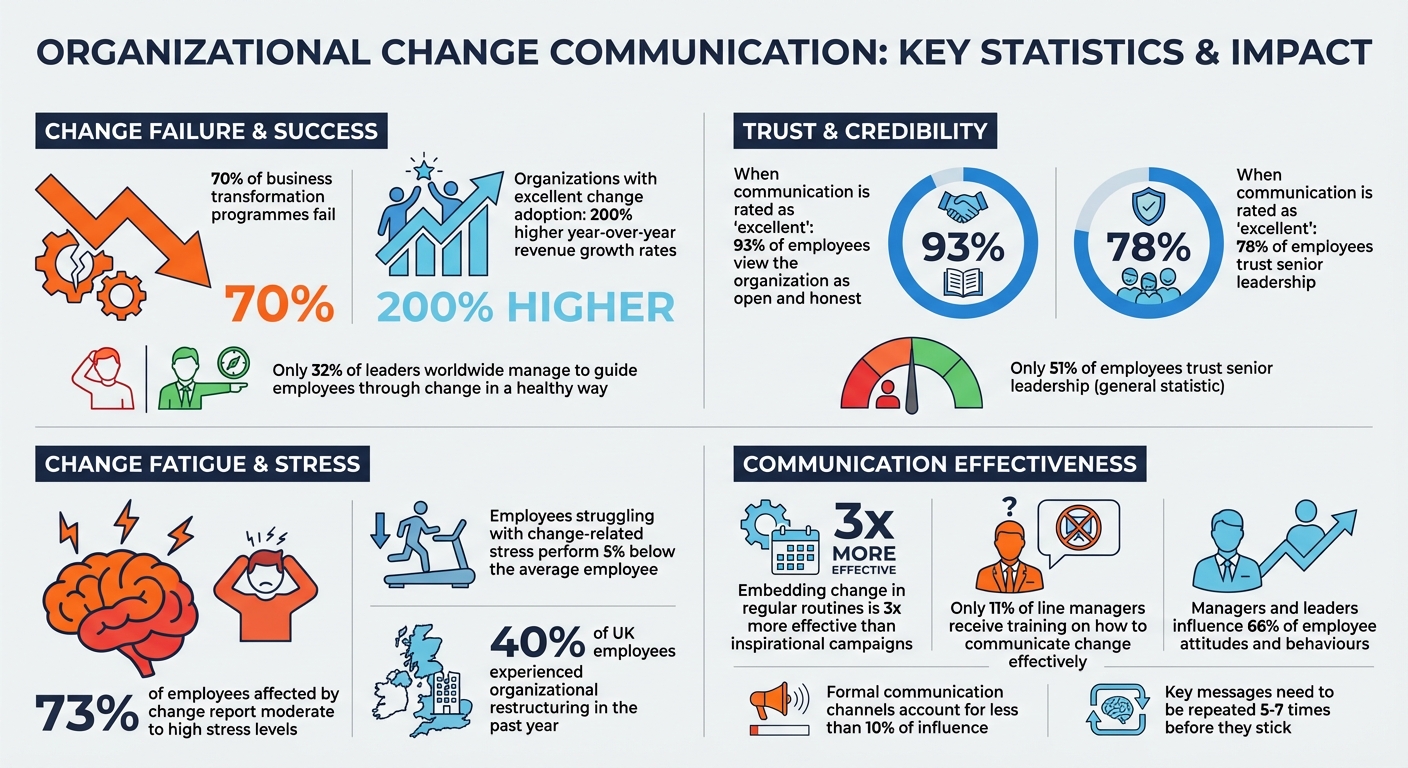
The Impact of Change Communication: Key Statistics on Trust, Performance, and Success
The campaign approach often falters due to inconsistent follow-through, a breakdown in trust, and the resulting issue of change fatigue, all of which undermine long-term transformation efforts.
Lack of Consistency and Follow-Through
A campaign-style approach tends to kick off with a flurry of activity around the announcement but quickly loses momentum. This leaves employees, who adapt at varying speeds, without the ongoing support they need. Leaders might spend months preparing for the announcement, but for employees, it's brand-new information. When communication fades after the initial push, those still processing the change are left in the dark.
Research highlights that embedding change as part of regular routines is three times more effective than relying on an inspirational campaign approach. Despite this, only 11% of line managers receive training on how to communicate change effectively. This gap leaves organisations poorly equipped to maintain meaningful conversations after the initial announcement, eroding trust and credibility in the process.
Erosion of Trust and Credibility
Trust takes a hit when leaders fail to communicate consistently or when their actions contradict their words. Campaign-style communication often feels like internal PR - slick messaging designed to "sell" a decision that's already been made. This approach can come across as damage control rather than genuine dialogue, creating a sense of detachment among employees.
"When leaders say one thing and do another - or say different things entirely - it fractures trust." - Leadership Story Bank
The statistics tell a compelling story: while 70% of business transformation programmes fail, organisations with strong internal communication during transitions see markedly different outcomes. When communication is rated as "excellent", 93% of employees view the organisation as open and honest, and 78% say they trust senior leadership. The key isn't the sheer volume of messages but the consistency and sincerity of the communication. Without this, trust erodes, and employees are left grappling with change fatigue.
The Risk of Change Fatigue
Campaign-style communication also fuels change fatigue by treating every shift, big or small, with the same level of urgency. Bombarding employees with constant "urgent" updates - whether about minor adjustments or major overhauls - leads to desensitisation and overwhelm.
The impact is clear: 73% of employees affected by change report moderate to high stress levels, and those struggling with change-related stress perform 5% below the average employee. With 40% of UK employees experiencing organisational restructuring in the past year, the cumulative effect of poorly handled communication is evident. Campaign-style approaches, with their peaks of overwhelming information followed by long silences, prevent employees from adjusting to any sense of stability.
"You don't fix change fatigue with a new slide deck. You fix it with clarity, credibility, and consistent follow-through." - Leadership Story Bank
The Case for Continuous, Flexible Communication
Instead of relying on one-off campaigns, leaders should embrace communication as an ongoing process that adapts to the evolving needs of an organisation. This approach hinges on maintaining continuous dialogue and crafting messages that evolve alongside change. By doing so, leaders can build the trust and resilience needed to navigate shifts effectively.
Continuous Communication Builds Trust
Frequent and honest updates are the foundation of trust during times of change. When leaders communicate openly from the start, they prevent the uncertainty that often leads to speculation. This openness also supports sensemaking, helping employees grasp the broader context, align with shared goals, and gradually adopt new behaviours.
The benefits of this approach are clear. Organisations that excel in change adoption report year-over-year revenue growth rates that are 200% higher than their less successful counterparts. Yet, only 32% of leaders worldwide manage to guide employees through change in a healthy way. The key difference lies in treating communication as a continuous process rather than a series of isolated updates.
Flexibility Is Key During Uncertainty
Not every change demands the same level of communication. For instance, a minor software update doesn’t require the same effort as a major organisational merger. Tailoring the tone, timing, and depth of messages prevents employees from feeling overwhelmed. Skilled leaders integrate smaller updates into existing routines, like weekly team meetings, while reserving more intensive efforts for transformational changes.
Flexibility also applies to how messages are delivered. The "backstitch" technique - revisiting the core narrative through various channels and voices - ensures the message is reinforced without becoming monotonous. For example, a senior leader might introduce the overarching "why" during a town hall, while line managers provide team-specific context in smaller meetings. Written updates can then offer detailed guidance. This layered approach ensures consistency while addressing diverse needs and questions.
Examples of Successful Continuous Communication
Research shows that embedding change communication into daily workflows significantly improves employee adoption of new initiatives. Instead of treating these updates as exceptional events, successful organisations incorporate them into the everyday rhythm of work. Frameworks like the 4 Ps - Purpose (why), Picture (what success looks like), Plan (how to achieve it), and Part (individual roles) - help structure these ongoing conversations.
These organisations also empower line managers with resources like toolkits and FAQs, recognising their critical role. Studies reveal that managers and leaders influence 66% of employee attitudes and behaviours, whereas formal communication channels account for less than 10%.
"When change communication becomes an organisational competency rather than a specialised function, organisations become more resilient and adaptive." - Jenni Field, Founder, Redefining Communications
These insights highlight five core practices that underpin effective, long-term change communication.
5 Key Practices for Long-Term Change Communication
Shifting from one-off announcements to sustained conversations requires a structured and thoughtful approach. These five practices can help leaders maintain momentum while adapting to the complexities of organisational change.
Align Communication with Change Phases
Effective communication evolves as change progresses. Align your messaging with the key phases of change - announcement, engagement, involvement, and recovery. Start by explaining the purpose and vision, then address personal impact, involve teams through local champions, and focus on embedding new behaviours to ensure lasting change.
The 4 Ps framework - Purpose, Picture, Plan, and Part - offers a straightforward way to structure your messaging at each stage. This framework encourages meaningful back-and-forth communication, rather than just one-way updates.
Create Two-Way Dialogue
One-way updates won't cut it. Employees need ways to share their thoughts, ask questions, and raise concerns. With only 51% of employees trusting senior leadership, creating a safe space for dialogue is critical. Use both formal channels (like pulse surveys and town halls) and informal ones (team huddles or internal chats).
Focus groups and engagement sessions can surface hidden concerns. Appointing change champions as local points of contact provides real-time insights into how messages are being received. And remember, key messages need to be repeated five to seven times before they stick. Repetition works best when paired with opportunities for employees to engage with the content.
Measure Progress and Adjust Messaging
Regularly checking in ensures your communication stays on track. Use diagnostic reviews and informal feedback channels - like a "Sound & Signal Review" - to see what’s resonating and where gaps remain. Monitoring internal social media can also reveal trending concerns or areas of confusion.
If feedback shows that the core message hasn’t landed, don’t hesitate to revisit earlier stages and clarify the rationale. Leaders should also pace their communications to match employees’ learning curves, as they’re often further along in their understanding of the change. This approach keeps leadership engaged and communication relevant throughout the process.
Ensure Leadership Visibility and Engagement
Leadership presence plays a crucial role in signalling the importance of change. When senior leaders stay visible - not just at the start but throughout the entire process - they demonstrate commitment. Research shows that leaders and line managers influence 66% of employee attitudes and behaviours, compared to less than 10% from formal communication channels.
Leaders don’t need to craft every message themselves but should model consistent communication, participate in town halls, and equip managers with the right tools. Consistency across leadership actions, messages, and priorities builds the credibility needed to sustain momentum. This consistency also allows for effective tailoring of messages to different groups.
Customise Messaging for Different Audiences
Different teams experience change differently. For example, a finance team implementing new software will need distinct guidance compared to a sales team adapting to new targets. Tailor your messaging to address specific concerns while keeping the overall narrative consistent. Start with WIIFM ("What’s in it for me?") before diving into technical details. Employees are more likely to engage with strategic goals once they understand how the change impacts their daily routines. This personalised approach ensures that communication resonates across diverse groups.
| Change Phase | Communication Objective | Primary Strategy |
|---|---|---|
| Announcement | Create awareness and understanding | Explain "Why" and "What" |
| Engagement | Clarify impact for buy-in | Foster two-way dialogue; address "What’s in it for me?" |
| Involvement | Maintain momentum | Involve teams directly through change champions |
| Recovery | Gain acceptance | Embed new behaviours to prevent backsliding |
Conclusion: Moving Beyond the Campaign Mindset
Key Takeaways
Change communication isn’t something you can tick off a to-do list - it’s a continuous journey. Treating it as a one-time effort risks losing both trust and the momentum needed for meaningful transformation. Instead, leaders are encouraged to embrace the Sensemaking–Alignment–Activation framework. This involves:
- Sensemaking: Clearly articulating why the change is necessary.
- Alignment: Ensuring words and actions are consistent.
- Activation: Supporting and embedding new behaviours over time.
As the Leadership Story Bank aptly states:
"You don't fix change fatigue with a new slide deck. You fix it with clarity, credibility, and consistent follow-through." – Leadership Story Bank
Precision is key here - not just saying more, but saying the right things at the right time, in the right way. Leaders need to adapt their tone and approach to match the scale of change, reinforcing their message through multiple voices and channels. This practice, often referred to as "backstitching", helps weave the message into the fabric of the organisation. Crucially, communication must be integrated into the broader change strategy, with early involvement and well-prepared local managers facilitating open, two-way conversations.
This mindset lays the groundwork for a more effective and strategic communication approach.
The Role of Leadership Story Bank in Change Communication
Leadership Story Bank offers practical tools to help leaders move beyond surface-level communications. Instead of simply narrating change, it equips leaders to shape understanding, foster alignment, and encourage new behaviours. The platform promotes a dynamic, ongoing approach to communication, essential for sustaining long-term transformation.
With resources like the Sound & Signal Review and the Rapid Action Accelerator, leaders can evaluate the effectiveness of their communication efforts and make real-time adjustments. Whether facing large-scale transformation or incremental improvements, Leadership Story Bank ensures your narrative stays relevant, credible, and connected to the day-to-day experiences of your people.
FAQs
How can leaders keep change communication effective over time?
To make communication around change effective, leaders need to approach it as an ongoing process, not just a single announcement. This involves maintaining open and continuous dialogue to ease uncertainty, strengthen trust, and keep employees actively involved throughout the transition.
Preparation is critical. Before sharing any news, clarify the purpose behind the change, the outcomes you're aiming for, and any concerns that might arise. Messages should be tailored to different groups within the organisation, matching the tone and content to the situation's scale and impact. It's also important to strike a balance - don’t overwhelm employees with excessive updates, but equally, avoid leaving them in the dark about major developments.
Focusing on consistency, relevance, and timing while ensuring communication channels remain open will help leaders sustain progress and make change truly stick within their organisations.
What are the dangers of treating change communication as a one-off campaign?
Treating change communication as a one-off effort rather than an ongoing process can create serious hurdles. When employees feel left out or poorly informed, it often leads to disengagement, resistance, or even mistrust. Sporadic updates or inconsistent messaging can quickly come across as insincere or disconnected from employees' day-to-day realities.
This kind of approach can also breed confusion and fatigue, especially if messages arrive at the wrong time or lack clarity. Employees may start to doubt the change initiative altogether, making it much harder to build trust, maintain momentum, or encourage lasting behavioural shifts. Success comes from communication that is ongoing, transparent, and flexible enough to address the organisation's changing needs.
How can organisations tackle change fatigue effectively?
To manage change fatigue effectively, organisations need to move away from treating change communication as a one-off event. Instead, it should be approached as a continuous and flexible process. The way messages are delivered should match the scale and impact of the change - smaller updates might only require brief, targeted communication, while larger shifts demand clear and open messaging to prevent employees from feeling overwhelmed or disconnected.
Tools that support ongoing dialogue are crucial for keeping communication sustainable. Regular and consistent updates build trust and engagement while minimising the risk of information overload. Leaders should also prioritise relevance and specificity in their messaging, tailoring it to address the unique concerns of different teams or individuals.
Equally important is recognising the emotional impact of change. By addressing feelings such as anxiety or resistance with empathetic, people-focused communication, organisations can foster trust, ease stress, and support employees in adapting more smoothly to change.