
Leading Through Change: What Internal Communication Can and Can’t Fix
How internal communication can reduce uncertainty, rebuild trust and equip managers during organisational change — and why it can't fix structural or resource problems.

Internal communication is a powerful tool during organisational change, but it has its limits. It can clarify uncertainty, reduce stress, and rebuild trust when used effectively. However, it cannot resolve deeper issues like resource shortages, structural problems, or misaligned values on its own. Leaders must combine clear communication with meaningful action to ensure success.
Key Points
✓ What it can do: Provide clarity, stop rumours, build trust, and equip managers with tools to guide teams.
✓ What it can’t do: Fix systemic problems, address resource gaps, or bridge the gap between promises and actions.
✓ Why it matters: Poor communication costs businesses billions and undermines trust, while effective communication improves outcomes during change.
To make communication work, leaders should focus on honesty, consistency, and empowering managers to deliver messages that resonate. But words alone aren’t enough - actions must back up the message.
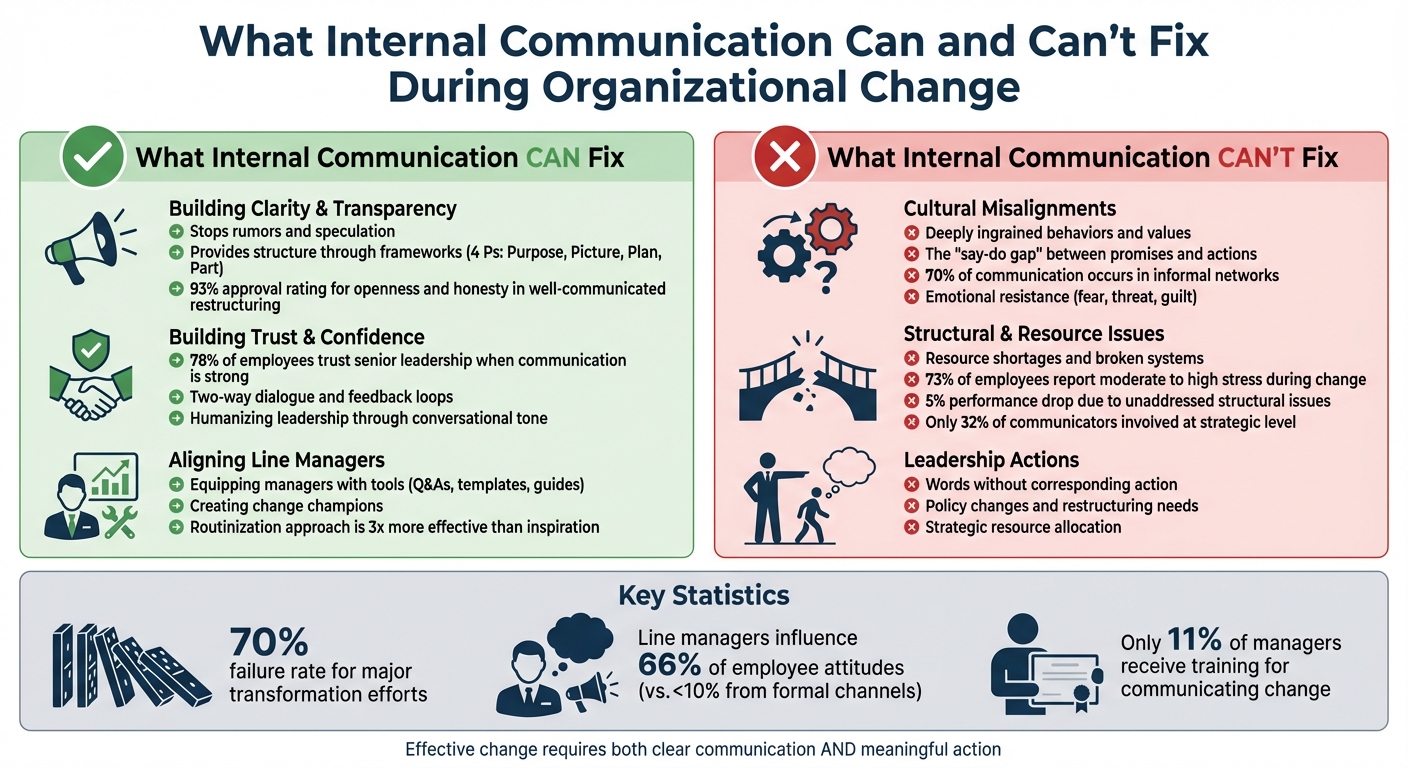
What Internal Communication Can and Cannot Fix During Organizational Change
The difference between leading change and leading through change | Ask Leah
What Internal Communication Can Fix
Internal communication may have its challenges, but it remains a powerful tool for tackling specific issues during times of organisational change. It turns confusion into clarity, helps rebuild trust, and equips managers with the skills to guide their teams through uncertain periods.
By focusing on what internal communication can tangibly address, organisations can make meaningful improvements.
Building Clarity and Transparency
Clear communication stops rumours in their tracks. When employees are left in the dark, they often fill the gaps with speculation. Regular updates, even when there's little new to share, help prevent this. Simply explaining what is known, unknown, or cannot yet be disclosed can make a big difference.
The 4 Ps framework is a practical way to structure communication and provide clarity. It covers:
- Purpose: Why the change is happening.
- Picture: What success will look like.
- Plan: How the organisation will get there.
- Part: What each individual needs to do.
This framework ensures employees understand not just the "what", but also the "why" behind decisions, aligning them with organisational goals and reducing confusion.
Transparency thrives on honesty, not perfection. Companies rated highly for internal communication during restructuring score a 93% approval for openness and honesty. This doesn’t mean having all the answers - it means being upfront about what’s undecided or commercially sensitive. Overly polished messaging or forced optimism can backfire, eroding trust faster than simply admitting uncertainty.
Tailored, localised messages that show how changes will impact specific teams make strategies feel more relevant and actionable.
Building Trust and Confidence
Trust grows through consistent, two-way communication. When internal communication is strong during restructuring, 78% of employees report trust in their senior leadership team. This trust isn’t built through one-sided updates - it requires genuine dialogue. Employees need to feel heard.
Creating feedback loops - whether through CEO drop-in sessions, regular email prompts, or internal social platforms - demonstrates that leadership values employee input. Importantly, when feedback is acted upon and reflected in future updates, credibility strengthens.
Humanising leadership bridges the gap. Employees are often frustrated by distant, impersonal messaging. They want leaders to engage in real conversations and acknowledge the emotional challenges of change. A conversational tone, free from corporate jargon, helps employees feel recognised and understood. This approach has been shown to reduce the perceived disconnect between leadership and the wider workforce.
However, trust can be quickly undone if leaders fail to align words with actions. Promises of transparency mean little if decisions are made behind closed doors or if stated values are not consistently demonstrated.
Once trust is established, the next step is to ensure that line managers are prepared to deliver these messages effectively.
Aligning Line Managers
Line managers are the bridge between strategy and execution. Yet many lack the training or resources to communicate change effectively, leaving frontline teams feeling unsupported. Internal communication can address this by equipping managers with the tools and confidence they need to guide their teams through transitions.
Managers, being closer to decision-making, often adapt to change more quickly than their teams. Providing them with early access to information, as well as practical resources like Q&As, email templates, and conversation guides, enables them to communicate with clarity and authenticity. These tools should encourage managers to be honest, even if they don’t have all the answers, as this builds more trust than pretending to know it all.
Creating "change champions" within the management team can also strengthen alignment. These individuals act as key communicators, offering local insights that help tailor messages to specific departments or teams. They also influence their peers, amplifying the organisation’s message beyond formal channels.
The move from "inspiration to routinisation" is reshaping how managers approach change. Instead of relying on grand motivational speeches, effective managers focus on integrating change into daily routines. This approach - centred on small, consistent actions - has been shown to be three times more effective in driving adoption. By building these "change reflexes", employees become more comfortable with ongoing transformation, making change feel less disruptive and more manageable.
What Internal Communication Can't Fix
Internal communication has its limits, especially when it comes to addressing entrenched organisational challenges. Relying solely on tools like emails or town halls can sometimes exacerbate employee frustration if deeper, systemic issues remain unaddressed.
Addressing Cultural Misalignments
Communication alone can't alter deeply ingrained cultural norms. Long-standing behaviours and values within an organisation aren't easily shifted by well-crafted messages. Often, poor communication is a symptom of broader systemic problems, not the root cause of cultural misalignment.
Employees interpret messages through their own experiences and perceptions. When communication conflicts with their reality, it risks being disregarded. This selective filtering explains why even the clearest messages can fall flat when they clash with established beliefs.
The "say‑do gap" further undermines trust. Employees judge actions far more than words. Additionally, informal networks - where around 70% of organisational communication actually occurs - are often viewed as more trustworthy than official channels, especially when formal messaging feels overly polished or disconnected from reality.
Resistance to change is also shaped by emotions like fear, threat, or guilt, as well as individual personality traits. These deeply rooted responses can't be overcome by messaging alone.
Cultural challenges require more than communication; they demand tangible action and systemic change.
Resolving Structural and Resource Issues
Messaging can't fix resource shortages or flawed systems. When employees face unmanageable workloads, lack essential tools, or operate within a broken structure, no amount of communication can resolve these issues.
For instance, 73% of employees undergoing change report moderate to high stress levels, which can lead to a 5% drop in performance. Addressing these issues requires tackling the structural causes, not simply increasing updates or announcements. Key indicators like project delays exceeding 30% of timelines or engagement scores dropping below 65% signal problems that go beyond communication.
Unfortunately, internal communication often isn't positioned as a strategic partner in managing change. Only 32% of communicators are involved at a strategic level in change initiatives. Without this integration, communication risks being seen as superficial, disconnected from the real work needed to drive progress.
Leadership Actions Beyond Communication
Words need to be backed by action. While communication can set the tone for change, it's the actions of leaders that determine whether progress is made. Visible, decisive leadership is essential - messaging alone won't cut it.
Employees need to see leaders aligning their actions with the vision they've communicated. This might involve allocating resources, removing obstacles, or making strategic decisions that demonstrate commitment. When leaders fail to follow through, employees don't just lose trust in the message - they lose faith in the organisation’s ability to deliver results.
In many cases, the stress employees feel stems not from a lack of information, but from a lack of meaningful action. Leaders must recognise when the solution lies in policy changes, restructuring, or addressing cultural issues, rather than sending another email or holding another meeting.
How to Improve Internal Communication Impact
While internal communication has its challenges, refining how it’s delivered can make a real difference. By adopting structured approaches and prioritising early engagement, organisations can address common gaps and boost effectiveness.
Using Frameworks to Structure Communication
A structured approach avoids confusion and provides clarity. Frameworks like William Bridges' 4 Ps offer a way to organise communication effectively, while tools such as the Kubler-Ross Change Curve help gauge emotional responses.
The Kubler-Ross Change Curve is particularly useful for understanding how employees process change. People tend to move through emotional stages - starting with denial and resistance before reaching acceptance and commitment. Aligning communication to these stages ensures employees aren’t overwhelmed or left behind. Leaders often find themselves further along this curve than their teams, so it’s crucial to match the pace of communication with where employees are emotionally.
Engaging Employees Early and Often
Change isn’t a one-off event; it’s a continuous dialogue. Engaging employees early helps make communication feel relevant and trustworthy. Involving them in conversations from the outset ensures their concerns are acknowledged, fostering credibility.
Two-way communication is key. Tools like focus groups, online platforms (e.g., Yammer), and direct feedback channels allow employees to voice concerns before they escalate. Change Champions - team members who provide on-the-ground insights - can also play an important role. However, they must be selected carefully to avoid being perceived as simply echoing management.
Line managers are especially influential in shaping employee attitudes, yet only 11% receive specific training for communicating change. Equipping them with clear toolkits and early updates ensures they can confidently deliver consistent messages to their teams.
Listening helps our communications to be relevant, credible and powerful for people. - Government Communication Service (GCS)
These strategies build a foundation for smoother transitions and help organisations avoid common pitfalls.
Avoiding Common Mistakes
The success of change initiatives often hinges on avoiding common communication errors. Research highlights that when internal communication is rated as "excellent" during restructuring, 93% of employees report a sense of openness and honesty, and 78% trust senior leadership. Yet, with a 70% failure rate for major transformation efforts, it’s clear many organisations miss the mark.
| Effective Method | Common Mistake | Impact of Mistake | What Works Instead |
|---|---|---|---|
| Two-Way Engagement | One-way broadcasting | Employees feel excluded; risk of resistance | Builds trust and uncovers valuable insights |
| Strategic Narrative | No clear vision | Creates uncertainty and hesitation | Provides a compelling sense of purpose |
| Honesty & Transparency | Overuse of corporate spin | Damages credibility and trust | Promotes trust with realistic expectations |
| Phased Communication | Rushed messaging | Resistance and regression to old habits | Allows time for change to be absorbed |
| Manager Empowerment | Keeping managers uninformed | Contradictions between leaders and managers | Ensures consistent messaging locally |
The most damaging mistake is the "say-do gap" - when leaders’ actions don’t align with their words. Employees are far more influenced by what leaders do than what they say. Using excessive corporate jargon, being invisible, or failing to acknowledge past challenges can quickly erode trust. Instead, share what you know, admit what you don’t, and commit to providing updates. Transparency, even when the answers aren’t clear, is always more effective than overly polished messaging.
Using Storytelling for Change Leadership
While internal communication sets the stage for clarity and trust, storytelling takes it a step further by fostering emotional connection and ensuring change sticks. Storytelling is more than a communication tactic - it’s a way to anchor change effectively. Stories add context, meaning, and purpose, filling the gaps where raw data falls short.
The difference between presenting information and crafting a narrative is critical. Information tells people what is happening, but a narrative explains why it matters and how it impacts them. Without a clear story, employees might fill in the blanks with uncertainty, fear, or resistance. Research highlights that around 70% of business transformation efforts fail, often because the "why" behind the change isn’t communicated effectively across the organisation. Understanding this distinction is the first step in crafting stories that truly resonate.
Crafting Core Stories for Change
The best change stories follow a clear framework. Using the 4 Ps - Purpose, Picture, Plan, and Part - helps clarify why the change is necessary and how employees can contribute. This structure allows people to make sense of the change, rally around a shared vision, and adopt the behaviours needed to move forward.
Change is deeply personal, so the stories must reflect the emotional journey involved. Employees may feel anxious, uncertain, or even optimistic. Leaders should acknowledge these emotions rather than dismiss them. Recognise the challenges while showcasing how the change addresses real problems.
People don't change because they're told to. They change when they understand why, believe it matters, and know what it means for them. - Leadership Story Bank
Empowering Managers with Narratives
Line managers are often the most trusted voices during periods of change, yet only 11% receive training on how to communicate it effectively. This lack of preparation can leave managers unable to answer team-specific questions or tailor corporate messages to their local context. Building on earlier discussions about supporting line managers, Leadership Story Bank helps managers craft narratives that align with the organisation’s vision while remaining authentic to their teams.
Getting managers involved early - before messages are broadly shared - ensures consistency and builds their confidence. They need more than just a slide deck; they require tools and resources to adapt the story in a way that feels relevant to their teams.
When managers can tell the story in their own words, they shift from being reluctant messengers to credible advocates. This approach transforms communication from a one-way broadcast into a meaningful dialogue that feels personal and relatable.
Balancing Honesty and Professionalism
Being authentic doesn’t mean sharing every detail - it means being honest about what you know, what you don’t, and what’s still uncertain. Leaders who rely too heavily on corporate jargon or overly polished messaging risk losing credibility. Employees are quick to spot insincerity, and this can erode trust.
The solution? Communicate early and often. Share what’s known, acknowledge areas of uncertainty, and commit to regular updates as decisions unfold. This transparency builds trust and prevents silence from fuelling speculation or fear. For instance, in organisations where internal communication during restructuring is rated as "excellent", 93% of employees perceive leadership as open and honest.
Consistency between words and actions is non-negotiable. If leaders preach collaboration but make decisions behind closed doors, the narrative unravels. Trust is built when words align with actions, creating the foundation needed to guide teams through change successfully.
Conclusion: Balancing Communication and Action
Internal communication plays a crucial role during times of change, but it must go hand in hand with decisive action. Empty promises lead to scepticism, and unexplained decisions cause confusion. Leaders must ensure their actions align with the vision and values they communicate, as these principles are fundamental to effective change leadership.
Key Takeaways for Leaders
Good communication fosters clarity, aligns teams, and builds trust. However, it cannot resolve deeper issues such as structural inefficiencies, lack of resources, or misaligned values on its own. As discussed earlier, clarity, trust, and empowering managers are essential for successful change. True organisational integrity lies in ensuring that the vision and values promoted by the organisation are mirrored in everyday actions. When leaders follow through on their promises and align their actions with their words, trust develops naturally.
Interestingly, research shows that line managers influence 66% of employee attitudes and behaviours, while formal communication channels account for less than 10%. This highlights the importance of equipping managers with the tools and narratives they need to communicate effectively. Additionally, making change a routine - through small, consistent actions - is three times more effective than relying on grand gestures or inspirational speeches. Building these “change reflexes” ensures a steady and practical approach to transformation.
Next Steps for Effective Change Leadership
To create lasting change, start by auditing whether your organisation’s actions truly reflect its stated goals and values. Being transparent about what you know, what you don’t, and what remains uncertain fosters far more trust than overly polished corporate messaging.
Line managers play a pivotal role, so empower them with the information and confidence they need to communicate effectively. Balance active listening with clear messaging by establishing channels for employee feedback and engagement - two-way communication is a critical leadership tool. Resources like the Leadership Story Bank can offer frameworks to help leaders craft impactful narratives that resonate with employees while maintaining consistency between messaging and actions. Evaluate your current strategy, identify where it falls short, and refine it to ensure that communication and action work together to drive meaningful and lasting change.
FAQs
How can leaders ensure their communication matches their actions during organisational change?
Leaders can align their communication with their actions during organisational change by focusing on being transparent, consistent, and empathetic. While clear and honest communication lays the foundation for trust, it’s the actions that follow those words that truly reinforce credibility.
Here are some practical ways to achieve this:
- ✓ Regular updates: Share timely progress reports and openly address employee concerns.
- ✓ Active listening: Take feedback seriously and respond with thoughtful, meaningful actions.
- ✓ Lead by example: Demonstrate the behaviours and values you expect from your team, and ensure decisions align with the organisation’s stated priorities.
When leaders’ words and actions are in sync, it shows integrity and fosters trust - particularly in uncertain times. Employees are far more likely to stay motivated and engaged when they witness genuine concern, accountability, and a shared commitment to achieving common goals.
What are the limits of internal communication in solving structural issues?
Internal communication plays a key role during times of organisational change, but it can only go so far when deeper, more ingrained challenges are at play. Issues like leadership misalignment, emotional resistance, or deeply rooted cultural barriers often extend beyond what improved messaging alone can fix. These challenges typically call for broader organisational reforms or shifts in workplace culture.
Moreover, systemic obstacles - such as rigid hierarchies or conflicting priorities - can undermine even the most carefully crafted communication efforts. While effective communication can foster alignment and trust within teams, it cannot replace the structural adjustments needed to tackle the underlying causes of these problems.
Put simply, internal communication is an important tool, but it works best when paired with decisive leadership and meaningful systemic change to address organisational hurdles effectively.
Why is it essential for line managers to be involved in internal communication during organisational change?
Line managers are essential in internal communication during organisational change, serving as the crucial link between leadership and employees. Often the first point of contact for staff, they ensure messages are conveyed clearly, accurately, and with sensitivity. This approach helps address concerns specific to their teams, fosters trust, and eases uncertainties.
Their role extends to supporting employees as they navigate emotional reactions to change, while reinforcing the organisation’s broader vision and objectives. By taking an active role in communication, line managers shape how messages are perceived, boosting engagement, morale, and the likelihood of successful change initiatives.