
Why Leadership Stories Matter in Change
Authentic leadership stories reduce resistance, build trust and make organisational change clearer and more memorable.

Leadership stories are the secret weapon for driving successful organisational change. While leaders often rely on data-heavy presentations and emails, these methods fail to address a critical human question: “What does this mean for me?” Stories, however, simplify complex changes, create emotional connections, and inspire action. Here’s why they work:
- 70% of change initiatives fail due to unclear communication.
- Stories are 22x more memorable than facts alone.
- Only 13% of employees feel their leaders communicate effectively.
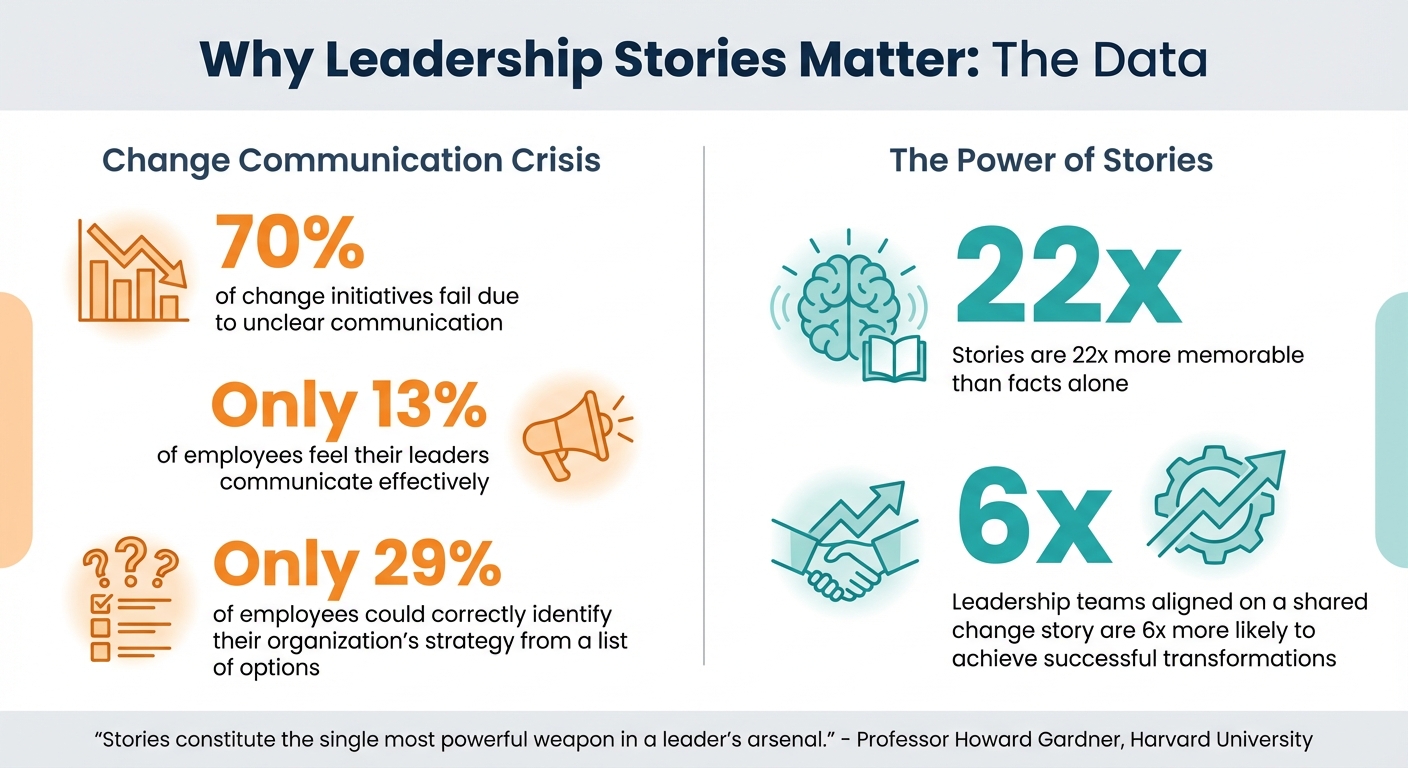
Leadership Storytelling Statistics: Why Stories Drive Successful Change
Communication Barriers During Organisational Change
Why People Resist Change
Resistance to change is a deeply ingrained human reaction, tied to both biology and psychology. When organisations announce shifts - be it restructuring, introducing new systems, or implementing strategic changes - employees often react with worry or frustration. This happens because change disrupts stability, which our brains instinctively interpret as a potential threat to our well-being. Without clear and consistent communication, uncertainty takes root, leading to speculation and fear.
Three key reasons underpin this resistance. Firstly, when leaders fail to clearly explain the reasons behind a change, employees are left grappling with fear of the unknown. Secondly, change often diminishes employees' sense of control over their roles and daily responsibilities, which can feel disempowering. Lastly, a lack of clarity about the rationale behind decisions and their personal impact leaves employees asking, "What’s in it for me?" Without answers, they may fill the gaps with negative assumptions, fostering further resistance.
The impact of unclear communication is profound. When employees don’t understand the purpose or benefit of a change, it’s easy for disengagement to set in. This "why bother?" mindset can sap energy from even the most well-designed initiatives.
Resistance only grows when leadership fails to deliver consistent messaging.
The Dangers of Inconsistent Messaging
Inconsistent communication can be particularly damaging, as it erodes trust. When leaders’ actions don’t align with their words, or when different executives share conflicting information, scepticism and cynicism quickly take hold. Employees are highly attuned to these inconsistencies, and once trust is broken, it’s difficult to repair.
The fallout from inconsistent messaging can be widespread. In a study of 20 major corporations with clearly defined strategies, only 29% of employees could correctly identify their organisation’s strategy from a list of options. This disconnect between leadership's vision and employees' understanding hinders the execution of strategic plans. Overwhelming employees with too much information - or failing to provide a clear, unified narrative - leads to confusion, with the core message often getting lost. Silence can be equally harmful; when leaders delay or withhold information, employees interpret it as a lack of transparency, which only heightens anxiety and mistrust.
How Leadership Stories Drive Change
Creating Emotional Connection
When leaders share stories during times of organisational change, they do more than just pass along information - they tap into the power of empathy. Stories with a clear beginning, middle, and end trigger the release of oxytocin, a chemical in the brain linked to trust and connection. This natural reaction makes people more receptive and cooperative than they might be when faced with dry statistics or formal presentations.
Stories also have a way of sticking with us. Unlike facts, which are often forgotten, narratives engage multiple parts of the brain, creating memories that last.
What’s more, when leaders share personal challenges or past missteps, it doesn’t weaken their authority - it strengthens it. This openness breaks down the "us versus them" dynamic, making leaders seem more approachable and human. Employees are more likely to trust and follow leaders who they see as relatable, especially when those leaders have faced and overcome similar struggles. This sense of connection fosters a feeling of psychological safety, which becomes crucial during periods of change.
Shifting Perspectives Through Stories
Once that emotional connection is established, stories can help shift mindsets in ways that pure data often can’t. While facts and figures can sometimes provoke scepticism, a well-told story engages both the heart and the imagination. This makes change feel less intimidating, especially for employees who may feel unsettled or even threatened by organisational shifts.
Stories play a critical role in easing these fears by helping people envision a positive future. By incorporating relatable characters and using a "hero’s journey" structure, leaders can turn abstract goals into vivid, human-centred experiences. Crucially, the audience - not the leader - becomes the hero of the story. This shift allows employees to see themselves thriving in the new reality and helps answer the question: "What’s in it for me?" When the benefits of change feel personal and achievable, fear gives way to confidence, and resistance melts into a willingness to move forward.
How to Craft Leadership Stories for Change
Core Elements of a Leadership Story
A strong leadership story follows a three-act structure: the first act sets the stage and introduces the challenge, the second act raises the stakes, and the third act delivers a solution infused with hope. This classic framework keeps the audience engaged, guiding them through the journey from problem to resolution.
Genuine stories resonate more than perfectly polished ones. Consider John Chambers, the former CEO of Cisco, who openly discussed his struggles with dyslexia. Rather than diminishing his authority, this honesty made him more relatable and credible. Sharing personal challenges can bridge the gap between leaders and employees, building trust and fostering connection. To make the story truly impactful, frame ordinary employees as the heroes, ensuring the narrative speaks directly to their concerns and aspirations.
A compelling leadership story also needs a memorable core message - a concise, repeatable statement that employees can easily share with others. Effective stories highlight the risks of inaction while also illustrating how new initiatives connect to employees' daily responsibilities.
These components form the backbone of a story that resonates both personally and across the organisation.
Steps to Build Your Leadership Narrative
With these elements in mind, here’s how to create a leadership story that inspires and motivates.
Start by reflecting on your own experiences. Identify moments or individuals that shaped your perspective or catalysed change in your thinking. Personal stories like these provide the raw material for a meaningful narrative.
Structure your story with an "I" to "we" transition: begin by sharing a personal challenge, then shift to a collective vision. Barack Obama’s "Fired up, ready to go" speech is a masterclass in this approach, using a small personal anecdote to inspire a broader, shared purpose.
Tailor your story for different audiences. A one-size-fits-all narrative won’t work - different teams have unique motivations and concerns. For example, what resonates with the finance department might not connect with operations staff. Grab attention in the first 30 seconds with a powerful emotion or a thought-provoking question. Then, refine your delivery through practice to ensure your message is clear and impactful. Dr Jennifer Aaker from Stanford Graduate School of Business explains:
"Stories are remembered up to 22 times more than facts alone"
- but only when they’re told effectively. Dedicate time to polishing your narrative so it answers key questions and leaves a lasting impression.
Using Storytelling in Daily Leadership
Where to Use Stories in Leadership
Storytelling isn’t just for grand announcements or annual speeches. The best leaders bring stories into their everyday interactions, embedding them into the organisation’s rhythm rather than saving them for special moments.
In one-to-one conversations, personal stories can build trust. Sharing a moment of vulnerability - like a challenge you’ve faced or a mistake you’ve learned from - can actually enhance your credibility and connection with others. Use Origin Stories during team introductions to communicate your values and purpose. For larger gatherings, Quest Stories can inspire ambition or provide reassurance during times of change, such as major business shifts, while Overcoming-the-Monster narratives are perfect for demonstrating resilience and problem-solving during stakeholder presentations.
Stories don’t need to be confined to formal events. Incorporate them into everyday channels like team meetings, newsletters, emails, or even the company intranet. Highlight small wins that align with organisational values, showing the behaviours you want to encourage. When sharing success stories, don’t gloss over the struggles - include the doubts, obstacles, and pivotal moments to make the story relatable and engaging.
To keep your storytelling consistent and effective, consider creating a Leadership Story Bank - a resource you can draw from regularly.
Building a Leadership Story Bank
A Leadership Story Bank is a personalised collection of meaningful stories, ready to use whenever the situation calls for it. Start by reflecting on your own experiences: think about key events, influential people, or moments of failure that taught you important lessons or changed your perspective.
Organise your stories by their purpose to make them easy to find. For example, you could group them into categories like "Trust stories" (to show your human side), "Teaching stories" (to simplify complex ideas), or "Action stories" (to motivate change). You might also include narratives like Origin, Quest, Overcoming-the-Monster, and Rebirth to suit different situations.
Add testimonials from employees who’ve successfully navigated recent challenges - these can lend extra weight and credibility to your messages. Practise delivering your stories so they feel natural and answer the audience’s unspoken question: “What’s in it for me?”. Above all, focus on being genuine. A well-told but inauthentic story won’t resonate - people can sense when something doesn’t feel real.
Leading effective change through storytelling | Ilze Lansdell-Zandvoort | TEDxHult Boston

Conclusion
Change is never easy, but clear communication makes it manageable. Leadership stories have the power to break through resistance, simplify complex ideas, and create emotional connections where plain facts often fall short. When you share a thoughtful narrative, you’re not just outlining a new path - you’re inviting others to see themselves as part of the journey. This approach can turn doubt into cooperation, confusion into understanding, and hesitation into genuine support.
The numbers speak volumes: leadership teams that align on a shared change story and communicate it consistently are six times more likely to achieve successful transformations. Yet, only 13% of employees strongly believe their organisation’s leadership communicates effectively. There’s a significant gap between what leaders intend to convey and what employees actually hear. Storytelling is the bridge that closes this divide.
Professor Howard Gardner of Harvard University famously said:
"Stories constitute the single most powerful weapon in a leader's arsenal."
But the key lies in authenticity. Only genuine, personal narratives can inspire real commitment.
Once you’ve used clear and compelling stories to overcome resistance, take a moment to reflect on your own journey. What experiences have shaped your outlook? What missteps taught you the most valuable lessons? Start building your own Leadership Story Bank - don’t reserve these stories for big announcements. Share them regularly. Celebrate your team, acknowledge the past, and don’t be afraid to show vulnerability. When you do, people won’t just understand the change - they’ll embrace it.
Your story as a leader has the power to turn challenges into opportunities. The question is: are you ready to share it?
FAQs
How do leadership stories enhance employee engagement during organisational change?
Leadership stories have the unique ability to build emotional connections, turning complex change initiatives into relatable and motivating narratives. When leaders share clear and genuine stories, they help employees grasp the purpose behind the change, creating a sense of inclusion and encouraging active involvement. Stories stick with us far longer than facts because they engage us on a personal level, leaving a lasting impression.
By blending the organisation’s past successes, the reasons for change, and an optimistic vision for the future, leaders can foster trust and inspire commitment. This approach makes employees feel valued, encourages them to share ideas, and transforms them into enthusiastic supporters of the transformation. Tools like the Leadership Story Bank assist leaders in shaping these impactful narratives, enabling them to communicate with confidence and inspire their teams, driving meaningful engagement throughout the change process.
What makes a leadership story effective?
An engaging leadership story weaves together a few essential elements to captivate and inspire. It starts with a clear structure: a strong opening to set the stage, a middle that introduces obstacles or challenges, and a conclusion that ties everything together while reinforcing the leader’s message. This approach ensures the story flows logically and holds the audience’s attention.
Every story needs a clear purpose - whether it’s to highlight a core value, spark a shift in mindset, or drive people towards action. Relatability is equally important. Stories that include genuine emotions, real-life characters, and personal stakes create connections and build trust with the audience. To leave a lasting impression, a great story wraps up with a call to action, prompting the audience to take steps that align with the leader’s vision.
When leaders master these storytelling techniques, they can go beyond simply sharing information - they inspire action and foster change. The Leadership Story Bank is a resource designed to help professionals sharpen these skills, enabling them to communicate with clarity, confidence, and purpose.
Why is consistent messaging crucial during organisational change?
Consistent messaging plays a key role in shaping a clear and unified narrative, especially during periods of change. It minimises the risk of misunderstandings or the spread of rumours, strengthens trust among employees, and ensures everyone remains aligned with the organisation's objectives.
When communication is steady and reliable, it inspires teams, providing them with the confidence to adapt to changes and actively support the transition. It also promotes openness, which is vital for keeping morale high and maintaining engagement throughout the journey.