
How Leaders Communicate Calm in Uncertainty
How leaders steady teams during uncertainty by using mission-led messaging, honest frequent updates, empathetic tone and calm body language.

When uncertainty strikes, how you communicate as a leader can make or break your team’s ability to navigate challenges. Employees don’t just need answers - they need reassurance that someone is in control. The key lies in balancing honesty, empathy, and clarity while projecting a calm, composed presence.
Here’s how to approach it:
✓ Anchor your team with purpose: Reaffirm your organisation’s mission and values to provide direction. Clear priorities reduce panic and help employees focus on what matters.
✓ Be honest and transparent: Share what you know, acknowledge what you don’t, and outline next steps. Silence or sugar-coating erodes trust.
✓ Project calm through tone and body language: Your emotional state influences others. Maintain steady eye contact, open postures, and a composed tone to reassure your team.
✓ Communicate frequently and clearly: Regular updates stop rumours and build trust. Use simple, actionable language and repeat key messages across multiple channels.
✓ Show empathy: Recognise stress and validate emotions. Encourage open dialogue and lead by example in prioritising well-being.
Leaders who prioritise clear, consistent, and empathetic communication foster trust and stability, even in the most challenging times.
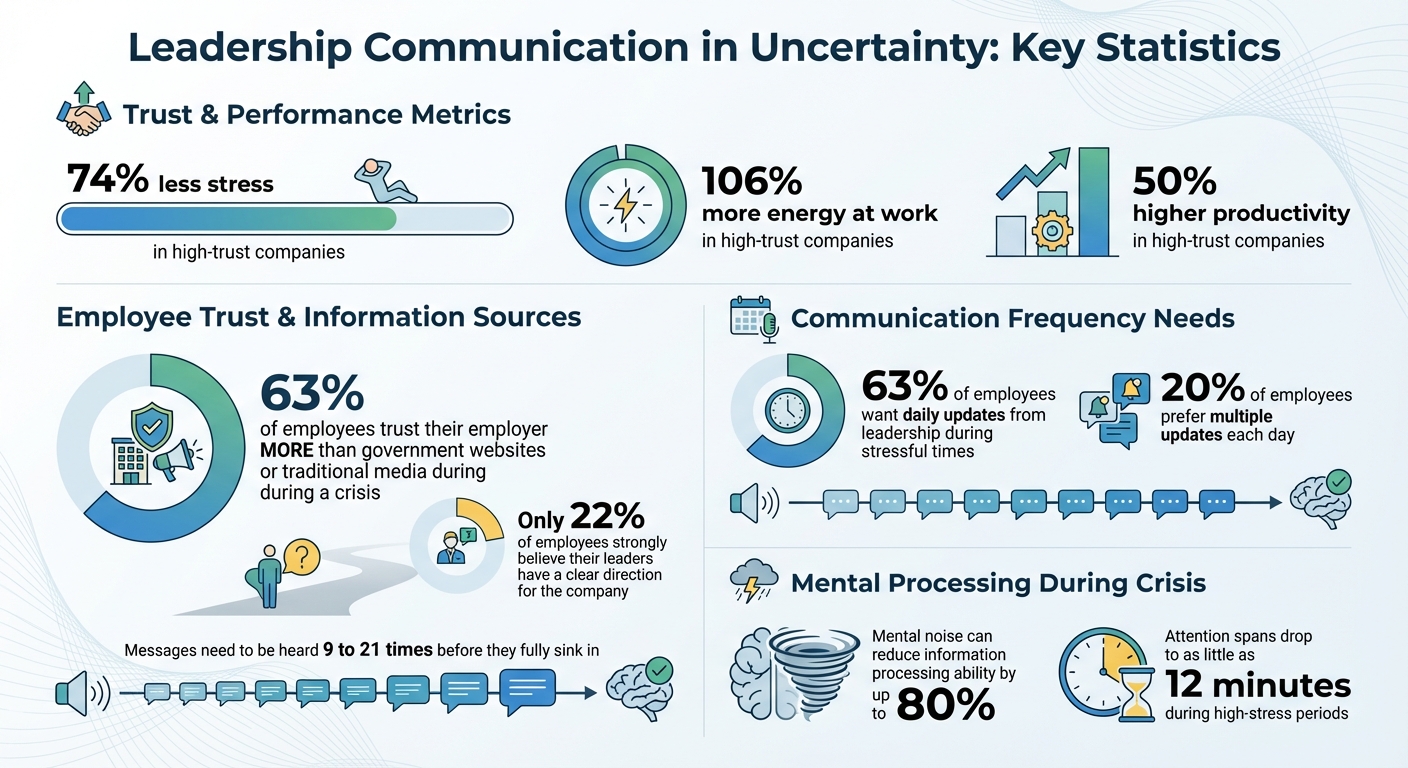
The Impact of Trust and Communication Frequency on Leadership During Uncertainty
Donald Miller On How To Communicate In Times of Crisis
Using Mission and Vision to Provide Direction
When times are uncertain, your mission becomes the anchor that steadies your team. A clear purpose and unwavering values are the backbone of calm and effective leadership during crises. Research highlights a concerning reality: only 22% of employees strongly believe their leaders have a clear direction for the company. Without a defined purpose, employees often create their own interpretations, which can lead to rumours and fear.
Reaffirming your organisation's mission helps employees see how their individual roles contribute to a broader goal. This sense of purpose fosters psychological resilience, reducing panic. When people understand how their work fits into a meaningful bigger picture, they’re better equipped to navigate uncertainty and stay focused amidst external chaos. A clear mission provides the stability needed to address immediate challenges effectively.
Emphasising Purpose During Change
Leaders who link short-term challenges to their organisation's long-term mission help their teams find meaning in adversity. A great example comes from March 2020, when Best Buy, under CEO Corie Barry, set a dual focus during the pandemic: prioritising employee well-being while continuing to serve customers who depended on technology for remote work. They ensured employees could stay home if unwell, offering full pay, while swiftly introducing contactless curbside service to maintain their commitment to customer service. By aligning operational decisions with their mission, they clarified priorities and provided direction.
Similarly, following the September 2001 attacks, Dell Technologies took proactive steps to support affected customers. Their teams worked tirelessly, using purchase records to help clients quickly replace lost equipment. This approach tied employees’ daily tasks to customer recovery efforts, giving their work a sense of purpose during a national crisis. Framing challenges as part of a larger mission, rather than isolated problems, helps teams stay motivated and focused.
Linking Decisions to Core Values
In addition to mission, aligning decisions with core values is critical for building trust during uncertain times. Core values should guide even the toughest decisions. When announcing plans, explicitly showing how they reflect your organisation's values fosters trust and transparency. Consistency is key - if your company values "people first", for instance, employee safety must take precedence over office attendance during periods of social unrest. A disconnect between stated values and actions can quickly erode credibility.
James Bevan, CEO of the Environment Agency, demonstrated this during the uncertainty of a potential "No Deal" Brexit in early 2019. Recognising that "certainty of outcome" was unattainable, he provided "certainty of process" instead. By focusing on immediate, clear tasks - like incident handling and risk assessment - he kept the organisation aligned with its core mission of protecting the public and the environment. This approach avoided paralysis in a volatile political climate. When priorities compete or data conflicts, using your organisation's core values as a compass helps identify where resources are most urgently needed.
"In the face of uncertainty, weak leaders are guided primarily by concerns over the 'optics' of their decisions; strong leaders are guided by a clear view of the sacrifices required to preserve strategic direction."
The takeaway is simple: communicating decisions rooted in your values reduces anxiety and strengthens performance when your team needs it the most.
Projecting Calm Through Emotional and Nonverbal Signals
How you deliver a message can significantly impact how it's received. In challenging times, your tone of voice, facial expressions, and body language can either reassure your team or heighten their concerns. Studies reveal that humans are naturally attuned to emotional cues - if your tone communicates impatience, fear, or frustration, it can erode your team's sense of security. This phenomenon, called emotional contagion, means your emotional state has a ripple effect throughout your organisation, whether intentional or not. This makes it essential to master both verbal and nonverbal communication to consistently project calm.
Leaders who maintain a composed tone help their teams approach problems with creativity and avoid stress-induced reactions like fight, flight, or freeze. Research highlights that tone, pitch, and pace not only shape how leadership is perceived but also influence team performance directly. An empathetic tone becomes especially vital in cutting through the mental noise that stress creates.
Striking the right tone involves blending hope with realism, ensuring it aligns with your organisation's goals.
Balancing Hope with Honesty
Projecting calm doesn’t mean glossing over reality. Leaders who balance optimism with honesty are far more credible than those who rely on empty reassurances or overconfidence. A compelling example comes from March 2020, when Netherlands Prime Minister Mark Rutte addressed the nation about COVID-19. He avoided oversimplifications, stating:
"My message to you this evening is not an easy one to hear. The reality is that coronavirus is with us and will remain amongst us for the time being."
This candid yet composed approach earned public trust by acknowledging hard truths while maintaining a steady delivery.
Similarly, in April 2020, New York Governor Andrew Cuomo adopted a compassionate but factual tone during the peak of the pandemic. He told residents:
"I wish I could promise New Yorkers this will be over soon. I can't. Here's what I can promise. I will continue to give you the facts and I will make decisions based on science and data."
By pairing honesty with data-driven assurance, Cuomo helped unify a diverse population behind challenging measures like stay-at-home orders. The takeaway? Acknowledge uncertainties, but deliver your message with calm and composure to prevent fear from spreading.
Using Body Language to Build Reassurance
Your physical presence can reinforce the calm you project through your words. Effective leaders use body language - such as posture, gestures, and facial expressions - to communicate stability. Open postures, like uncrossed arms or legs, make you appear more approachable and less defensive. Steady eye contact, controlled gestures, and a warm tone foster trust and connection.
A remarkable example is Captain Chesley Sullenberger, who, in January 2009, safely landed a US Airways plane on the Hudson River after a bird strike disabled both engines. By maintaining a calm tone while coordinating with air traffic control and his crew, he avoided panic and saved all 155 passengers on board. His composed demeanour - both in voice and body language - was instrumental in navigating a life-or-death situation.
To maintain this level of composure, it’s helpful to practise what researchers call "integrative awareness." This involves recognising your own signs of stress, like shallow breathing or irritation, and pausing to engage your rational mind before responding. One practical method is the "parking lot" technique - mentally setting aside distractions to address later, ensuring they don’t seep into your tone or body language during critical conversations. By consciously managing your internal signals, you can ensure your nonverbal communication supports, rather than undermines, the calm you aim to project.
Delivering Clear, Consistent, and Timely Messages
In times of uncertainty, silence can fuel anxiety and lead to the spread of rumours. While leaders might hold off on communicating until they have all the facts, this hesitation can damage trust far more than sharing an incomplete update ever would. Research highlights that during crises, many employees feel a lack of clear direction, which only heightens the sense of uncertainty. This is compounded by what experts call "mental noise", which can reduce a person's ability to process information by as much as 80%. The takeaway? Sharing updates early and being transparent is absolutely essential.
The key isn’t waiting for complete clarity - it’s about speaking up early and often, even when all the answers aren’t there. Be upfront about what’s known, what’s uncertain, and what steps are being taken to fill in the blanks. This approach not only builds trust and develops a shared understanding of the situation, stopping speculation in its tracks. In fact, 63% of employees trust updates from their employer more than information from government websites or traditional media during a crisis.
The Power of Frequency
Regular communication is more important than you might think. During stressful times, 63% of employees want daily updates from leadership, and 20% would prefer multiple updates each day. Repetition is also critical - research suggests that people may need to hear a message 9 to 21 times for it to truly sink in. This is especially vital when attention spans drop to as little as 12 minutes.
The 3 Rs: Review, Repeat, Reinforce
To make sure your message sticks, a structured approach like the "3 Rs" can be invaluable. Start by reviewing information with your team to confirm they’ve received it. Then, repeat the message across various platforms to ensure it resonates. Finally, reinforce the message with added context or guidance to make it memorable. This isn’t overkill - it’s smart communication strategy.
Make your messages memorable by using techniques like mantras, rhymes, or alliteration. Keep the language simple and actionable. Focus on what people should do rather than what they shouldn’t - positive framing is far more effective in building trust during tense situations. As the situation develops, adapt your messaging: start with "instructing information" (immediate rules and safety protocols), move to "adjusting information" (helping people adapt to changes), and eventually shift to "internalising information" (helping people make sense of the experience).
Choosing the Right Communication Channels
The way you deliver your message matters just as much as the message itself. Video platforms are excellent for team updates, as they allow you to convey nonverbal cues like facial expressions and body language, which can add warmth and clarity. For big-picture updates about business continuity, the CEO should lead. On the other hand, technical or health-specific updates are often best delivered by subject matter experts or direct managers.
Use a variety of channels - town halls, emails, internal social platforms - and empower direct managers to share role-specific information. Incorporate opportunities for dialogue, like unstructured time in meetings or quick pulse surveys, to gather feedback and encourage open communication. The ultimate goal is consistency, ensuring everyone hears the same core message, no matter how it’s delivered.
Building Trust Through Honesty and Empathy
Honest and empathetic communication is the backbone of team resilience, especially during challenging times. Trust isn’t about having all the answers - it's about being upfront about what you don’t know. When leaders openly admit uncertainty, they’re not showing weakness but rather respecting their team’s intelligence. This honesty builds lasting credibility. Research supports this: employees in high-trust companies report 74% less stress, 106% more energy at work, and 50% higher productivity compared to those in low-trust environments. The key is to communicate with transparency and confidence.
Once trust is established, leaders can guide their teams effectively, even when the path forward isn’t entirely clear.
Acknowledging Uncertainty While Offering Next Steps
Acknowledging uncertainty while maintaining a sense of direction strengthens trust. The best leaders balance realism about the challenges with optimism about the organisation’s ability to overcome them.
Take the example of Dutch Prime Minister Mark Rutte, who addressed his nation in March 2020 during the early days of the COVID-19 pandemic. He was upfront about the enduring nature of the virus but paired this honesty with a call for unity, saying, "Together we will get through this difficult period. Take care of each other. I'm counting on you." His message struck a balance between acknowledging the storm and pointing towards the way forward, earning widespread respect.
Similarly, in April 2020, Governor Andrew Cuomo of New York took a transparent approach as the state grappled with soaring COVID-19 cases. He told New Yorkers:
I wish I could promise New Yorkers this will be over soon. I can't. Here's what I can promise. I will continue to give you the facts and I will make decisions based on science and data.
This mix of honesty and a commitment to evidence-based decisions helped bolster public trust and support for tough measures like stay-at-home orders.
The lesson here is clear: separate what you know from what remains uncertain. Avoid speculation or downplaying risks, as these can erode credibility when reality unfolds differently. Instead, focus on explaining the steps being taken to address unknowns. This approach not only builds trust but also allows leaders to lean on subject-matter experts, reinforcing that decisions are rooted in facts rather than personal assumptions.
This foundation of transparency paves the way for empathetic communication.
Showing Empathy in Communication
Empathy is about recognising and validating the emotional reality of your team. By acknowledging the stress and anxiety that uncertainty brings, leaders create an environment where these feelings are seen as natural, not as weaknesses.
Start by being self-aware - understand both the external situation and your internal reactions. This awareness helps you avoid reactive behaviours and respond thoughtfully. Sharing your own challenges, when appropriate, fosters a sense of connection and reminds your team that they’re not facing difficulties alone.
Encourage open dialogue. Dedicate the first few minutes of meetings to unstructured conversations, allowing team members to share their thoughts freely. Quick pulse surveys can also help gauge how people are feeling and ensure their voices are heard. During a crisis, 63% of employees view their employer as the most credible source of information, even more so than government websites or traditional media. This level of trust is a responsibility, and it requires listening as much as speaking.
Lastly, lead by example when it comes to self-care. When you prioritise your own well-being - whether through proper sleep, regular breaks, or exercise - you send a powerful message to your team that their health matters too. Slack CEO Stewart Butterfield exemplified this during the pandemic, telling his team:
Take care of yourselves, take care of your families, be a good partner.
This simple yet meaningful statement reinforced the idea that life outside of work matters, demonstrating empathy in action.
Conclusion
Leading through uncertainty isn’t about having all the answers - it’s about how you present yourself. Studies highlight that leaders who balance calm composure with transparent communication foster environments where teams can stay focused and perform, even amidst external chaos. By grounding your messages in your organisation’s mission, acknowledging gaps in knowledge, and speaking with genuine empathy, you build trust - an essential foundation for navigating turbulent times. These habits pave the way for actionable, meaningful steps.
Mastering these fundamentals takes practice. Anchor your communication in core values so your team understands the reasoning behind tough decisions. Pay attention to your tone and body language, as over half of communication is nonverbal. Maintain a consistent rhythm for updates; research shows that people need to hear key messages 9 to 21 times before they fully sink in. Be honest about what’s uncertain, but always provide clear next steps - especially since 63% of employees trust their employer more than the government or media during a crisis.
The ability to instil calm rather than fuel anxiety often hinges on self-awareness. Recognise your own stress signals and take a moment to regulate your emotions before addressing your team. These are not innate skills but ones that can be developed with time and effort. Building this self-awareness transforms these practices into everyday habits.
If you’re looking to sharpen your communication skills under pressure, tools like Leadership Story Bank can help you refine your business storytelling techniques and self-awareness needed to lead with clarity and authenticity. In a world where uncertainty is constant, the ability to connect meaningfully with others isn’t just a skill - it’s a necessity.
Uncertainty is inevitable, but how you communicate through it defines your leadership. With research-backed strategies, you can bring calm, honesty, and empathy to even the most challenging situations.
FAQs
How can leaders balance honesty with reassurance during uncertain times?
Leaders can strike a balance between honesty and reassurance by acknowledging uncertainties while offering a clear, optimistic direction. For instance, openly admitting, "We don’t have all the answers yet", paired with a calm and confident tone, helps teams feel both informed and supported. It’s about framing the situation constructively - explain the current reality, share what’s being done to tackle challenges, and clarify how employees can play a role in moving forward.
Empathy plays a crucial role in this approach. By recognising and validating team concerns, leaders build trust. At the same time, providing practical next steps reassures everyone that progress is underway. Using straightforward, jargon-free language and maintaining a steady delivery conveys both transparency and composure. This combination of openness and solution-oriented communication can inspire confidence and keep teams motivated, even when the path ahead is uncertain.
How can leaders use body language to convey calm and confidence during uncertainty?
Body language plays a crucial role in how leaders project calm and confidence, particularly during uncertain times. Studies reveal that while words contribute just 7% to communication, tone of voice accounts for 38%, and body language, including facial expressions, dominates at 55%. This highlights that how a message is delivered often carries more weight than the words themselves.
Leaders can use non-verbal cues to communicate stability and build trust. Simple actions, such as maintaining a relaxed, open posture, steady eye contact, and using controlled gestures, can make a significant difference. For example, keeping your shoulders back (but not rigid), aligning your torso with the person you’re speaking to, and nodding subtly to show engagement all signal confidence and attentiveness. On the other hand, avoiding closed-off gestures, like crossing your arms, helps reinforce approachability and calmness.
At Leadership Story Bank, we specialise in helping leaders enhance these non-verbal skills, empowering them to exude confidence and stay composed, even in the face of challenges.
Why is clear and regular communication essential for building trust during uncertainty?
Clear and consistent communication becomes especially important during uncertain times. It helps to provide clarity, minimise misunderstandings, and create a sense of steadiness. By keeping the flow of information open, leaders show they are both transparent and dependable, which goes a long way in building and sustaining trust within their teams.
When the future feels unpredictable, regular updates delivered in a calm and assured manner can offer much-needed reassurance. This approach not only reinforces trust but also fosters a feeling of togetherness and shared direction.