
How Leaders Use Active Listening to Build Trust
How leaders use active listening—full attention, clarifying questions and visible follow-up—to build trust, engagement and better team collaboration.

Active listening is one of the most effective tools leaders can use to build trust in the workplace. It’s not just about hearing words but understanding the speaker’s perspective and acting on what you’ve learned. When leaders listen attentively, ask meaningful questions, and follow through with actions, employees feel valued and respected. This improves collaboration, encourages open communication, and strengthens team relationships.
Key Points:
- Active listening behaviours: Give undivided attention, avoid interruptions, and ask clarifying questions.
- Impact on trust: Employees feel twice as valued when leaders act on feedback, not just listen.
- Practical steps for leaders: Reflect on feedback, validate emotions, and take visible action to address concerns.
- Organisational support: Embed listening practices in leadership training, feedback systems, and performance reviews.
By making active listening a daily habit, leaders can create stronger, more engaged teams while fostering a culture of open and honest communication.
What Is Active Listening and Why Does It Matter?
How to Define Active Listening in Leadership
Active listening in leadership goes beyond simply hearing words - it’s about truly engaging with the speaker to understand their perspective, rather than just preparing a response. It demands full attention, thoughtful responses, and a genuine effort to connect with what’s being communicated.
Unlike passive hearing, active listening is a deliberate skill that leaders use to strengthen trust, spark creativity, and make better decisions. It involves slowing down, tuning out distractions, and focusing entirely on the speaker’s message. This approach is a cornerstone of effective leadership, fostering stronger relationships and collaboration.
Key behaviours that demonstrate active listening include: setting aside distractions like phones or laptops, maintaining appropriate eye contact, and refraining from interrupting. Leaders can also ask thoughtful questions to clarify points (e.g., “Can you elaborate on what’s most concerning to you?”), paraphrase to confirm understanding (e.g., “So, you’re saying the deadline feels unmanageable?”), and reflect emotions (e.g., “It sounds like you’re feeling frustrated”). Open body language - such as nodding and maintaining a calm tone - further signals engagement. These actions not only show respect but also reassure team members that their input is valued, even if immediate action isn’t possible. Understanding these techniques lays the groundwork for discussing how trust influences team collaboration.
Why Trust Matters for Team Collaboration
Trust is built on three essential elements: reliability (following through on commitments), integrity (aligning actions with values), and benevolence (showing genuine care for others). Together, these qualities create the foundation for strong collaboration.
Studies consistently highlight the connection between trust and team success. High levels of trust lead to better collaboration, stronger commitment, fewer conflicts, and more open communication. For UK-based teams, where fairness, consistency, and feeling “heard” are particularly prized, these trust elements are especially critical. They shape how team members perceive their leaders and determine whether they feel comfortable contributing fully.
How Listening Builds Trust
Active listening plays a crucial role in fostering trust. When leaders listen attentively, they make team members feel valued, understood, and respected. This practice demonstrates benevolence by showing acceptance without judgement and reinforces integrity by encouraging open dialogue rather than shutting it down.
Research from the Centre for Creative Leadership reveals that employees feel twice as valued when leaders not only listen but also act on feedback. Following up on input signals reliability and shows that speaking up can lead to meaningful outcomes. These behaviours are the building blocks of trust and will be explored further in the next sections.
Research Findings: How Active Listening Builds Trust
Evidence from Servant Leadership Studies
Studies on servant leadership reveal a clear link between listening behaviours and trust, engagement, and commitment. In corporate and financial environments, managers who practice servant-leader principles - such as listening with empathy, being approachable, and encouraging feedback - see higher levels of trust among their employees. This trust often inspires employees to go above and beyond in their roles.
An analysis by Zenger Folkman of 3,492 leaders found a striking correlation: those in the top 10% for listening skills were also in the top 10% for trust-building. This finding underscores that listening is more than just a "soft skill"; it’s a key indicator of reliability. In sectors like financial services, advisers who actively listen to fully understand their clients’ concerns are often seen as dependable partners. This perception strengthens long-term relationships and boosts client retention. In high-stakes industries such as banking, wealth management, and insurance, listening proves to be both a moral strength and a practical advantage.
Authentic Leadership and Listening Practices
Research into authentic leadership highlights how listening fosters trust through transparency, balanced decision-making, and ethical conduct. Leaders who actively seek diverse viewpoints, listen before making decisions, and communicate how input has influenced their choices are often regarded as trustworthy.
Qualitative studies in community and health initiatives further illustrate this point. Leaders who create safe spaces for honest conversations and engage in mutual dialogue build the trust needed for effective collaboration. In workplace settings, employees who feel heard report lower stress levels, experience fewer conflicts, and develop a stronger sense of belonging and purpose. Authentic leaders who listen with empathy are often seen as more ethical and compassionate, which enhances job satisfaction and supports overall wellbeing. These individual leadership practices provide valuable lessons for organisations aiming to cultivate trust.
What Organisations Have Learned About Listening
At the organisational level, research highlights a crucial takeaway: listening must be paired with visible action. When leaders not only listen but also act on feedback, employees feel valued and experience greater psychological safety. This combination encourages them to share ideas and concerns more openly in the future.
Organisational studies show that when leaders act on what they’ve heard, teams collaborate more effectively, exchange ideas freely, and approach problem-solving constructively. Employees trust that their input will lead to meaningful outcomes. On the other hand, listening without follow-up can damage trust and discourage further contributions, no matter how genuine the initial listening effort seemed. For example, research on a US fire department found that empathetic, non-judgemental listening reduced tension, improved cooperation, and strengthened trust between officers and subordinates. Conversely, defensive listening led to misunderstandings and conflict. These findings reinforce the idea that active listening is a cornerstone of trust and collaboration within teams.
How Active Listening Builds Trust in Leadership
Active Listening Behaviours That Build Trust
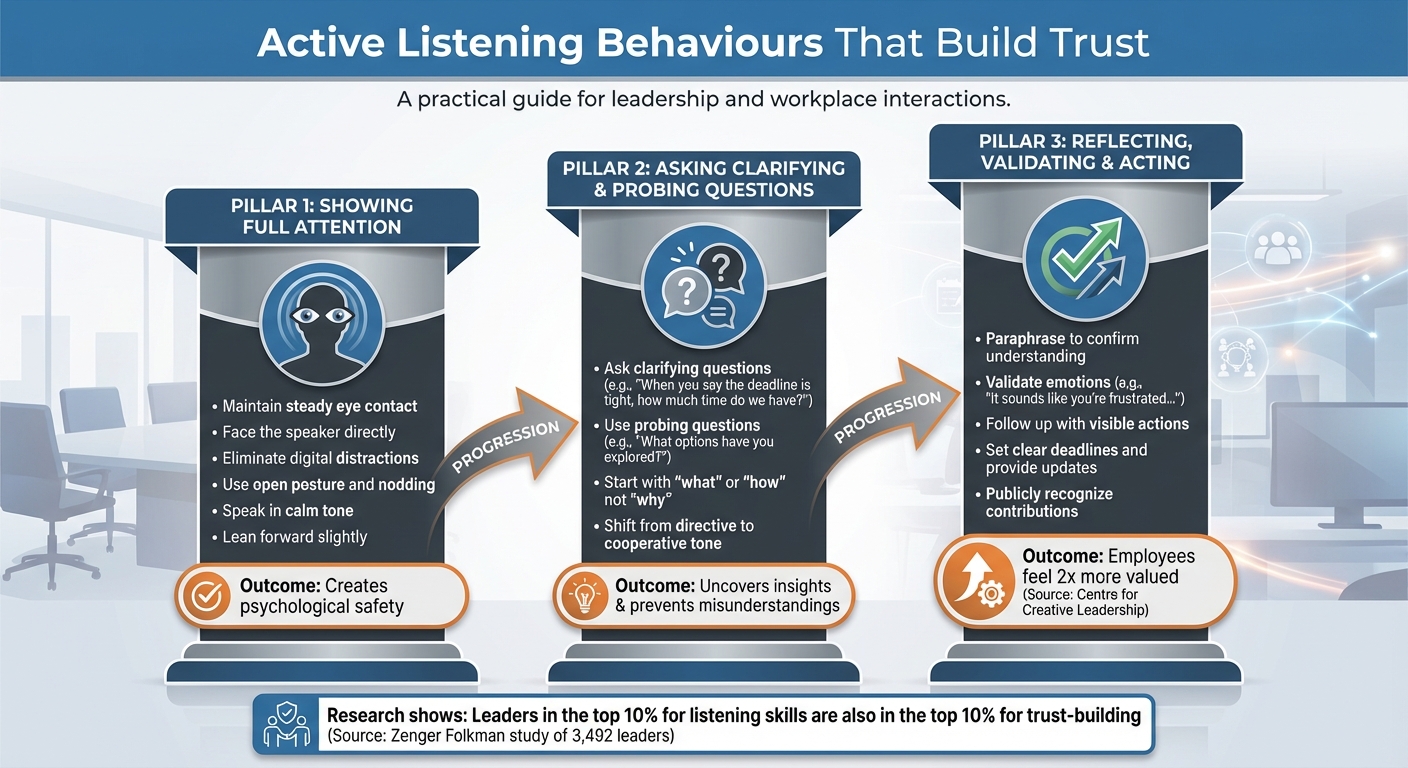
Active Listening Framework for Leaders: Building Trust Through 3 Core Behaviours
Showing Full Attention
Giving someone your undivided attention can be a powerful way to build trust. When leaders maintain steady eye contact, face the speaker directly, and eliminate digital distractions - like silencing notifications or closing irrelevant apps - they send a clear message: "What you’re saying matters". Research highlights that these visible behaviours create a sense of psychological safety, encouraging team members to voice concerns, acknowledge mistakes, and share ideas. In UK workplaces, where hierarchical structures can sometimes stifle open dialogue, leaders who are fully present make it easier for quieter team members to feel valued and heard.
Simple gestures, like an open posture, nodding, or speaking in a calm tone, signal that the leader is engaged and receptive rather than defensive or impatient. Even subtle actions, such as leaning forward slightly or mirroring emotions when appropriate, can foster a sense of connection and cooperation. When people feel that their concerns are genuinely understood, they’re more likely to see their leader as approachable and fair, which builds trust.
Once a leader has established this foundation of attention, they can strengthen trust further by asking thoughtful and clarifying questions.
Asking Clarifying and Probing Questions
Asking the right questions can uncover valuable insights and prevent misunderstandings. Clarifying questions - for instance, "When you say the deadline is tight, how much time do we actually have?" - help ensure everyone is on the same page, reducing the risk of miscommunication or wasted effort. Probing questions, such as "What options have you already explored?" or "What do you think might be influencing the client’s reaction?" go deeper, surfacing concerns or opportunities that might otherwise go unnoticed.
This collaborative, question-driven approach shifts the tone of the conversation from directive to cooperative. When leaders prioritise asking rather than instructing, employees feel their perspectives are valued, and they’re more likely to take ownership of the solutions. Open-ended questions that start with "what" or "how" are particularly effective, as they avoid the potentially accusatory tone of "why." For example, asking "What’s the most challenging part of this?" or "How do you think we should proceed?" fosters deeper understanding without making the discussion feel like an interrogation.
After gaining clarity, leaders can solidify trust by reflecting on and acting upon the feedback they’ve received.
Reflecting, Validating, and Acting on Feedback
Paraphrasing is a simple yet powerful tool to confirm active listening. For example, saying, "If I understand correctly, you’re worried that the new process might slow down our response to customers?" invites confirmation or correction. Research shows that when people feel their message has been accurately reflected back to them, they’re more likely to feel understood and valued, which strengthens trust. This approach also helps address any misinterpretations early, preventing small issues from escalating into bigger conflicts.
Acknowledging and validating emotions is equally crucial. Statements like, "It sounds like you’re really frustrated by the last-minute changes, which makes sense given how much effort you’ve put in", demonstrate empathy and help team members feel emotionally supported. This kind of validation reduces defensiveness and encourages a more collaborative approach to addressing challenges.
However, active listening doesn’t stop at understanding - it requires action. Research from the Center for Creative Leadership shows that employees feel twice as listened to when leaders follow up with visible actions. This could mean summarising agreed next steps, setting clear deadlines, providing updates on progress, or publicly recognising contributions. By ensuring conversations lead to tangible outcomes, leaders not only reinforce trust but also foster a culture of continuous, open communication. These follow-through actions show that listening isn’t just a passive activity - it drives meaningful collaboration.
How Leaders and Organisations Can Apply These Findings
What Individual Leaders Can Do
Active listening isn’t just a skill; it’s a daily practice that requires preparation and consistency. Before heading into one-to-ones, reviews, or briefings, eliminate distractions, find a quiet space, and focus on understanding rather than jumping to solutions. During conversations, simple yet effective behaviours - like giving your full attention, asking open-ended questions (e.g., "What concerns you most about this?"), paraphrasing key points, and checking your understanding ("Have I got that right?") - can create a more supportive and engaging dialogue.
The Center for Creative Leadership highlights that employees are twice as likely to feel heard when leaders not only listen but also act on what they’ve learned. This means following through with clear commitments, such as saying, "I’ll bring this up at Friday’s leadership meeting," and keeping the individual or team updated on progress. If certain issues can’t be addressed, transparency is key - acknowledge the limitations, offer alternative solutions, and maintain trust by being upfront.
Integrating active listening into daily routines can make it second nature. For example, start one-to-one meetings with a dedicated 10–15 minute listening session, allowing employees to share their thoughts without interruption. In team settings, consider “listening rounds,” where each person has the floor to speak freely. This approach can be particularly useful in British workplaces, where hierarchical norms or politeness might otherwise discourage quieter voices. Additionally, leaders can ask for feedback on their listening skills, directly inviting team members to share how well they feel heard and where improvements could be made. This honest self-assessment helps bridge the gap between intent and perception.
While individual leaders refine their listening habits, organisations must step in to support and embed these practices at a systemic level.
What Organisations Can Do
For organisations, fostering a culture of active listening starts with making it a core leadership skill. Leadership development programmes should include dedicated modules on listening, role-playing exercises, and coaching sessions, especially for new and frontline managers. Tools like 360-degree feedback can provide valuable insights into how leaders are perceived in their listening abilities.
To ensure these practices stick, organisations should define clear behavioural indicators, such as "regularly seeks input before making decisions" or "accurately reflects others’ perspectives before responding." These benchmarks can then be woven into performance reviews and promotion criteria. However, creating a listening culture isn’t about one-off training sessions - it’s about embedding listening into the fabric of the organisation.
This can be achieved through systems like regular pulse surveys with transparent follow-up, listening forums during periods of change, or inclusive decision-making processes that empower employees to shape policies and projects. Symbols also matter - when senior leaders openly ask questions, genuinely consider feedback, and admit when their views evolve, they set a powerful example. Sharing internal success stories, such as a frontline idea that boosted service quality or cut costs, makes the impact of listening visible and relatable.
Organisations can also partner with initiatives like Leadership Story Bank to help leaders craft narratives that reflect their teams’ concerns and aspirations. Recognising and rewarding leaders who excel at listening is another crucial step. Whether it’s through promotions, bonuses, internal newsletters, or peer-nominated awards, these acknowledgements reinforce the value of listening. Research from Zenger Folkman shows that leaders rated highly for listening also score higher in overall leadership effectiveness and trust. Aligning recognition with tangible outcomes - such as improved retention, successful innovations, or reduced workplace conflict - demonstrates that active listening isn’t just a soft skill; it’s a strategic tool for achieving meaningful results.
Conclusion
Active listening is more than just a communication skill - it's a cornerstone of effective leadership. By giving their undivided attention, posing meaningful questions, reflecting on responses, and acting on feedback, leaders can foster trust, engagement, and collaboration. When leaders follow through with actions rather than relying solely on words, employees are far more likely to feel heard - nearly doubling their sense of being valued.
Research into servant and authentic leadership highlights the power of empathetic listening. Leaders who listen with care, respond openly, and show genuine concern not only strengthen relationships but also reduce conflict and encourage innovation. The ripple effects are clear: active listening builds trust, which in turn boosts employee engagement. This heightened engagement leads to better retention rates, improved service delivery, and stronger, more adaptable teams - key advantages in a competitive UK market.
Every interaction offers a chance to listen with intent, ask thoughtful questions, and act on what you learn. Organisations can take this further by embedding active listening into leadership development programmes, performance evaluations, and recognition systems. When individuals embrace this practice, it lays the foundation for a listening culture across the entire organisation.
Leadership Story Bank supports professionals in becoming more self-aware and impactful communicators. By helping leaders clarify their narrative, find their true voice, and practise deep listening, it equips them to build trust and influence. In a world saturated with noise, those who genuinely listen stand out - and they build teams that achieve remarkable results.
FAQs
How can leaders use active listening to build trust in their teams?
Leaders can strengthen trust by practising active listening, which involves fully focusing on conversations, steering clear of distractions, and showing real interest in others' perspectives. Engaging with open-ended questions invites team members to express themselves more openly, while summarising or paraphrasing their points shows you’ve understood and value their input.
Actively seeking feedback and addressing concerns thoughtfully further nurtures collaboration and mutual respect. By making active listening a habit, leaders can build stronger connections, enhance team unity, and cultivate a workplace where everyone feels appreciated and heard.
What steps should leaders take after receiving feedback to strengthen trust?
Leaders who receive feedback should handle it with care and a clear plan to strengthen trust. Begin by acknowledging the feedback and showing sincere gratitude for the effort it took to share it. If any points are unclear, ask follow-up questions to ensure you fully understand the perspective being offered.
Once you’ve grasped the key insights, take time to assess the feedback and decide on any changes or improvements that may be needed. When adjustments are made, be sure to follow up with your team to share updates or outcomes. This not only shows that you value their input but also reinforces a sense of collaboration and openness across the group.
How does active listening help leaders improve trust and teamwork?
Active listening is an essential skill for leaders aiming to build trust and enhance teamwork. By genuinely tuning into and understanding their team members’ viewpoints, leaders cultivate an atmosphere of respect and openness. This approach not only encourages honest dialogue but also strengthens collaboration and ensures team members feel appreciated.
Moreover, practising active listening helps establish psychological safety - a crucial element for boosting motivation and engagement within teams. When people feel safe to express their ideas, take risks, and contribute freely, it leads to stronger connections among team members and improved overall productivity.