
Internal Communication as an Organisational Operating System
Treat internal communication as the organisation's operating system: align leaders, train managers, amplify employee voice and use AI and hybrid tools to boost trust and performance.

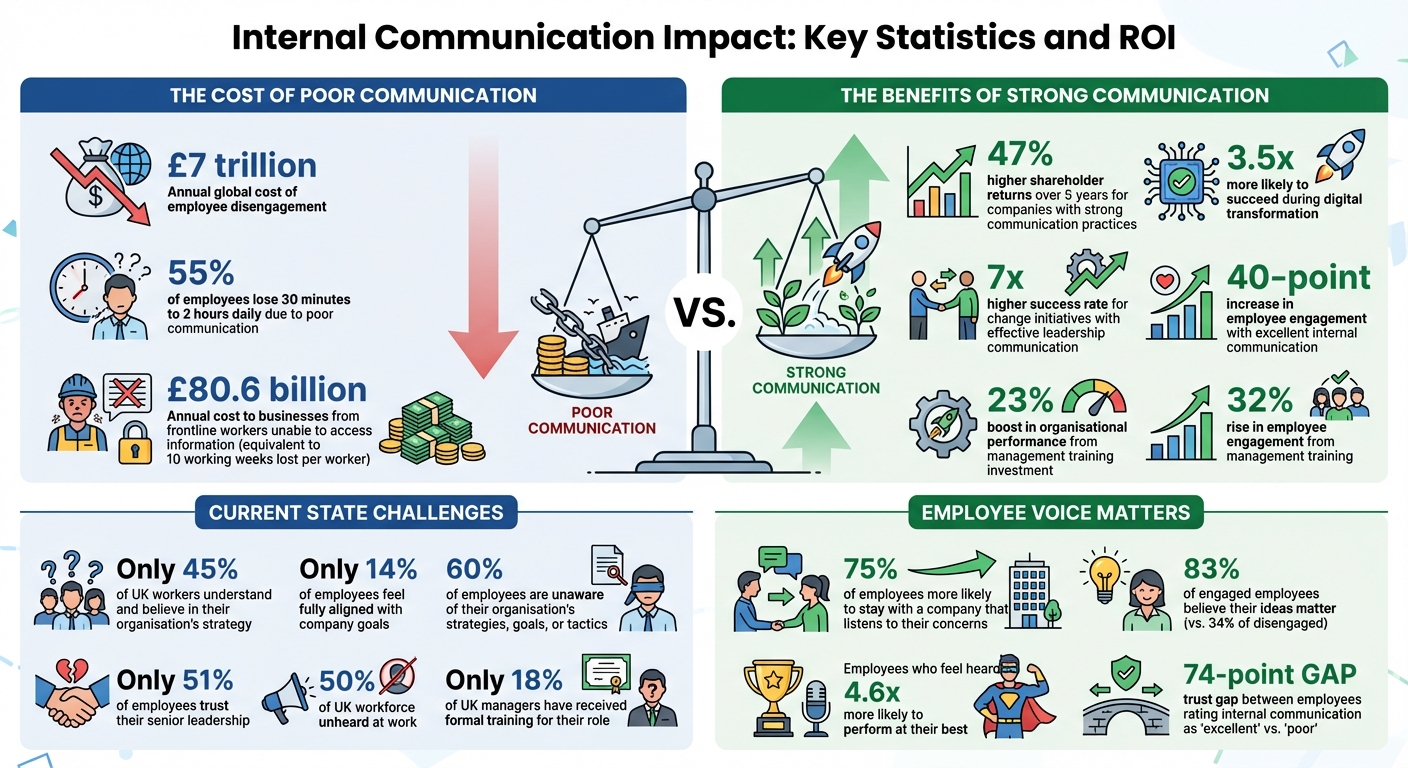
Internal communication is the backbone of any organisation, acting as the system that connects people, processes, and tools. When done well, it ensures clarity, trust, and alignment across teams, driving performance and engagement. However, poor communication can lead to significant losses, with disengagement costing the global economy around £7 trillion annually.
Key takeaways:
- Internal communication = organisational operating system: It links leadership, teams, and workflows to turn strategy into action.
- Why it matters: Companies with strong communication practices see 47% higher shareholder returns over five years, and employees with clear communication are more engaged and productive.
- What works: Clear messaging, engaged managers, and employee feedback loops are critical. For example, organisations using multiple feedback channels report higher engagement.
- Leadership’s role: Leaders must communicate with empathy and consistency, using tools like strategic narratives and feedback platforms to build trust.
- Future focus: Hybrid work and AI are reshaping communication. Organisations need to balance technology with human connection to maintain trust and efficiency.
This article explores how to strengthen internal communication, from practical principles to future-ready strategies.
Internal Communication Impact: Key Statistics and ROI
How to Create a World Class Internal Comms Strategy with Jenni Field | IC Masterclass
Core Principles of Effective Internal Communication
Think of internal communication as the backbone of your organisation - it keeps everything connected and running smoothly. To make it work, you need to focus on three key principles: clarity, engaging managers and employees, and amplifying the voices of your people.
Clarity and Unified Messaging
Clear communication starts with a strong narrative that connects your organisation's mission to everyday tasks. Without this guiding framework, even well-meaning messages can get lost in the shuffle. Shockingly, only 45% of UK workers understand and believe in their organisation's strategy. On top of that, 55% of employees lose anywhere from 30 minutes to two hours each day due to poor communication.
The fix? Keep it simple. Break down complex ideas into straightforward, jargon-free messages. For instance, when Anchor, a not-for-profit organisation, partnered with H&H in 2020 to roll out a bold growth plan, they created a clear strategic narrative map and facilitated manager-led discussions. This approach doubled employee understanding of the business strategy.
Consistency is just as important as clarity. Messages should align with your goals and follow a predictable schedule - whether through weekly updates or monthly meetings. This structure helps cut through the noise and ensures employees know where to find key information. The stakes are high: only 14% of employees feel fully aligned with their company’s goals, and nearly half of those who feel disconnected are likely to leave within two years.
Once clarity is in place, the next step is ensuring managers and employees are engaged in meaningful ways.
Engaging Managers and Employees
Managers play a pivotal role in communication - they’re the bridge between high-level strategy and the daily grind. Yet, only 18% of UK managers have received formal training for their role. This lack of preparation is costly, especially since investing in management training can lead to a 23% boost in organisational performance and a 32% rise in employee engagement.
Great managers don’t just pass on information; they make it relevant and actionable for their teams. They act as coaches and motivators, helping employees see how their individual efforts contribute to the organisation’s success. This connection matters. When employees understand their role in the bigger picture, their confidence in the company’s strategy increases significantly - by as much as 35 percentage points.
Creating a culture of psychological safety is also critical. This means fostering an environment where employees feel safe to speak up, take risks, and admit mistakes without fear of backlash. When communication becomes a two-way street, engagement soars. In fact, organisations with excellent internal communication see a 40-point increase in employee engagement.
With strong managerial support and a safe space for dialogue, organisations can unlock the true power of employee voices.
Employee Voice and Organisational Authenticity
Listening to employees isn’t just a nice-to-have - it’s a must. Yet, half of the UK workforce feels unheard at work. This is a problem, especially since 75% of employees are more likely to stay with a company that listens to their concerns. The impact of feeling valued is striking: 83% of engaged employees believe their ideas matter, compared to just 34% of disengaged ones.
To genuinely hear employees, you need more than an annual survey. Organisations that use five or more feedback channels - such as one-to-one meetings, pulse surveys, and open forums - achieve higher employee engagement scores, with an average increase of 6%. The goal is to create ongoing conversations where every voice, regardless of rank, is acknowledged.
Authenticity is about closing the gap between what you say and what you do. If your organisation’s actions don’t align with its stated values, trust erodes quickly. Transparency and honesty, especially during challenging times, are crucial for maintaining trust and resilience. When employees feel heard and see their feedback driving real change, your communication system becomes a source of strength for the entire organisation.
Key Channels and Components of Internal Communication
Ensuring smooth communication within an organisation means understanding how information flows and choosing the right channels for each type of interaction.
Top-Down, Bottom-Up, and Lateral Communication
Internal communication relies on three main flows. Top-down communication delivers leadership messages, strategic updates, and company-wide announcements from senior management to employees. Bottom-up communication allows employees to share feedback, ideas, and concerns with leadership. Meanwhile, lateral communication happens between peers, enabling collaboration and knowledge-sharing across departments without hierarchical barriers.
Each flow plays a critical role. Without clear top-down communication, employees may feel directionless. Without bottom-up feedback, leaders lose touch with on-the-ground realities. And without lateral communication, teams risk working in silos. A well-designed communication system supports all three flows, fostering open dialogue across all levels.
"The very best internal communication experiences are when employees have a meaningful and direct connection with leaders. And, crucially, when leaders listen to, understand and care about employees."
- IoIC Index 2025
Common Communication Channels and Tools
Email remains the go-to channel for most organisations, with 65% of employees relying on it for general updates. One-to-one meetings with managers follow at 35%, while newsletters and team meetings each hold a 34% share.
Each channel has a distinct role:
- Email: Best for formal announcements and maintaining a record.
- Instant Messaging (e.g. Slack, Teams): Ideal for real-time collaboration and quick exchanges.
- Intranet: Acts as a centralised hub for evergreen content and self-service resources.
Generational preferences also shape how these tools are used. For instance, while only 5% of Baby Boomers use SMS or WhatsApp for work, 19% of Gen Z employees do. Similarly, Baby Boomers are twice as likely to use intranets (20%) compared to Gen Z (10%). Recognising these differences ensures communication reaches diverse groups effectively.
A great example of impactful internal communication comes from Aviva. In January 2026, the company empowered six employee communities to take over internal communications, sharing authentic stories. The campaign led to a 280% spike in traffic to community pages, thousands of comments, and a 30% increase in community memberships. This highlights the power of tailored and inclusive communication strategies.
Modern vs Traditional Channels
The move from traditional to modern communication tools isn’t just about adopting technology - it’s about improving accessibility and engagement. Traditional methods, like printed memos and quarterly magazines, often leave frontline workers out of the loop, favouring office-based staff. Modern platforms address this gap by offering instant, mobile-first access for everyone.
Finding the right balance between traditional and modern methods is key. Here’s a quick comparison:
| Channel Type | Reach | Interactivity | Primary Effectiveness |
|---|---|---|---|
| High (65% reliance) | Low | Formal announcements and documentation | |
| Intranet | High (in large organisations) | Medium | Centralised information hub and self-service |
| Instant Messaging (e.g. Slack) | High (Gen Z focus) | High | Real-time collaboration and peer communication |
| One-to-Ones | Low (Individual) | Very High | Builds trust and personal alignment |
| Newsletters | Medium (34% reliance) | Low | Curated updates and storytelling |
Modern tools also bring measurable benefits. Digital platforms can track open rates, click-throughs, and even sentiment, offering actionable insights. Organisations with intranets are twice as likely to rate their internal communication as "excellent" compared to those without. Additionally, all-in-one platforms often outperform fragmented systems, with higher employee connection rates (81% vs 74%).
The goal isn’t to abandon traditional methods but to integrate them with modern solutions. For instance, while 53% of employees prefer written updates about employer plans, modern platforms make these materials easier to access, search, and act on compared to printed formats. This balanced approach ensures communication is both effective and inclusive.
Building and Measuring an Internal Communication Strategy
An effective internal communication strategy is crucial for aligning an organisation's processes and people. It ensures resources are used wisely, trust is maintained, and productivity thrives. Without a structured plan, organisations risk inefficiency and disengagement.
Creating an Internal Communication Strategy
Start by auditing your current communication channels. Identify gaps in messaging and gather employee feedback to uncover areas for improvement.
Next, set SMART objectives that directly align with your business goals. Whether you're aiming to enhance safety, improve employee retention, or boost productivity, your communication objectives should lead to measurable outcomes. Use the "Know, Feel, Do" framework to clarify what employees need to know, how they should feel, and what actions they should take to support the strategy.
Tailor your communication to suit different employee groups:
- Frontline staff benefit from mobile-friendly updates.
- Corporate teams may prefer in-depth briefings.
- Managers need toolkits to effectively cascade information.
Create a message architecture that reflects your organisation’s vision, purpose, and key pillars. Then, select a mix of communication channels and clearly define their purpose and frequency. For instance:
- Use Slack for real-time collaboration.
- Reserve the intranet for important, evergreen documents.
- Send formal updates through email.
Establish governance with a RACI model to clarify roles, responsibilities, and approval workflows. Editorial calendars can help maintain consistency and ensure timely communication. This is especially important given that only 51% of employees trust their senior leadership.
"If employees know what needs to be done, and what their role is in achieving this, they can align their efforts to the strategy."
Measuring Success: Metrics and KPIs
To evaluate success, focus on metrics that connect communication efforts to business outcomes, rather than vanity metrics. The AMEC Integrated Evaluation Framework offers a clear process: Objectives → Inputs → Activities → Outputs → Out-takes → Outcomes → Impact.
Divide your metrics into two categories:
- Operative metrics: These include reach (e.g., email opens, app activity) and engagement (e.g., click-through rates, comments, video completion rates).
- Strategic metrics: These focus on broader goals like retention, productivity, and trust.
For example:
- In 2022, Shell used its employee experience platform to streamline tasks, saving 82 seconds per task. This added up to over 3,500 hours saved daily across the company, translating to an estimated £33 million in productivity gains.
- Similarly, The Estée Lauder Companies launched "MyELC", a centralised platform that improved search accuracy by 300%, saving employees two hours per week. Recognised as one of the world's top ten intranets by the Nielsen Norman Group, it became a game-changer for the company.
Key metrics to track include:
| KPI Tier | Examples | Purpose |
|---|---|---|
| Reach | Email opens, app DAU/MAU, unique visitors | Establish audience baselines |
| Engagement | Click-through rates, reactions, comments | Measure active participation |
| Enablement | Search success rate, content findability | Assess clarity and usability |
| Outcomes | Retention, safety incidents, policy compliance, eNPS | Link communications to business goals |
Set benchmarks using past KPI data and ensure your objectives are SMART. Analyse trends over time, identify underserved employee groups, and evaluate which channels perform best for specific topics. Keep your focus on metrics that align with organisational priorities.
Given that 72% of internal communications professionals find measurement challenging, simplicity is key. Avoid overcomplicating the process and concentrate on actionable insights.
"If you don't measure, you're not being strategic. You're flying by the seat of your pants."
- Kimberley-Marie Sklinar, Communications Manager, AutoProtect Group
This structured measurement approach empowers leadership to strengthen internal communication further.
Leadership's Role in Internal Communication
Leaders play a pivotal role in shaping how communication flows within an organisation. When they align their actions with their words, trust among employees grows. Research highlights this, showing a 74-point trust gap between employees who rate internal communication as "excellent" compared to those who rate it as "poor". However, only 49% of employees feel that senior leaders genuinely follow through on sustainability promises.
Leadership communication impacts more than just trust - it directly influences organisational success. Effective communication during change initiatives increases the likelihood of success by up to seven times. Similarly, organisations with strong internal communication practices are 3.5 times more likely to thrive during digital transformation efforts. Much like a well-functioning operating system, strong leadership ensures communication flows smoothly across all levels. With this foundation in mind, let’s explore how leadership style, tools, and technology shape internal communication.
How Leadership Styles Affect Communication
The way leaders communicate sets the tone for the entire organisation. Command-and-control leadership may create an atmosphere of fear and silence, while empathetic and conversational leadership fosters psychological safety. This sense of safety allows employees to take risks, share ideas, and admit mistakes without fear of negative repercussions. The push towards more human-centred communication approaches is transforming relationships between leaders and employees. Joe Salmon from Iron Mountain shares:
"We've made a real effort to encourage leaders to be more human in their communication. Making their language more chatty, their stories more personal, their tone more conversational".
This approach helps bridge the gap between leadership and employees, especially when 60% of employees report being unaware of their organisation's strategies, goals, or tactics.
Empathy is equally critical when leaders explain complex changes. For instance, during digital transformations, using relatable analogies can help employees better understand new technologies like AI. This reduces resistance and builds confidence in these tools. The focus is shifting from simply adopting AI to fostering "AI fluency", where employees grasp not only how these tools work but also their purpose and ethical considerations.
Tools for Leaders to Improve Communication
Practical tools can help leaders communicate more effectively and consistently. For example, frameworks like the Leadership Story Bank guide leaders in crafting authentic stories that connect organisational goals to employees' daily work. By creating clear and relatable strategic narratives - one of the key drivers of employee engagement - leaders can make high-level objectives meaningful for their teams.
Equally important is establishing regular feedback channels. Initiatives such as CEO drop-in sessions, weekly feedback emails, and internal social media platforms show employees that their input is valued and acted upon. This two-way communication is essential, especially given that only 25% of employees feel their leaders are engaging, passionate, and inspiring.
Using Technology to Improve Communication
Modern technology offers leaders new ways to enhance their communication strategies. Platforms like SharePoint and Simpplr serve as centralised hubs for organisational resources, while tools like Slack and Microsoft Teams enable real-time collaboration. Organisations using Slack for communication report a 47% increase in productivity.
AI-driven analytics take communication a step further by providing insights beyond basic metrics. Advanced tools can track email open rates, summarise lengthy threads, and analyse sentiment. These capabilities are crucial, given that 55% of employees lose between 30 minutes and two hours daily due to ineffective communication. By leveraging such insights, leaders can identify which messages resonate most and which channels are most effective for different audiences.
Choosing the right channel for each message is equally important. Public platforms work well for broad announcements, while private threads are better suited for sensitive updates. Video tools like Zoom enable face-to-face communication, and asynchronous video clips allow for flexible updates across time zones. Jennifer Sproul, Chief Executive of IoIC, highlights this need for connection:
"In a world marked by uncertainty, the research underscores the enduring human need for connection and the critical importance of our role... in driving real outcomes".
Preparing Internal Communication for the Future
As the workplace transforms, internal communication must keep pace. With 59% of the global workforce expected to need reskilling by 2030 due to AI and automation, organisations face a dual challenge: adopting new tools while embedding "AI fluency" into daily operations. This isn't just about technology - it's about reshaping how people connect and share information.
Consider this: frontline workers lose around 10 working weeks annually because they can't access the information they need, costing businesses an estimated £80.6 billion each year. Yet, only 14% of employees feel their organisation is leading in AI adoption, and over half report having no formal AI strategy. These gaps highlight an urgent need for communication strategies that balance technological progress with the human element. As work becomes increasingly digital, communication must evolve to support new ways of working.
Adapting to Hybrid Work Environments
Hybrid work has changed the game for organisational communication. Gone are the spontaneous "water cooler" chats that once fostered connection. Now, companies are turning to digital substitutes - like Slack or Microsoft Teams channels dedicated to social interactions - to keep the sense of community alive.
But hybrid communication has to go further. It needs to cross physical and cultural boundaries, ensuring that global teams feel equally informed and connected. This means moving away from a one-way, top-down approach to a more interactive system that prioritises empathy and inclusion. For critical updates - like mergers or strategic shifts - direct communication from leadership is key to preventing rumours and building trust.
To make hybrid communication effective, organisations must align channels with specific goals and avoid overwhelming employees. Mismanagement of communication can waste up to 3.5 hours per week for 38% of workers. Managers play a pivotal role here, breaking down silos and keeping teams engaged. Employees who feel heard are 4.6 times more likely to perform at their best. Practical steps include setting up rapid-response Q&A systems to address concerns within 48–72 hours of major announcements and using mobile-first formats like short videos or SMS to reach deskless workers. As hybrid work continues to evolve, AI offers tools to further personalise and streamline communication.
The Role of AI and Data-Driven Insights
Building on hybrid strategies, AI is revolutionising internal communication. From drafting content to improving information accessibility, AI tools are reshaping how organisations operate. However, the goal isn't just to use AI - it's to embed it into the organisation's DNA, enabling scalable, personalised communication. Communications expert Jenni Field sums it up well:
"Communicators have to learn the language of business and connect the dots between communication and outcomes".
AI can transform core messages into role-specific formats and ensure clarity in an increasingly information-heavy environment. Advanced analytics and sentiment tools add another layer, offering predictive insights to identify potential issues before they escalate. This is crucial when 72% of frontline workers don't fully grasp their company's strategy. To win trust, communicators need to explain how AI tools support employees and improve their work experience.
Data-driven insights also allow for personalised messaging that blends seamlessly into employees' "flow of work", reducing information overload. However, technology alone isn't enough. The rise of "artificial colleagues" - AI integrated into teams - introduces new challenges for maintaining human connection. Success in this area relies on balancing AI's efficiency with emotional intelligence, recognising the importance of non-monetary benefits like flexibility, recognition, and belonging.
Organisations are shifting focus from surface-level productivity to fostering genuine engagement and well-being - a concept some refer to as "quiet thriving". By leveraging AI's capabilities while preserving the human touch, internal communication can remain effective and empathetic, ensuring trust and connection thrive in an increasingly digital workplace.
Conclusion: Internal Communication as the Key to Organisational Success
Internal communication functions as the engine driving organisational success. Much like the software that powers a computer, it forms the foundation for sharing knowledge, fostering collaboration, and sparking motivation.
The data is compelling: organisations with effective communication practices enjoy tangible improvements in employee engagement, financial returns, and the ability to navigate change successfully. Despite this, disengagement remains a widespread issue, with a striking 74-point disparity in how employees perceive senior leaders based on the quality of communication.
Clear messaging, alignment with organisational goals, and flexibility in approach are non-negotiable. Employees who understand the strategy and their role within it feel far more confident and engaged. These principles help leaders connect strategy with day-to-day operations. Progress happens when organisations amplify employee voices, equip managers to effectively share key messages, and close the gap between what they say and what they do.
Ben Horowitz captured this dynamic perfectly:
"In any human interaction, the required amount of communication is inversely proportional to the level of trust... As an organisation grows, communication becomes its biggest challenge".
Building trust involves more than issuing top-down directives. It requires fostering real dialogue, creating an environment of psychological safety, and valuing human connection alongside technological tools.
Organisations that treat internal communication as a critical system position themselves for success. By embedding strong communication frameworks, they ensure every team and individual is aligned - turning a functioning organisation into a thriving one.
FAQs
How can organisations assess the success of their internal communication strategies?
Organisations can gauge the effectiveness of their internal communication strategies by focusing on key elements like employee engagement, message clarity, and noticeable shifts in behaviour. Gathering feedback through tools such as surveys, quick polls, or focus groups helps reveal how messages are received and whether they meet their intended goals.
Monitoring Key Performance Indicators (KPIs), such as participation levels, understanding of messages, and overall employee satisfaction, plays a vital role in this process. Digital tools, including intranet analytics or communication platforms, can offer detailed insights, showing how communication efforts align with broader organisational objectives.
By blending quantitative data with qualitative feedback, organisations gain a comprehensive view of their communication effectiveness. Regular reviews of these findings enable smarter decisions to refine communication strategies, strengthen alignment, and boost team engagement.
How does leadership improve internal communication within an organisation?
Leadership plays a key role in improving internal communication by shaping an environment of openness, trust, and teamwork. Strong leaders ensure that communication aligns with the organisation's goals, making employees feel informed, valued, and connected. By prioritising transparency and inviting feedback, they foster a space where meaningful dialogue and collaboration can flourish.
Effective leadership also means leading by example - demonstrating clear and thoughtful communication and encouraging teams to develop these skills. This not only builds trust and morale but also strengthens the organisation's overall unity, which positively influences performance and engagement. When leaders focus on consistent and clear communication, they empower the organisation to stay aligned, adapt to challenges, and achieve success.
How can organisations balance technology with human connection in a hybrid workplace?
Organisations can find harmony between technology and human connection in hybrid work setups by pairing effective digital tools with genuine interpersonal engagement. Digital platforms that support collaboration, streamline information sharing, and ensure transparency are key to keeping teams connected. However, these tools should work alongside efforts that nurture real relationships.
Leaders play a vital role in fostering a sense of belonging by actively listening to their teams, encouraging open dialogue, and creating spaces for informal interactions. Practices like regular check-ins, approachable leadership, and cultivating empathy can strengthen trust and unity. By combining the practical benefits of technology with meaningful human touchpoints, organisations can cultivate a motivated and cohesive hybrid workforce.