
Why Internal Communication Breaks Down During Change
Why internal communication fails during organisational change and how clear plans, transparency, manager training and two-way dialogue rebuild trust.

Change in organisations is now a constant, but poor communication often undermines its success. Misaligned messaging, lack of transparency, and disengaged employees create confusion, mistrust, and resistance. The numbers don’t lie: 70% of business transformations fail, and stressed employees see a 5% performance drop. Yet, when communication is clear and honest, trust in leadership jumps to 78%.
To fix this, organisations need a clear plan, honest dialogue, and consistent actions. Equip managers to communicate effectively, prioritise two-way conversations, and align words with actions. Real examples, like Iron Mountain’s relatable leadership and ZSL’s feedback-driven approach, show how trust and engagement can turn change into progress.
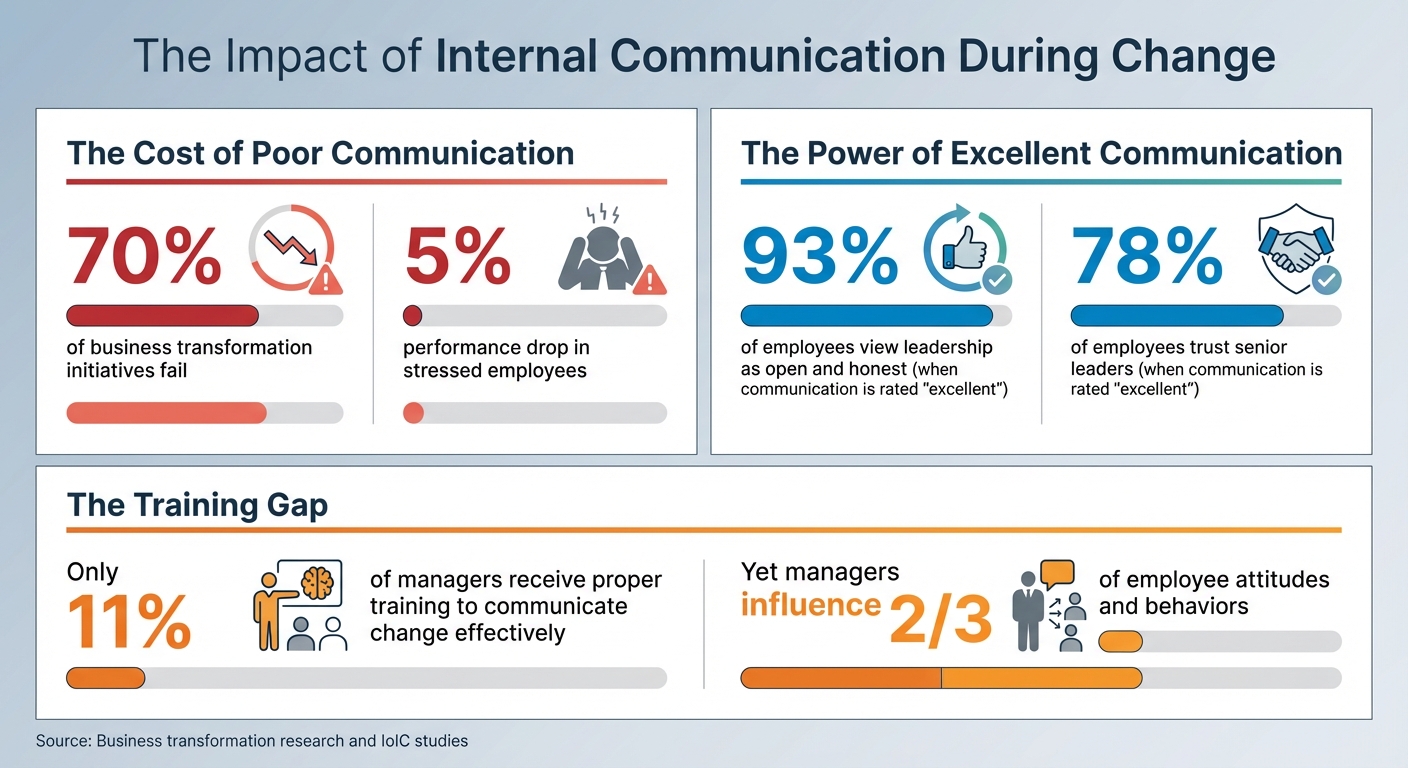
Internal Communication Statistics During Organizational Change
3 Must-Know Change Communication Principles
Why Internal Communication Breaks Down During Change
When organisations undergo change, communication often falters. Understanding the reasons behind these breakdowns is crucial to addressing them effectively. Three key issues tend to surface: misaligned messaging, lack of transparency, and insufficient employee engagement. These factors often build on one another, creating a cycle of confusion and distrust.
Misaligned Messaging
One of the biggest challenges arises when leaders and managers deliver inconsistent messages about the change. This misalignment often stems from timing - leaders, being closer to the decision-making process, tend to grasp the change more quickly. However, this can lead to hurried communication that doesn’t resonate with employees’ day-to-day realities.
Without adequate preparation, managers might inadvertently share conflicting information or fail to explain the reasoning behind decisions. This lack of a cohesive narrative can erode confidence. Research shows that around 70% of business transformation initiatives fail, often because the purpose of the change is poorly communicated. When employees don’t understand the rationale, mistrust and scepticism grow.
"Any gap between what you say and what you do erodes trust very quickly." – Kate Jones, Tarmac
Inconsistent messaging lays the groundwork for further issues, particularly when transparency is lacking.
Lack of Transparency
Misaligned messages are often compounded by a lack of open and honest communication. When leadership holds back information - whether deliberately or unintentionally - employees are left to fill the gaps themselves. This "grapevine effect" often amplifies fears, as speculation tends to skew more negative than reality. Once these alternative narratives take hold, they are far harder to dispel than if leaders had communicated clearly from the start.
Another issue is the use of overly polished messaging, which can come across as insincere or overly optimistic. The impact of transparency - or the lack of it - is striking. When internal communication during organisational change is rated as "excellent", 93% of employees rate leadership as open and honest, and 78% say they trust senior leaders. On the other hand, withholding information leads to a breakdown in trust.
"People are tired of distant leadership and vague, impersonal messaging. They want real conversations. They want to feel seen, heard and understood." – IoIC IC Index 2025
Uncertainty is a major source of stress for employees. When they don’t know what’s happening, why decisions are being made, or how they will be affected, anxiety rises, which can directly impact performance.
Insufficient Employee Engagement
When communication is marred by conflicting messages and a lack of transparency, employees often disengage. This is especially true when change is presented as a one-sided announcement rather than a collaborative process. Over-reliance on top-down channels like emails or company-wide updates leaves little room for employees to ask questions or share concerns. This approach can make employees feel that change is imposed upon them, rather than something they are part of, leading to disengagement or even resistance.
There’s also the issue of the "onlooker effect." As Paul Diggins, Board Member at IoIC, explains:
"We tend to do a really good job of looking after the people impacted by change, but in my experience, the onlookers can actually react more strongly."
When employees who aren’t directly affected by restructuring see their colleagues excluded from meaningful conversations, it can drag down overall morale.
Additionally, failing to engage employees in two-way dialogue means missing out on valuable insights from the frontline. Employees often spot practical issues or unintended consequences early on. Without mechanisms to gather and act on this feedback, organisations risk letting small problems snowball into larger challenges.
How to Improve Internal Communication During Change
When organisations undergo change, communication often breaks down. To address this, focus on planning, engagement, and aligning actions. These strategies ensure every message supports a unified narrative.
Create a Clear Internal Communications Plan
Misaligned messages and lack of transparency can derail change efforts. A well-thought-out plan is the first step. The 4 Ps framework can help you craft your approach:
- Purpose: Why is the change happening?
- Picture: What will the future look and feel like?
- Plan: How will the organisation get there?
- Part: What role does each individual play?
Structure communications into clear phases:
- Announcement: Build awareness.
- Engagement: Clarify the impact and secure buy-in.
- Involvement: Encourage participation to sustain momentum.
- Recovery: Secure long-term commitment.
Line managers are a crucial link in this chain - they influence two-thirds of employee attitudes and behaviours. However, only 11% of managers receive proper training to communicate change effectively. Providing managers with tailored toolkits and early briefings equips them to translate corporate messages into actionable insights for their teams.
Build Two-Way Communication and Trust
Top-down announcements alone won't cut it. Employees need space to ask questions, share concerns, and feel genuinely heard. Shifting from "broadcasting" to "conversation" helps employees understand how the change affects them personally.
Consider hosting drop-in sessions where employees can speak directly with senior leaders. When feedback is collected - whether through surveys or emails - close the loop by sharing what actions were taken in response. This demonstrates that their input is valued.
Another effective method is appointing change champions - employees who embrace the change early and can act as connectors. They can highlight where messages are failing and help adapt communication to better resonate with their peers.
Transparency is non-negotiable. If you don’t have all the answers, admit it. If certain details are confidential, explain why. Employees appreciate honesty far more than vague reassurances. Research shows that when internal communication is rated as "excellent", 93% of employees view leadership as open and honest, and 78% trust senior leaders. On the flip side, silence creates a vacuum where rumours thrive.
Trust forms the foundation for aligning organisational actions with communicated values.
Align Structure, Culture, and Messaging
Even the best communication plan will fail if actions don’t match words. A disconnect between what’s said and what’s done erodes trust rapidly. To maintain credibility, ensure that day-to-day behaviours reflect the organisation's stated values.
A strategic narrative can help tie everything together. This narrative should clearly explain the organisation’s purpose, describe the envisioned future, outline the steps to get there, and clarify each employee’s role. Repeating this story consistently across all levels ensures alignment between structure, culture, and messaging.
Collaboration is key. Internal communication teams need to work closely with HR and operations to ensure messages align with the broader strategy. This avoids mixed signals and ensures every interaction - from team meetings to performance reviews - reinforces the same core messages.
Tools like the Leadership Story Bank can support this effort. They help leaders craft relatable, personal stories that reflect organisational values and resonate with employees. A conversational tone and shared experiences can bridge the gap between leadership and frontline staff.
It’s worth noting that 70% of business transformation efforts fail, often because the purpose of the change isn’t communicated effectively. Aligning structure, culture, and messaging isn’t just helpful - it’s critical for success.
Examples of Successful Internal Communication During Change
Real-world examples bring these concepts to life:
Case Study: Clear Leadership During Restructuring
Iron Mountain, a global leader in records management, faced a common challenge during organisational change: bridging the gap between senior leaders and frontline employees. In large companies, communication from the top can often feel distant and impersonal.
Joe Salmon, a member of Iron Mountain's internal communications team, shared their strategy:
"We've made a real effort to encourage leaders to be more human in their communication. Adopting a conversational tone with personal stories. This has had a big impact on how employees perceive them".
By moving away from overly formal messaging, the leadership team became more relatable. Sharing personal stories and using a conversational tone helped employees see leaders as approachable and empathetic, building trust during a time of uncertainty. This approach tackled the common pitfalls of misaligned messaging and lack of transparency, making employees feel more connected to the organisation's direction.
Case Study: Employee Involvement in Organisational Transformation
The Zoological Society of London (ZSL) adopted a collaborative approach during their organisational transformation, focusing on two-way communication. Instead of relying solely on traditional top-down updates, ZSL created opportunities for employees to share their thoughts and feedback.
Clare Bowers from ZSL highlighted their efforts:
"Our CEO runs drop-in sessions and encourages direct feedback through his weekly email, then shares what's happened with those inputs. Internal social media enhances employee listening".
This strategy went beyond simply informing employees about changes. By actively involving them in the process and closing the feedback loop - showing how their input influenced decisions - ZSL fostered a sense of ownership and alignment. Employees felt valued and understood, which helped maintain morale and engagement throughout the transition.
These examples show how a combination of relatable leadership and meaningful employee involvement can transform internal communication during periods of change.
Conclusion
The price of poor communication during organisational change is high. Transformation efforts often falter, and employees face heightened stress levels as a result. These failures typically occur when communication does not effectively bridge the gap between strategy and execution.
To break this cycle, communication must shift from one-way announcements to genuine two-way conversations. Leaders should focus on explaining the Purpose, Picture, Plan, and Part of the change while actively listening to employees' concerns. Equipping managers with proper training and resources is equally important. When communication during restructuring is rated as "excellent", a striking 93% of employees view their organisation as open and honest.
Addressing unclear messaging, increasing openness, and engaging employees directly can help leaders build trust during periods of change. The key lies in fostering human connection - using a conversational tone, sharing relatable stories, and creating feedback channels that show employees their voices influence decisions.
Change is no longer a rare occurrence; it’s a constant. Leaders who prioritise clear, open, and engaging communication will not only ease transitions but also strengthen their teams’ ability to turn strategic goals into action.
FAQs
How can organisations maintain transparency during periods of change?
Transparency during organisational change relies on clear, honest, and consistent communication. Keeping employees informed about changes as they happen, explaining the reasons behind them, and openly addressing concerns can help minimise confusion and build trust across the team.
Equally important is listening to employees. Encourage a two-way dialogue by establishing channels where feedback can flow freely and be acknowledged. Digital tools, such as team messaging platforms, can support this process by promoting engagement and ensuring everyone feels included. By prioritising openness and responsiveness, organisations can make transitions smoother and reinforce team cohesion.
What is the manager's role in ensuring effective communication during organisational change?
Managers play a crucial role in keeping communication effective during times of organisational change. Acting as the link between leadership and employees, they ensure messages are clear, consistent, and aligned with the organisation’s objectives. By breaking down high-level strategies into practical steps, managers help their teams grasp the purpose and direction of the change, which can ease concerns, reduce resistance, and build trust.
Good managers prioritise two-way communication, creating an environment where employees feel comfortable sharing concerns, asking questions, and offering feedback. This open dialogue fosters transparency and keeps everyone on the same page. By providing regular updates, tailoring messages to their audience, and recognising individual and team efforts, managers keep communication meaningful and engaging. This approach not only helps employees stay informed but also supports a smoother adjustment to change.
Why is two-way communication important during organisational change?
Two-way communication plays a crucial role during organisational change, fostering trust, improving engagement, and ensuring everyone is on the same page. By giving employees the chance to voice concerns, ask questions, and share feedback, it helps ease uncertainty and reduces the emotional pushback that often arises during periods of transition.
This approach turns communication into a collaborative exchange, bridging leadership goals with employee viewpoints. When employees feel genuinely heard and involved, it builds trust, lifts morale, and deepens their commitment, making change easier to implement. Open and transparent communication offers reassurance, paving the way for a smoother and more cohesive transition.