
How Stories Clarify Ambiguity in Change
Storytelling reduces uncertainty in organisational change by building trust, explaining the why, and using metaphors and narrative structure to make change clear.

When organisations face change, uncertainty often follows. Employees may struggle to understand the "why" behind decisions, leading to speculation and disengagement. Traditional communication methods like slide decks or emails often fail to address emotional concerns, leaving gaps in understanding. Business storytelling offers a better way to navigate this ambiguity by creating meaning, building trust, and connecting people to the purpose of change.
Key Takeaways:
- Change creates uncertainty: Without clear communication, employees fill gaps with assumptions, often driven by fear.
- Traditional communication falls short: Data-heavy presentations focus on logic but miss emotional engagement.
- Stories provide clarity: They help people make sense of change, align actions, and connect emotionally to the process.
- Science backs storytelling: Stories are 22x more memorable than facts alone and can improve change success rates by up to six times.
- Practical tools: Use metaphors, narrative structures, and relatable examples to simplify complex ideas and reduce confusion.
By weaving stories into every stage of the change process, leaders can replace uncertainty with understanding, making change feel not just necessary but achievable.
Why Stories Work: The Science of Understanding
How Narrative Structure Creates Meaning
In times of change, when confusion takes hold, our brains naturally seek patterns to make sense of the chaos. A well-crafted story provides this clarity, acting as a framework that ties scattered facts into a cohesive whole. With its familiar elements - characters, conflict, and resolution - narrative structure offers a mental guide to navigate uncertainty.
There’s solid research backing this up. Cognitive psychologists have found that facts woven into stories are 22 times more memorable than when presented alone. The classic dramatic arc - setup, tension, resolution - resonates with how we naturally process information, holding our attention and embedding ideas in ways bullet points simply can’t.
This storytelling structure also helps prevent what researchers call "corridor stories." These are the anxious, speculative narratives that arise when leaders fail to provide clear communication during times of uncertainty. A well-constructed story doesn’t just fill the communication gap - it shapes the emotional and cognitive impact of how people understand events.
"Stories are how we learn to make choices. Stories are how we learn to access the moral and emotional resources we need to face the uncertain, the unknown, and the unexpected mindfully." - Marshall Ganz
Building Trust Through Emotional Connection
Facts alone often fall short in building trust during turbulent times. A compelling, character-driven story with a dramatic arc does more than inform - it builds connection. This happens because such stories trigger the release of oxytocin, a hormone that fosters trust and cooperation. It’s a biological response that explains why storytelling can create a sense of psychological safety when traditional methods of communication fail.
Paul J. Zak, Director of the Centre for Neuroeconomics Studies, sums it up well:
"Stories that are personal and emotionally compelling engage more of the [listener's] brain, and thus are better remembered than simply stating a set of facts".
The secret ingredient? Vulnerability. When leaders share honest stories about their own struggles and setbacks, they break down the "us versus them" divide. Instead of being seen as distant decision-makers, they become relatable individuals. This relatability is crucial when the future feels uncertain.
Emotionally resonant stories also address a key issue: without a clear narrative from leadership, people will create their own stories, often driven by fear and anxiety. By offering a genuine, emotionally honest account, leaders can replace speculation with understanding. From this foundation, metaphors can be used to simplify complex ideas and bring clarity to uncertainty.
Using Metaphors to Simplify Complex Ideas
Metaphors act as mental shortcuts, making abstract concepts easier to grasp. During periods of change, when uncertainty is high and people are overwhelmed, metaphors help translate complexity into something visual and relatable. Research shows they strengthen neural pathways, making it easier for the brain to process and retain information.
Take the metaphor of "crossing a bridge in the fog." It vividly captures the experience of navigating the "messy middle" - that awkward phase when old systems are gone, but new ones aren’t fully in place. The image reassures: while visibility is limited, there’s solid ground beneath your feet and a destination ahead.
Different metaphors fit different scenarios.
- Journey metaphors work well for gradual progress.
- Building metaphors suit structural redesigns.
- Nature metaphors resonate during shifts in company culture.
The key is to align the metaphor with the emotional reality of the situation.
"Metaphor is a fundamental mechanism of mind" - George Lakoff and Mark Johnson
The impact of metaphors isn’t just theoretical. In 2023, Jaipur Rugs transitioned from a B2B model to a global B2C brand. Their narrative shifted from focusing on technical product details to telling "stories of the artisans." This reframing positioned them not just as manufacturers, but as storytellers, which played a pivotal role in their successful expansion.
The Science of Effective Change Storytelling with Tom Dunmore
This video explores how narrative techniques reduce uncertainty, complementing these ways to use stories in change management to engage your team.
How to Craft Stories That Reduce Uncertainty
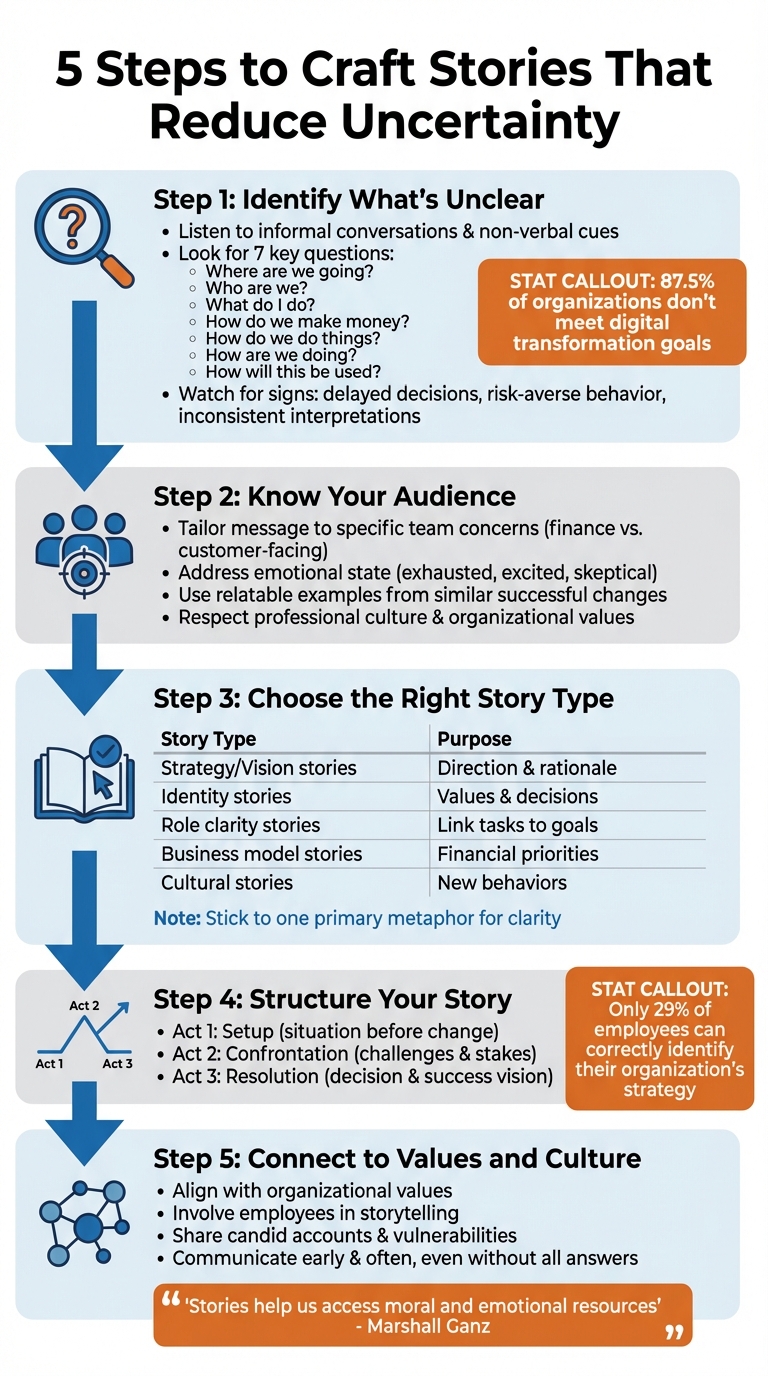
5-Step Process for Crafting Stories That Reduce Uncertainty During Organizational Change
Step 1: Identify What's Unclear
Start by figuring out where the confusion lies. Pay attention to informal conversations and non-verbal cues, as these often reveal underlying uncertainties. Ambiguity tends to cluster around seven key questions: Where are we going? Who are we? What do I do? How do we make money? How do we do things around here? How are we doing? How will this be used?. Look for signs like delayed decisions, risk-averse behaviour, or teams interpreting things in their own way - these behaviours often point to specific areas of doubt.
Gather informal feedback to understand which messages resonate and where gaps remain. It’s also crucial to listen for the emotional undertones. If the team feels overwhelmed by change, ensure your metaphor reflects their reality.
Consider this: 87.5% of organisations don’t meet their digital transformation goals, often because they overlook the importance of cultural shifts and fail to address underlying uncertainty. The issue isn’t usually with the solution itself but with leaders diving into explanations before ensuring their teams understand and agree on the problem.
Once you’ve identified the areas of uncertainty, focus on understanding the people affected by the change.
Step 2: Know Your Audience
After pinpointing the issues, tailor your message to address the specific concerns of your audience. Different teams experience change differently. For example, your finance team may worry about budgets, while customer-facing staff might stress over how new processes impact their daily work.
Address these concerns by shaping your narrative around them. Highlight relatable examples, such as stories of employees who successfully navigated similar changes. This helps make the journey feel achievable.
Be mindful of your team’s emotional state. Are they worn out by constant change? Excited about new opportunities? Skeptical of leadership promises? Your story should acknowledge these emotions and address them honestly.
In UK workplaces, reflect organisational values and respect professional norms. Avoid overly aggressive metaphors like "fighting a battle" unless the stakes genuinely warrant it. British professional culture often appreciates nuanced communication that acknowledges complexity rather than oversimplifying challenges.
With your audience in mind, select a narrative style that directly addresses their uncertainties.
Step 3: Choose the Right Story Type
Not all uncertainties are the same, and each requires a specific type of story. Match your narrative to the uncertainty you’ve identified:
| Uncertainty Type | Story Type Needed | Purpose |
|---|---|---|
| Where are we going? | Strategy and vision stories | Provide direction and explain the rationale |
| Who are we? | Identity stories | Reinforce values and guide decisions |
| What do I do? | Role clarity stories | Link daily tasks to broader goals |
| How do we make money? | Business model stories | Clarify financial priorities |
| How do we do things? | Cultural stories | Encourage new behaviours and habits |
For example, origin stories can establish credibility by showcasing where the organisation or leader started. Quest stories are ideal for setting a vision, focusing on a journey toward a meaningful goal. Rebirth stories work well during major transitions, highlighting transformation and new beginnings.
Consider the example of Kodak. When Steve Sasson invented the digital camera in 1975, management dismissed it, saying, "that's cute - but don't tell anyone about it." This reaction reflected their failure to address the "Who are we?" question during a major technological shift. Unable to reconcile their identity as a "film" company with the digital future, Kodak eventually declined.
Stick to one primary metaphor to keep things clear and avoid overloading your audience. A well-chosen story type naturally provides structure.
Step 4: Structure Your Story
A great story follows a clear arc that guides people through uncertainty. Start with the context, introduce the trigger for change, highlight the struggle, and then outline the decision and resolution.
Use the classic three-act structure:
- Act 1: Setup – Describe the situation before the change.
- Act 2: Confrontation – Present the challenges and stakes involved.
- Act 3: Resolution – Share the decision made and what success looks like, even if it’s still a work in progress.
For example, Amazon uses detailed six-page memos instead of PowerPoint slides to communicate change. These memos force leaders to clearly articulate both the "what" and the "why", ensuring everyone understands the narrative.
Keep in mind that only 29% of employees at high-performing companies can correctly identify their organisation’s strategy from a list of six choices. This statistic underscores the importance of not just structure but clarity in storytelling.
Step 5: Connect to Values and Culture
Your story needs to align with your organisation's values to resonate. Every change narrative should answer questions like: How does this align with who we are? What principles are we upholding? What truly matters to us as an organisation?
Involving employees in the storytelling process helps reinforce these values. When people contribute to the narrative, they’re more likely to support the change. Share candid accounts of past challenges or setbacks - this vulnerability breaks down "us versus them" dynamics and fosters psychological safety.
As Marshall Ganz from Harvard Kennedy School puts it: "Stories are how we learn to access the moral and emotional resources we need to face the uncertain, the unknown, and the unexpected mindfully".
Communicate early and often, even if you don’t have all the answers yet. Silence during times of change only fuels fear and speculation. If leadership doesn’t provide a clear narrative, people will create their own stories, often driven by anxiety. Your story doesn’t need to solve everything - it just needs to be honest about what you know, what you don’t, and what steps you’re taking to find out.
Using Stories Throughout the Change Process
Storytelling as a Continuous Practice
Stories aren't just for launch day - they're a tool for the entire change process. Think of it as a "backstitch" approach, where you keep revisiting and reinforcing the central narrative to frame updates as they arise. Instead of starting fresh with every new development, update the original story to reflect changes. Consistency here is key. Stick to the metaphor you began with - if you started with "building foundations", don’t suddenly pivot to a "journey" metaphor, as that can muddle the message. The goal of change communication is to provide clarity, align everyone on the same path, and inspire the right actions.
"You don't fix change fatigue with a new slide deck. You fix it with clarity, credibility, and consistent follow-through." – Rewired Work
This ongoing narrative approach also creates space for incorporating solid data and equips middle managers to reinforce the story effectively.
Combining Stories with Data and Reports
Stories and data work hand in hand. By using the Story Structure Ring (Initial Situation → Problem → Insight → Solution → Aftermath), you can turn dry reports into compelling narratives. Start by setting the stage with context before diving into the numbers - this helps your audience understand why the data matters. For senior leaders, the Minto Pyramid approach works well: lead with your conclusion, then back it up with the story and data. Keep presentations focused by limiting yourself to two or three key charts to avoid overwhelming your audience. Pair metrics with quotes and observations to bring the data to life. This approach not only makes your case clearer but also harder to refute. In fact, organisations where senior leaders align on a shared change narrative are six times more likely to achieve successful transformation.
When stories and data are combined effectively, middle managers are better equipped to adapt these narratives for their teams.
Helping Middle Managers Adapt Stories
Middle managers play a pivotal role as the bridge between leadership and teams, so they need to be deeply involved in shaping the narrative. Engage them early to uncover sub-narratives that resonate with specific groups. Provide them with adaptable tools, like the Story Structure Ring for crafting detailed narratives or the Minto Pyramid for delivering concise updates to time-pressed stakeholders. Allow managers the flexibility to choose metaphors that align with their teams’ unique perspectives - what works for one group may not resonate with another. Encourage them to blend change data, such as readiness surveys and adoption metrics, with team-specific observations and feedback. Ultimately, the aim is to move beyond simply broadcasting information. By fostering open conversations, managers can help their teams understand not only the why behind the change but also how it impacts their everyday work.
Conclusion
Key Takeaways
Change initiatives often fail, not because people resist, but because they lack understanding. Stories have the power to cut through uncertainty, offering a clear mental map and direction. By using consistent metaphors, tying into shared values, and embedding narratives into every update, you can replace confusion with clarity. As a guiding principle: people don’t change because they’re told to - they change when they understand why it matters and what it means for them.
Storytelling isn’t just an initial step; it’s a tool to be revisited throughout the change process. Consistently reinforce your core narrative, blending stories with data to create a persuasive case. Empower middle managers to tailor these messages for their teams. As Marshall Ganz of Harvard Kennedy School insightfully explains:
"Stories are how we learn to make choices. Stories are how we learn to access the moral and emotional resources we need to face the uncertain, the unknown, and the unexpected mindfully".
This ongoing narrative approach transforms uncertainty into actionable strategies. When storytelling becomes a continuous practice rather than a one-time effort, it builds the trust and understanding needed to make change endure. These principles lay the foundation for tools that turn effective communication into meaningful action.
How Leadership Story Bank Can Help
If you’re ready to harness storytelling for impactful change, Leadership Story Bank offers the resources to help you succeed. This platform goes beyond traditional presentations, providing frameworks and guidance that create narratives people truly connect with. Using the Sensemaking–Alignment–Activation Model, it helps you assess current beliefs, align leadership around a unified message, and activate communication strategies that resonate.
Leadership Story Bank provides tools like strategic metaphor frameworks, future state visualisation prompts, and diagnostic resources such as the Sound & Signal Review to identify what’s working and what’s being overlooked.
Founded by Gail Hackston, an experienced interim change communicator, the platform includes over 300 articles and premium resources through its Inner Circle membership. Whether you’re leading transformation or influencing key stakeholders, Leadership Story Bank equips you to find your voice, shape your core stories, and communicate with confidence. With premium access starting at just £2.50 per month, it’s an accessible way to develop the communication skills that drive alignment, clarity, and action.
FAQs
How does storytelling help teams navigate organisational change?
Storytelling has the power to turn complex, abstract ideas about change into something relatable and emotionally resonant. When leaders frame change as a story - perhaps as a journey or a shared mission - it becomes easier for teams to grasp, remember, and act on the message. Stories bridge the gap between the why of the change and its personal significance, helping to ease uncertainty and reduce resistance.
Studies reveal that stories stick in our minds far better than raw facts, creating a shared language that unites teams and encourages collaboration. A well-told narrative doesn’t just inform - it connects on an emotional level, motivating employees to actively embrace change. When leaders consistently share a positive and clear story, they instil a sense of purpose, minimise pushback, and speed up the transition to new ways of working. Leadership Story Bank supports leaders in shaping these impactful narratives, ensuring that every change initiative is understood, meaningful, and effective.
What are some effective metaphors to help teams understand complex changes?
Metaphors are a powerful way to make complex changes more approachable by linking abstract ideas to everyday experiences. Consider these examples:
- Journey and travel: Framing change as a journey encourages teams to see it as a step-by-step process rather than a daunting overhaul. Expressions like “we’re mapping a new route” or “there’s a mountain to climb” suggest progress, direction, and effort, making the path forward feel tangible.
- Building and architecture: Comparing change to construction paints a vivid picture of creating something solid and lasting. Phrases such as “we’re laying the foundations for a new operating model” or “we’re rebuilding the framework of our service delivery” highlight intention and the importance of groundwork for future success.
By using these metaphors, you can cut through uncertainty, foster shared understanding, and give teams a common way to approach and discuss change.
How can leaders ensure their stories reflect organisational values during times of change?
To ensure that stories align with organisational values during times of change, leaders should anchor their narrative in those very values. Begin by clearly articulating why the change is important, framing it in a way that connects with the organisation’s purpose and principles. By weaving these values into the language, characters, and outcomes of the story, employees can more easily relate to the change, building trust and easing any uncertainty.
Metaphors grounded in values can help make abstract ideas more relatable. For instance, describing change as a "journey" can highlight teamwork, while a "building" might symbolise strength and integrity. Personal stories from leaders can also be powerful - sharing examples of moments when they embodied organisational values in the past can make the narrative feel genuine and forward-thinking. This helps employees see their role in the same value-driven path.
Consistency, however, is non-negotiable. Leaders must ensure their messaging remains aligned across all platforms, whether it's in team discussions, presentations, or visual materials. Any contradictions can undermine credibility, so clarity and coherence are essential throughout the process.