
How Leaders Accidentally Undermine Their Own Messages
Leaders erode trust when actions, jargon or audience neglect contradict their words — practical fixes to restore clarity, consistency and influence.

Leaders often unintentionally weaken their own messages, even when well-prepared. Misaligning actions with words, using overly complex language, or ignoring audience perspectives can erode trust, confuse teams, and damage morale. For example, when Better.com’s CEO fired 900 employees via a short Zoom call, it contradicted the company’s stated values and led to widespread backlash.
Key issues include:
- Inconsistent actions: 64% of employees see a gap between leaders' words and behaviours, which undermines trust.
- Complex messaging: Jargon and unclear communication cost businesses billions annually and confuse teams.
- Neglecting audience perspective: 80% of leaders think they’re clear, but only 50% of employees agree.
The solution? Align words with actions, simplify communication, and connect emotionally through storytelling. Leaders who prioritise clarity and consistency build stronger teams and better outcomes.
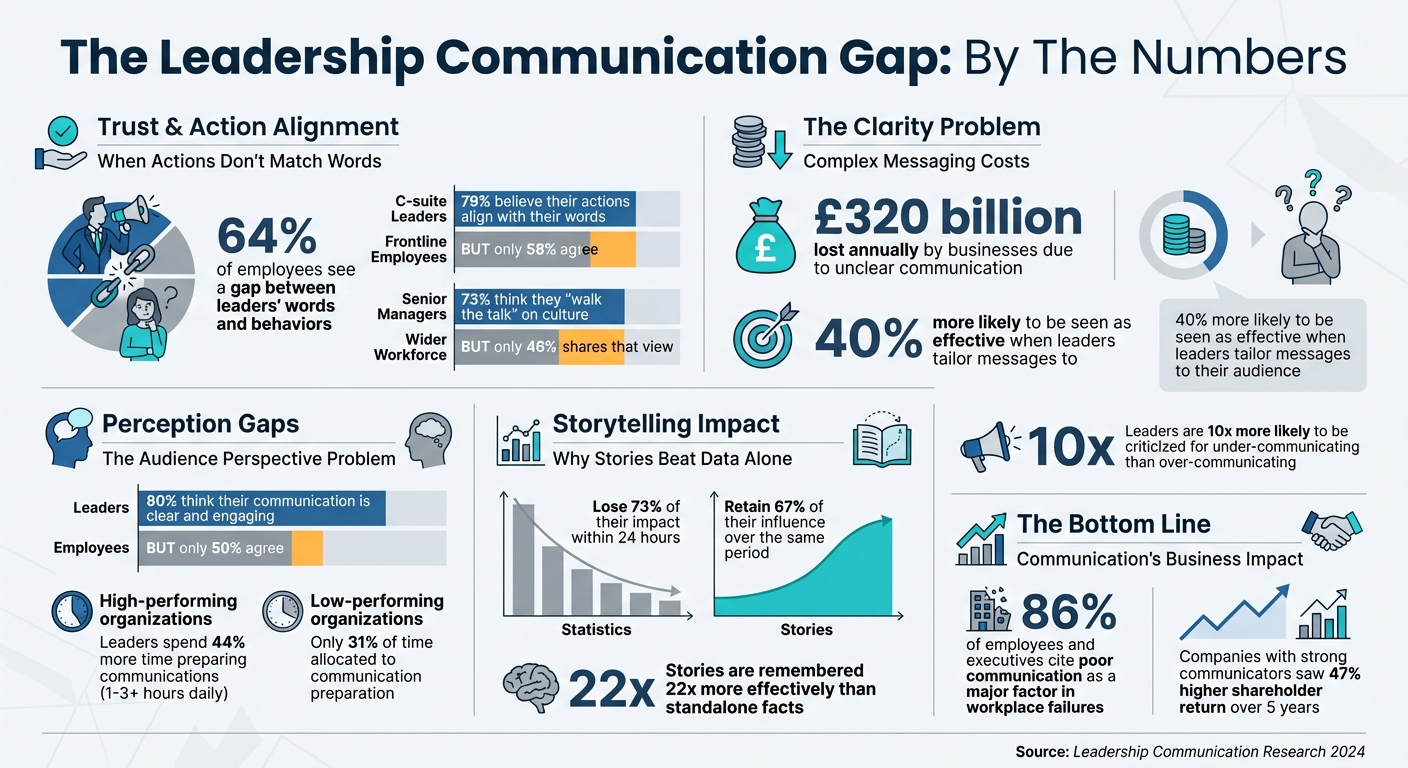
Leadership Communication Gap: Statistics on Trust, Clarity, and Employee Perception
Leadership Communication Mistakes That Quietly Kill Team Performance
When Actions Don't Match Words
The quickest way for a leader to lose trust is by failing to align actions with words. When what you do contradicts what you say, employees notice - and they disengage. The numbers paint a stark picture: 64% of employees observe a disconnect between their organisation's stated values and leadership's actual behaviours. This isn't just a minor misstep; it's a breach of trust that can ripple through the organisation, undermining morale and productivity.
How Mismatched Messages Erode Trust
Mixed signals from leaders tend to alienate employees. As one expert describes it, these messages become "mere corporate decoration", inspiring scepticism instead of commitment. The gap in perception is telling: 79% of C-suite leaders believe their actions align with their words, but only 58% of frontline employees agree. Even more concerning, 73% of senior managers think they "walk the talk" on organisational culture, while only 46% of the wider workforce shares that view.
This disconnect creates confusion and frustration. Employees expend unnecessary energy trying to decipher what’s genuinely expected of them, leading to stress and burnout. Over time, this erodes performance, reduces productivity, and prompts talented individuals to seek opportunities elsewhere.
"Leadership isn't about what you say - it's about what you show. And culture is shaped more by what's modelled than what's messaged." - SmartBrief
Consider the power of consistency in action. Leaders who send pre-dawn emails while promoting work–life balance send a clear, albeit unintended, message: availability matters more than well-being. On the other hand, the US Army demonstrates its commitment to servant leadership by ensuring officers eat only after their soldiers have been served - a practice that speaks volumes about their priorities. These examples highlight how actions, not words, define leadership credibility.
Aligning Words with Actions
Closing the trust gap requires more than good intentions; it demands deliberate, visible alignment between words and actions. This starts with honest self-reflection. A "credibility gap audit", as one expert suggests, involves comparing your stated priorities with how your time and resources are actually allocated. For instance, if you claim to value innovation but penalise every failure, your behaviour undermines your message. Similarly, an "open door" policy means little if your calendar is perpetually booked.
Some organisations have successfully bridged this gap. HubSpot, for example, classifies all employees as "designated insiders", granting them access to detailed financial and management information. This practice reinforces their commitment to transparency through action, not just words. Target took a similar approach in August 2021 by launching a programme to cover 100% of college tuition for its 340,000 full-time and part-time US employees. This initiative backed up their stated commitment to employee development with meaningful investment.
Start small by focusing on one core value and consistently demonstrating it in your daily interactions. For example:
- If inclusion is a priority, actively seek input from quieter team members.
- If collaboration is a cornerstone, ensure performance reviews reward teamwork rather than just individual accomplishments.
Equally important is accountability. Encourage your team to call out instances where your actions don’t align with your words, and own up to those moments when they happen. Far from weakening your position, this openness enhances your credibility. Consistency and accountability are essential for aligning leadership communication with organisational values, fostering a culture where trust can thrive.
The Clarity Problem: Overcoming Complex Messaging
Overcomplicated language can undermine your message just as much as inconsistent actions erode trust.
Why Complex Messages Miss the Mark
Leaders often fall into the trap of the "curse of knowledge." Immersed in the intricacies of their work, they tend to use abstract terms like "innovation", "excellence", or "agility" that may feel clear to them but leave others scratching their heads. These words can obscure meaning because they assume a shared understanding that often doesn’t exist.
The cost of unclear communication is staggering - businesses lose nearly £320 billion each year due to misunderstandings. To make matters worse, as messages filter down through layers of an organisation, key details often fail to reach those working on the front lines. Harvard Business School’s Frances Frei highlights this gap perfectly:
"We mistake having said it for your having heard it".
The problem isn’t just jargon. It’s also about mismatched levels of detail. Executives might be overwhelmed by excessive technical information, while frontline employees are left puzzled by overly conceptual instructions. Striking the right balance is crucial. Research shows that leaders who tailor their messages to their audience are 40% more likely to be seen as effective by their teams. Simplifying messages is not just helpful - it’s essential for clarity and action.
Making Communication Clearer and More Impactful
Once you recognise the pitfalls of complex messaging, the next step is to simplify. Frances Frei offers a straightforward solution:
"If you want broad influence and persuasion, we have to understand it really deeply. And then describe it in a simple and compelling enough way that others can take action".
One effective strategy is to imagine explaining your message to a seven-year-old. This forces you to strip away unnecessary details and focus on the core components of your message.
Tailoring your communication to your audience is equally important. For example:
- For engineers or frontline teams, focus on specific tasks and immediate steps, such as "reducing turnaround time by 7% through code refactoring."
- For board members or investors, emphasise broader goals like "removing friction from the digital delivery chain."
This kind of targeted messaging ensures that everyone, regardless of their role, understands how their work connects to the bigger picture.
Repetition is another vital tool. Messages often lose clarity as they travel through an organisation, so reinforcing key points is critical. This isn’t overkill - leaders are 10 times more likely to be criticised for undercommunicating than for saying too much. Instead of assuming your message has landed, take the time to confirm that your audience has truly understood it.
Ignoring the Audience: Why Perspective Matters
A message, no matter how well-crafted, falls flat if it doesn't connect with its audience. Many leaders mistakenly believe their position guarantees attention, but that's rarely the case. People naturally interpret information through their own beliefs and biases. When leaders fail to account for these filters, their messages risk being ignored or misunderstood. This highlights the need to consider how audience perception shapes communication outcomes.
Understanding Audience Perception Gaps
Complex messaging can confuse, but neglecting audience perspective poses an equally pressing issue. Interestingly, while 80% of leaders think their communication is clear and engaging, only 50% of employees agree. This disparity sheds light on a broader problem of relevance. Leaders in high-performing organisations dedicate 44% more time to preparing their communications (spending 1–3+ hours daily) compared to their counterparts in low-performing organisations, who allocate only 31% of their time to this essential task.
Tom Lemanski, an executive coach, sums it up well:
"Influence doesn't automatically come with authority. It comes with clarity, connection, and consistency".
One common misstep is limiting communication to direct reports, which creates silos and distances frontline employees from the organisation's broader goals.
Tailoring Messages to the Audience
To close these gaps, leaders must adapt their communication to suit each specific audience. Mary Gannon, Executive Vice President at Edelman, cautions:
"A lack of message differentiation means your messages will most likely fall on deaf ears".
A generic, one-size-fits-all approach is a recipe for disengagement.
Using the "Know, Feel, Do" framework can help refine your messaging. This approach encourages leaders to clarify what they want their audience to know, feel, and do. For employees, credibility grows through meaningful interactions and admitting mistakes when needed. For clients, focus on shared values and positioning yourself as a trusted partner. For investors, prioritise transparency and regular updates with consistent messaging. Notably, leaders are nearly 10 times more likely to face criticism for saying too little rather than too much. By tailoring communication, leaders not only engage diverse groups but also strengthen their overall impact.
The Missing Emotional Connection: Why Storytelling Matters
Adding an emotional layer through storytelling is the final piece in effective communication. Even the most meticulously prepared data can fail to resonate if it doesn’t evoke emotion. Leaders often overlook a key insight from neuroscience: humans process emotions and make decisions based on them before applying logic. Skipping this emotional connection forces audiences to make their own leaps, weakening the impact of the message.
Why Data Alone Isn't Enough
Statistics can grab attention momentarily, but their persuasive power fades quickly - 73% of their impact is lost within 24 hours. In contrast, stories retain 67% of their influence over the same period. Even more compelling, people remember stories 22 times more effectively than standalone facts. This isn’t just about memory; it’s about inspiring action. As Nancy Duarte, CEO of Duarte Inc., explains:
"Whilst logical arguments can lead audience members to agree with you intellectually, emotional resonance is often what spurs them into action".
Over-reliance on data can also make leaders appear less empathetic, which undermines their credibility. Presentations that focus solely on analytics create a "chasm effect", making the message feel transactional rather than transformational. While the audience might understand the material, they won’t feel driven to act on it.
Using Storytelling to Build Influence
The goal isn’t to replace data but to enrich it with emotion and context. Corporate communication coach John Bates captures this perfectly:
"Facts inform. Stories transform".
Successful storytelling blends Aristotle’s three rhetorical appeals: Logos (data and logic), Pathos (emotional connection), and Ethos (credibility and character). By pairing data with anecdotes or stories about the people behind the statistics, you create a message that sticks.
A practical framework for storytelling involves six steps: start with a Hook to capture attention, add Context to set the stage, introduce a Shift to highlight the challenge, use an Anchor like a metaphor or relatable image, show Emotion to humanise the story, and tie everything back to the Purpose. Personal stories, even those about failures, foster trust and reduce scepticism. When presenting change, connect it to the organisation’s broader vision and history to explain why now. This approach shifts communication from a "push" (delivering information) to a "pull" (engaging the audience).
Strategies for Aligning Communication with Leadership Goals
Effective leadership communication isn’t just about delivering messages; it’s about ensuring those messages resonate and align across all levels of the organisation. When leaders send mixed signals - like one advocating for innovation while another prioritises caution - the result is confusion, often referred to as "destructive interference", where conflicting messages effectively cancel each other out. To avoid this, leaders must focus on signal coherence, ensuring their communication is unified and consistent, from the boardroom to the frontline.
One common pitfall is "managerial ventriloquism", where leaders deflect responsibility by attributing decisions to others, such as saying, "The CEO wants this." This undermines their authority and fosters a culture of blame-shifting. Tony Martignetti highlights the importance of authentic leadership:
"It's one thing to declare, 'We care about our people.' It's entirely different to prove it in messy, unscripted moments, especially when no one is watching".
To build trust and credibility, leaders must take ownership of their decisions and communicate with precision. Vague terms like "teamwork" or "accountability" often lead to misinterpretation. Instead, these should be clearly defined to ensure everyone has a shared understanding. Additionally, applying the 80/20 rule of listening - spending 80% of the time listening and 20% talking - can help leaders better understand their teams' perspectives. When feedback is gathered, it’s crucial to close the loop by explaining how that feedback has influenced decisions or actions.
Common Pitfalls and Solutions
Here’s a quick breakdown of frequent communication challenges and how to address them:
| Pitfall | Undermining Effect | Practical Strategy | Expected Outcome |
|---|---|---|---|
| Managerial Ventriloquism | Weakens authority; promotes blame-shifting. | Take responsibility for decisions; choose words that reflect autonomy. | Stronger credibility and clearer accountability. |
| Cliché Messaging | Causes confusion with vague language. | Define broad terms with specific, shared meanings. | Greater clarity and alignment on priorities. |
| Signal Interference | Contradictory messages nullify each other. | Ensure consistent messaging across all leadership levels. | Unified organisational momentum. |
| Inconsistent Actions | Breeds distrust and cynicism. | Align actions with stated values, especially in unscripted, high-pressure moments. | Increased trust and engagement. |
| One-Way Communication | Creates perception gaps, such as well-being disparities. | Focus on active listening (80/20 rule) and establish feedback loops. | Enhanced morale and psychological safety. |
Conclusion
Leadership communication goes far beyond simply delivering a message. It’s about aligning words, actions, and signals to build trust and inspire results. When leaders fail to match their stated values with their behaviours or send mixed messages, they risk creating confusion and undermining their credibility. As Laura Sicola aptly explains:
"Leaders don't lose trust when they make mistakes; they lose trust when they deny, deflect, or disguise them".
The numbers back this up: 86% of employees and executives point to poor communication as a major factor in workplace failures, while companies with strong communicators saw a 47% higher shareholder return over five years. Despite this, leaders are almost 10 times more likely to face criticism for under-communicating than for over-communicating, showing that many still underestimate the value of clear, consistent messaging.
Four essential elements underpin effective leadership communication: aligning words with actions, simplifying complex ideas, understanding audience perspectives, and connecting emotionally through stories. Missteps, like the infamous Better.com incident, show how quickly trust can erode when actions contradict words.
The good news? These challenges are manageable. By conducting regular audits to align actions and messages, clarifying ambiguous communication, and using storytelling to bring data to life, leaders can turn communication into a powerful tool for engagement and performance. Credibility is built when what you say consistently matches what you do.
FAQs
How can I tell if my actions don’t match my message?
It's worth taking a moment to think about whether your actions consistently reflect the values and commitments you claim to uphold. If there's a disconnect between what you say and what you do, others may notice, which can erode both trust and credibility. Seeking regular feedback from colleagues or team members can be a practical way to uncover any misalignments. This insight gives you the opportunity to address gaps, ensuring your behaviour aligns more closely with your intentions.
What’s a quick way to simplify a message without losing meaning?
To make a message clearer without losing its essence, break complex ideas into straightforward, actionable points. Stick to a single core message and trim unnecessary words through precise editing. This approach ensures the message remains direct, effective, and easy to grasp.
How do I tailor one message for different audiences?
To craft a single message that resonates with different audiences, begin with a well-defined, consistent core message. From there, adapt the tone, language, and focus to align with the specific needs and expectations of each group. For instance, you might emphasise collaboration and partnership when addressing clients, while highlighting trust and reliability when speaking to employees. The key is to ensure your message remains genuine and reflects your organisation’s values, even as it’s tailored to suit diverse audiences.