
Why Hostile Questions Happen and How to Respond
Spot and defuse hostile questions: pause, reframe, answer with facts, set boundaries and prepare to prevent conflict in meetings and presentations.

Hostile questions can derail even the best-prepared presentation or meeting. These aren't just tough questions - they're often designed to provoke or undermine. How you respond can either defuse the situation or escalate it. Here's what you need to know:
- Recognise hostility: Look for emotionally charged language, sarcasm, or aggressive body language like eye-rolling or interruptions. These are signs the question is more about confrontation than curiosity.
- Understand the cause: Hostility often stems from emotions like frustration, fear, or power struggles. Workplace stress or unresolved conflicts in leadership can also play a role.
- Respond effectively:
- Pause to avoid reacting emotionally.
- Reframe the question to remove aggression, focusing instead on the core issue.
- Stay calm and stick to facts, avoiding defensive or emotional responses.
- Set boundaries if the question becomes unproductive, offering to revisit it later or redirecting the conversation.
- Prepare in advance: Anticipate potential flashpoints by understanding your audience and rehearsing responses to tough questions.
- Create a positive environment: Encourage open dialogue, address concerns early, and build trust to reduce the likelihood of hostility in the first place. This is a core benefit of storytelling in leadership.
Handling Hostile Questions in Your Presentation
How to Recognise Hostile Questions
The first step in managing hostile questions is learning to identify them. Not all tough or direct questions are hostile. The key difference lies in the intention and tone. While a critical question seeks clarity or information, a hostile one is designed to unsettle or provoke. Recognising this distinction is crucial, as it helps you spot the verbal and non-verbal cues that signal hostility.
Signs of Hostility in Words and Body Language
Hostile questions often reveal themselves through both the words used and the questioner’s body language. Verbal signs include emotionally charged phrases like "grossly unrealistic" or digs such as "if you'd put some actual effort in." Sarcasm, repeated interruptions, and statements like "I'm right, you're wrong" are also clear indicators. Sometimes, the questioner might try to trap you with a negative assumption, for instance, "Don't you think you could've done more?"
Non-verbal cues are just as telling. Eye-rolling, avoiding eye contact, checking the time, or a sudden shift to a curt tone can all signal hostility. These behaviours often accompany visible frustration or annoyance, creating a tense atmosphere meant to put you on the back foot. Spotting these signals is essential for handling such situations effectively, as discussed in later sections.
What Causes Hostile Questions
To better interpret these cues, it helps to understand what drives hostility. Often, it stems from underlying emotions like shame, fear, or frustration. When someone feels criticised, defensiveness can act as a shield, deflecting attention by shifting blame onto the other party.
In the workplace, hostile questions frequently arise from concerns about reputation, unresolved disputes, or power dynamics. For instance, a manager stressed about an upcoming deadline might lash out, or a colleague who feels undervalued might use hostility to assert themselves.
The prevalence of workplace conflict in Great Britain illustrates how common these triggers can be. In 2025, workplace conflict reached its peak, with 44% of employees reporting issues. Among managers and their teams, this figure soared to 94%, with 57% experiencing stress, anxiety, or depression as a result. These numbers show that hostile questions often reflect deeper workplace tensions, which, if ignored, can lead to more serious challenges.
How to Respond to Hostile Questions
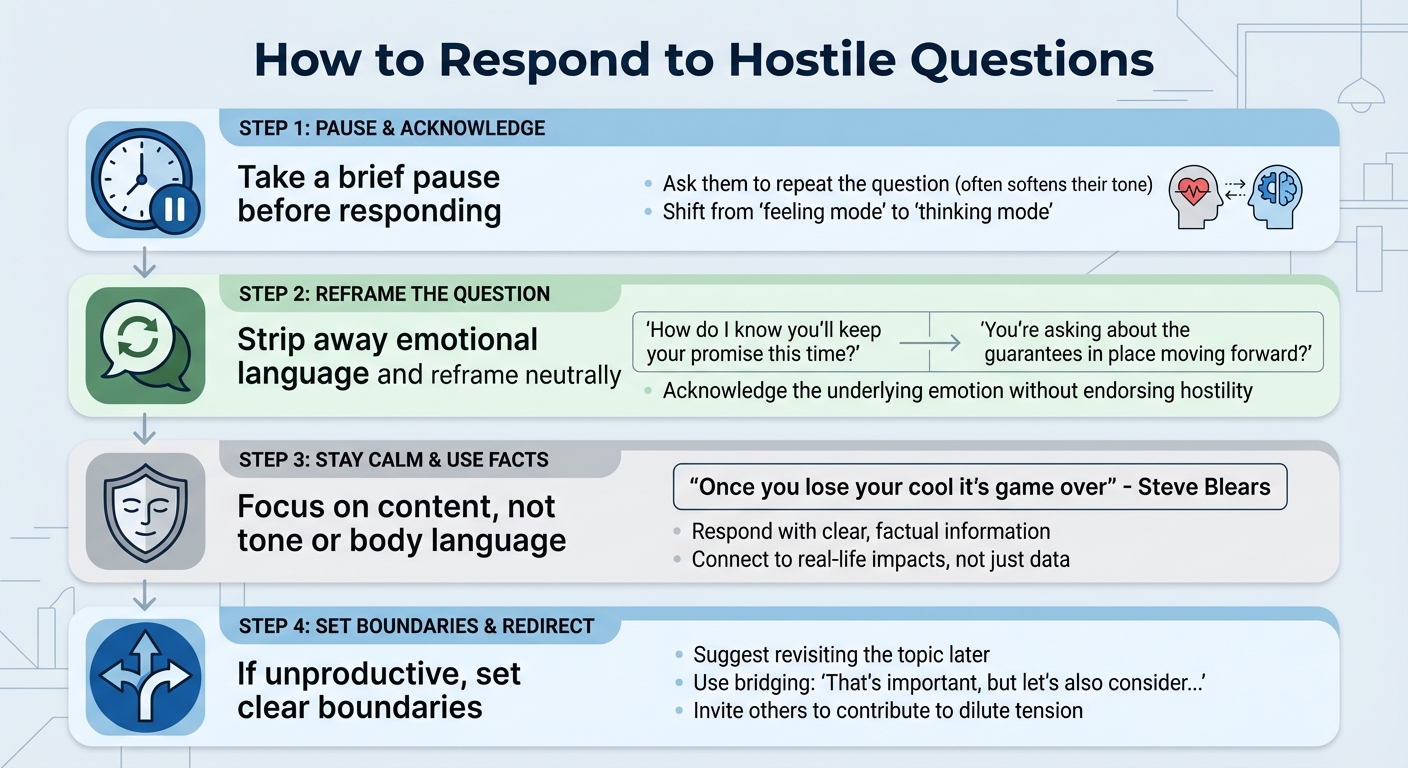
4-Step Framework for Responding to Hostile Questions
Handling a hostile question can either calm tensions or escalate the situation. Building on the ability to spot hostility, the strategies below focus on keeping discussions productive. The goal is to shift from "feeling mode" - where emotions take over - to "thinking mode", allowing you to assess the situation logically. This shift helps you respond thoughtfully rather than reacting impulsively.
Acknowledge Calmly and Reframe
Start by pausing. A brief pause before answering helps you avoid defensive or reactive replies. Asking the questioner to repeat their statement can be particularly effective. This often leads them to soften their language while giving you a moment to prepare a considered response.
Once the question is repeated, strip away any emotional or aggressive wording and reframe it into a more neutral, constructive query. For instance, if someone says, "How do I know you'll actually keep your promise this time?", you might rephrase it as: "You're asking about the guarantees in place moving forward?". This technique shows that you're listening without endorsing the hostility.
"By taking the high ground, you prove yourself to be a good listener who genuinely wants to extract potentially valuable input from someone's question or statement, regardless of its phrasing." – Impact Factory
Recognise the shared goal and acknowledge the underlying emotion. For example, you might say, "I understand how frustrating these delays can be", before addressing the actual issue. This approach positions you as an ally, reducing defensiveness and fostering a more collaborative tone.
Once reframed, focus on delivering a clear, fact-based response.
Stay Calm and Stick to Facts
Keeping your composure is crucial. As Steve Blears, founder of Marvellous Media Training UK, puts it: "Once you lose your cool it's game over. Whatever point you had will be forgotten". Instead of reacting emotionally, staying calm allows you to defuse tension and remain in control.
Concentrate on the content of the question rather than the hostile tone or body language. Identify the core concern and respond with clear, factual information. When possible, connect your response to real-life impacts, whether for team members or customers, rather than relying solely on data. This approach keeps the discussion grounded and can help evoke a more constructive emotional response.
If staying calm doesn’t resolve the situation, it may be necessary to set boundaries.
Set Boundaries and Redirect
Sometimes a hostile question signals an unproductive or overly dominant interaction. In such cases, setting boundaries becomes essential. For example, if the question is too complex or involves a senior stakeholder, suggest revisiting it later: "This is an important topic, and I want to give it the attention it deserves. Can we take a short break and discuss it further afterwards?".
You can also use bridging techniques to redirect the conversation. Acknowledge the question briefly, then pivot with phrases like, "That's an important point, but let's also consider…" or "I understand your concern; however, the key issue here is…". This approach validates the questioner without becoming stuck in their framing.
If one individual continues to dominate, consider inviting others to contribute. Opening the floor to other participants can dilute the tension and restore balance to the discussion, creating a more inclusive and constructive dialogue.
How to Prepare and Prevent Hostile Questions
Anticipating and preparing for hostile questions can transform your approach from simply reacting to confidently steering the conversation. By planning ahead, you can identify potential tension points and address them effectively, often before they arise.
Research Your Audience and Anticipate Concerns
Before stepping into a presentation or meeting, refine your leadership communications by taking the time to understand who will be present and what might provoke a strong reaction. Go beyond surface-level demographics to explore their motivations, frustrations, and areas where they might feel undervalued or overlooked. This deeper insight helps you predict the kinds of questions or concerns that could lead to hostility.
"These [hostile questions] are the thinly veiled challenges to your credibility, knowledge and integrity that can cause even the most seasoned presenter to sweat." – Deborah Grayson Riegel, Keynote Speaker and Leadership Consultant
Pinpoint areas where your audience may lack clarity or feel uncertain. Review your own data and arguments critically to identify any weak spots that could be probed. For example, if you're presenting budget cuts, think about their practical impact - such as how they might affect project timelines or the cost of living. By addressing these issues upfront, you can reduce the likelihood of emotional reactions.
Once you've identified potential flashpoints, the next step is to rehearse how you'll respond.
Practise Handling Difficult Questions
Preparation is key to staying composed under pressure. Rehearsing responses not only builds confidence but also helps you avoid reacting defensively in the moment. Develop a strategy for reframing hostile questions into neutral ones. For instance, if someone asks, "How do I know you'll keep your promises this time?" you might rephrase it as, "You're asking about the guarantees in place moving forward?".
Practise using short, calming responses like, "Thank you for your question. Let me take a moment to consider that", to buy yourself time and manage stress.
"A challenging question won't undermine your confidence if you have a plan." – Deborah Grayson Riegel, Keynote Speaker and Leadership Consultant
Focus on acknowledging the underlying concern rather than the emotional tone. For example, saying, "It seems like cost of living increases are a key concern for you", is far more constructive than, "You sound angry", which can escalate the situation. Work on finding common ground by highlighting shared goals or acknowledging the importance of the issue at hand. Additionally, prepare a polite way to redirect the discussion, such as, "Thank you for your question. Does anyone else have something they'd like to ask?" This ensures one person doesn't monopolise the conversation.
Foster an Atmosphere of Open Dialogue
Creating a positive and respectful environment can significantly reduce the chances of hostility. A warm, approachable tone makes it harder for others to maintain an argumentative stance. Treat every question as a valuable contribution, showing that you respect different viewpoints.
Address potentially sensitive topics early in your presentation to prevent them from becoming flashpoints later on. If there's a misunderstanding, take a diplomatic approach by assuming responsibility for clarifying your message. As Kathryn Perez, a Psychology Doctoral Student at Walden University, advises:
"Make it sound as though you were the one who failed to communicate your research properly, and then go on to explain it again. After all, we want people to leave feeling good about having attended."
This method allows the questioner to save face and helps defuse tension. If a question isn't relevant to the group, briefly acknowledge it and suggest discussing it privately afterwards. This keeps the public discussion focused and ensures a respectful atmosphere. By laying this groundwork, you'll encourage a more constructive and open exchange of ideas.
Building a Culture That Reduces Hostility
Creating a positive workplace culture can prevent hostility before it even begins. The environment you cultivate determines whether disagreements are handled constructively or with aggression. When employees don’t feel safe to speak up, the consequences can be dire. A 2023 report from the National Guardian's Office revealed that many NHS staff hesitated to challenge decisions, even when patient safety was at stake. Establishing respectful communication practices is the first step towards fostering a healthier culture.
Lead by Example in Your Communication
Your communication style sets the tone for your team. If you dismiss concerns, interrupt others, or show favouritism, your team is likely to follow suit. Instead, treat every question as meaningful. When someone challenges your ideas, go beyond a simple "thank you" and acknowledge the validity of their input. As Professor Celia Moore from Imperial College London explains:
"Acknowledging challenge as legitimate (e.g. 'I think that's a fair comment') is a much surer way of eliciting further challenge".
It’s also crucial to address incivility as it arises. Behaviours like talking over colleagues, ignoring emails, or taking credit for others’ work might seem minor, but these "low-intensity deviant acts" can snowball into larger conflicts if left unchecked. Encourage open dialogue by asking targeted questions like, "What reasons are there not to do this?" rather than the more passive "Does everyone agree?" This approach invites concerns early on, preventing frustration from escalating into hostility.
Build Trust Within Your Team
Trust is another cornerstone of reducing hostility, and it’s built gradually through consistent actions. When people feel psychologically safe, they focus on solving problems collaboratively rather than shielding themselves from criticism. Regular one-to-one meetings can help address potential tensions before they grow. These "temperature checks" allow you to ask open-ended questions about team dynamics and personal stressors that might be affecting someone’s patience or tolerance.
Avoid singling out individuals in group settings, as this can make them defensive and less likely to offer genuine feedback. Instead, invite volunteers to share their thoughts or use anonymous voting to make dissent feel safer. When employees see that challenging ideas leads to better results - not reprimands - they’re more likely to engage constructively rather than letting frustrations boil over into hostility.
Conclusion
Dealing with hostile questions doesn't have to disrupt your leadership or damage professional relationships. Spotting the early signs - such as loaded language, accusatory tones, or aggressive body language - enables you to shift your mindset from reacting defensively to responding strategically. This shift not only helps you manage the situation but also offers valuable insights from tough conversations.
As we've explored, recognising and addressing hostility with a thoughtful approach can diffuse tension and even enhance team dynamics. Techniques like rephrasing charged questions, staying composed while presenting facts, and setting clear boundaries equip you to handle difficult situations with poise. When practised regularly, these methods can turn challenging interactions into productive opportunities, fostering a leadership style that thrives under pressure.
Preventing hostility takes consistent effort. By understanding your audience, rehearsing potential scenarios, and promoting open communication and active listening, you can create an atmosphere where disagreements are constructive rather than combative. Ignoring hostility can lead to real risks, including strained relationships and operational setbacks, as a lack of psychological safety stifles honest feedback and collaboration.
Fostering trust within your team transforms conflicts into cooperative problem-solving. When people feel safe to express their ideas, they focus on finding solutions together rather than shielding themselves from criticism. These practices lay the foundation for a resilient, collaborative culture. As Preston Ni, Professor and Author, wisely puts it:
"To know how to handle confrontational and hostile people is to truly master the art of communication. As you utilise these skills, you may experience less grief, greater confidence, better relationships, and higher communication prowess".
FAQs
How can I prepare for challenging questions during a presentation?
Challenging questions are often part and parcel of professional presentations, but with the right preparation, you can tackle them with ease. A good starting point is to anticipate the types of questions you might face and practise your responses with a trusted colleague or mentor. This not only helps you refine your answers but also builds your composure, making those tricky moments feel far less daunting.
When a tough question arises, take a moment to listen closely. This ensures you fully understand the concern before responding. Keep your reply clear and to the point, backing it up with relevant examples or evidence. Maintaining a calm and steady tone is key - it shows confidence and control. If the question needs more in-depth follow-up, be transparent and let your audience know you’ll circle back with a detailed response later.
Tip: Leadership Story Bank offers programmes designed to help professionals enhance their storytelling skills, boost confidence, and handle high-pressure situations with poise.
How can I handle hostility during a meeting?
Managing hostility in a meeting begins with maintaining your composure. Take a moment to pause, breathe deeply, and steady both your tone and body language. An open posture and avoiding defensive gestures signal that you’re ready to engage thoughtfully, not react emotionally.
The next step is to practise active listening. Show you’ve understood the speaker’s concerns by paraphrasing their points and acknowledging the emotions behind their words. Asking clarifying questions can help steer the conversation from blame to facts, opening the door to collaboration. For instance, you might respond with something like, “It sounds like the deadline is a major concern for you. Could you explain more about what’s driving the pressure?”
Empathy and reframing are also effective in easing tension. Statements such as, “I can see why that’s frustrating,” or inviting the person to suggest solutions, can shift the focus towards resolving the issue together. Over time, these approaches can transform challenging interactions into opportunities for deeper understanding and stronger teamwork.
How can fostering a positive workplace reduce hostile questions?
Creating a workplace rooted in respect, psychological safety, and clear expectations can greatly reduce instances of hostile questioning. When leaders consistently demonstrate respectful behaviour and set clear standards for civil interactions, employees feel valued and less inclined to resort to aggressive questioning as a way to protect themselves.
Encouraging a culture of open dialogue and trust also helps to ease the tensions that can trigger hostility. When employees are confident that their ideas will be listened to without judgement, they are more likely to ask thoughtful questions and navigate disagreements constructively. By fostering respect and civility in everyday interactions, organisations can create an atmosphere where collaboration thrives and conflicts are kept to a minimum.
Practical measures such as hiring individuals who prioritise civility, providing training on effective feedback, and recognising courteous behaviour can help build an environment where hostile questioning becomes a rarity, ensuring discussions remain both productive and professional.