
Hero's Journey Framework for Leadership Stories
Frame organisational change with the Hero's Journey to build alignment, reduce resistance and craft leadership narratives that empower teams.

The Hero's Journey, a storytelling model identified by Joseph Campbell, is a powerful tool for leaders. It transforms abstract ideas into relatable narratives, making complex changes easier to understand and embrace. This framework, broken into three acts and 12 stages, mirrors the challenges and triumphs of real-life leadership.
Key Points:
- Why it works: Stories are 22x more memorable than raw data, helping leaders inspire and connect emotionally.
- How it applies: Leaders can frame organisational changes or strategies as collective adventures, addressing resistance and celebrating progress.
- Structure: The journey includes stages like the "Call to Adventure" (introducing change), "Ordeal" (overcoming challenges), and "Return with the Elixir" (achieving goals and applying lessons).
- Practical use: Adapt the framework for team updates, strategy presentations, or personal leadership stories. Focus on making the team or customer the hero, with the leader as the mentor.
This tool isn't just about storytelling - it's about guiding teams through uncertainty, fostering alignment, and celebrating growth. Start small by mapping an upcoming initiative to this structure and watch how it transforms your communication.
The Hero's Journey: Transforming Stories and Businesses
The Hero's Journey Framework Explained
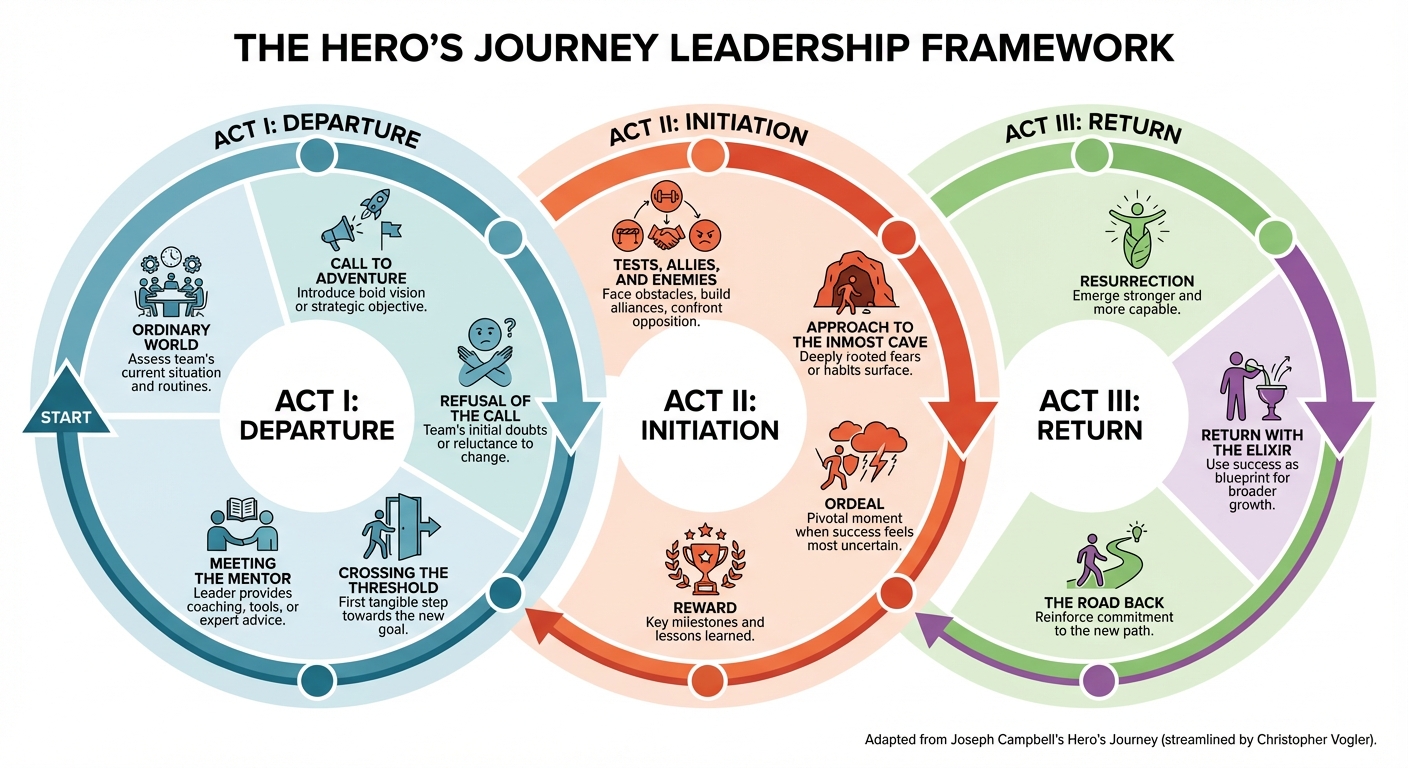
The Hero's Journey 12-Stage Framework for Leadership
The 12 Stages and 3-Act Structure
The Hero's Journey unfolds through 12 stages, organised into three acts. While Joseph Campbell originally outlined 17 stages, Christopher Vogler's streamlined 12-step version has become the go-to framework.
Act I: Departure (Stages 1–5) marks the transition from familiarity to stepping into the unknown. It starts with the Ordinary World, where leaders assess the team's current situation and routines. The Call to Adventure introduces a bold vision or strategic objective, while the Refusal of the Call reflects the team’s initial doubts or reluctance to embrace change. During the Meeting the Mentor phase, leaders provide coaching, tools, or expert advice to build confidence. Finally, Crossing the Threshold signals the first tangible step towards achieving the new goal.
Act II: Initiation (Stages 6–9) represents growth through challenge. Here, teams face obstacles, build alliances, and confront opposition - captured in the Tests, Allies, and Enemies stage. The Approach to the Inmost Cave brings deeply rooted fears or habits to the surface, followed by the Ordeal, the pivotal moment when success feels most uncertain and support is critical. The Reward stage highlights key milestones and lessons learned along the way.
Act III: Return (Stages 10–12) focuses on transformation and integration. The Road Back reinforces the team's commitment to the new path. In the Resurrection stage, individuals emerge stronger and more capable of tackling future challenges. Finally, the Return with the Elixir uses the journey’s success as a blueprint to inspire broader organisational growth.
These stages provide a narrative structure that translates seamlessly into workplace scenarios, offering clarity and purpose during times of change.
Key Terms and Workplace Examples
Reframing the Hero's Journey for workplace settings makes it a practical leadership tool. In this context, the Hero is typically the team or the customer, while the leader steps into the role of the Mentor - offering guidance and resources rather than taking centre stage.
The Boon or Elixir represents a significant organisational achievement, such as launching a successful product, boosting customer satisfaction, or achieving a cultural shift. Threshold Guardians might appear as middle managers or stakeholders who initially resist change and require engagement. Meanwhile, the Shadow symbolises challenges like market disruptions, declining performance, or internal resistance to progress.
By mapping these mythological elements to workplace dynamics, leaders can adapt the framework to suit diverse challenges and contexts.
Simplified Versions for Leadership Use
For faster communication, leaders can use condensed versions of the framework. The 3-Act Structure - Separation, Initiation, and Return - offers a high-level narrative ideal for brief updates or presentations. Alternatively, Christopher Vogler's 7-step model or a streamlined 10-step version provides a quicker way to convey the journey while maintaining its emotional resonance.
The choice of version depends on the situation. Leaders might lean on the full 12-stage framework for long-term organisational transformations, while the shorter models work well for quarterly reviews, strategic pitches, or project-specific discussions. Regardless of the format, the goal remains the same: to guide teams through challenges, acknowledge their resistance, and celebrate their growth and success.
Using the Hero's Journey in Leadership Communication
Change and Transformation Stories
Leading organisational change requires more than just a well-crafted memo or a polished slide deck. The Hero's Journey offers a framework to help teams navigate uncertainty while addressing their fears. Start with the Ordinary World, where you outline the team's current routines, strengths, and challenges. Then introduce the Call to Adventure, which presents the vision or strategic shift. Acknowledge the Refusal of the Call, as hesitation is a natural response, and leaders should approach these doubts with empathy.
The Ordeal stage is often the most challenging, as this is when teams confront deeply ingrained habits and face uncertainty about success. During this phase, leaders must offer unwavering support. Celebrate achievements quickly in the Reward stage to keep the momentum alive, and conclude with the Return with the Elixir, solidifying new habits and ensuring the team doesn’t revert to old patterns. This structured narrative can turn resistance into commitment, keeping teams aligned throughout the transformation process.
Strategy and Vision Stories
While change stories focus on overcoming challenges, strategy stories articulate the vision that drives these changes. Lofty organisational goals often fail to inspire action on their own. By using the Hero's Journey, leaders can connect daily tasks to what Dr. Kathy Cramer describes as a "mighty cause" - a purpose that motivates teams to invest their energy. In these stories, the customer or team should take the role of the Hero, rather than the leader. As Robert Bartram notes, "People resonate better with stories than with raw information simply because they empathise with the person whose story is described".
A practical way to bring strategy to life is through an amalgamation story. This combines real data into a relatable narrative, making the case for change more compelling and harder to ignore. Research shows that information presented in story form is at least 22 times more memorable than plain facts. Additionally, the human brain, which uses 20% of the body’s energy despite only making up 2% of its mass, tends to filter out repetitive data unless it’s wrapped in a captivating narrative.
Clearly define the Threshold Crossing - the moment when the team takes decisive steps away from "business as usual." During the Tests, Allies, and Enemies stage, help teams identify internal and external allies who can assist in overcoming obstacles. This collaborative approach builds engagement and ensures the vision becomes a shared journey rather than an abstract directive. By framing strategy as a collective adventure, leaders foster emotional investment in the organisation’s goals.
Personal Leadership Stories
Sharing your own leadership journey can build trust and demonstrate your growth, but it’s essential to position yourself thoughtfully. As Dr. Kathy Cramer explains, "You are casting yourself in the role of Hero not because you are suffering from hubris. You are the protagonist because you are the one instigating the journey. You are the one with the vision". However, in practice, the leader often plays the role of the Mentor, offering guidance and tools while empowering the team to take the spotlight.
Personal stories resonate most when they reveal vulnerability. Share your Refusal of the Call - the doubts or fears you faced before stepping into a leadership challenge. Describe the Ordeal, when success wasn’t guaranteed, and explain how you emerged stronger during the Resurrection phase. These stories show that growth requires discomfort and that setbacks are part of the process. By humanising your leadership journey, you strengthen connections with your team and make ambitious goals feel attainable.
Step-by-Step Story Design Process
To craft an effective leadership story, start by defining your purpose and audience. Identify the Hero - whether it’s a team member, the entire group, or even a customer. As a leader, you act as the Mentor, guiding and supporting the Hero without overshadowing their role.
Next, paint a clear picture of the status quo. Describe the Ordinary World - the familiar routines, challenges, and context that exist before the journey begins. This helps your audience see themselves in the story. Then introduce the Call to Adventure, which outlines the problem, vision, or goal that disrupts the status quo and signals the need for change.
Address resistance by acknowledging the doubts, fears, or external challenges the Hero might face. Highlight the Threshold Crossing, the first tangible step towards the goal, and guide the audience through the Ordeal, the critical phase where success hangs in the balance.
Finally, bring the story to a close by describing the transformation and return. Emphasise the Reward - the breakthrough achieved - and the Return with the Elixir, which represents the lessons learned and their application. This structured process turns abstract objectives into relatable and actionable leadership narratives.
Common Mistakes in Leadership Storytelling
Using the Hero's Journey as a storytelling framework can be powerful, but it’s easy to misstep. Here’s how to avoid some common pitfalls and keep your narrative both engaging and effective.
Overcomplicating the Framework
While the full twelve-stage Hero's Journey is a classic, trying to cram every communication into this structure can overwhelm your audience. A simpler approach, like a three-act story or a ten-step model, often works better for clarity and impact. Save the complete framework for big moments - think major strategic changes or transformation projects - and stick to streamlined versions for everyday messaging.
Casting Yourself as the Hero
It’s tempting to make yourself the star of the story, but this can alienate your audience. As mentioned earlier, your role as a leader is to be the Mentor, offering guidance and support while your team, employees, or customers take the spotlight. People connect with stories when they can relate to the hero's challenges. Ask yourself: does this story resonate with your audience, or is it just about showcasing your own accomplishments? If it’s the latter, it’s time to refocus.
Walking the Line Between Drama and Credibility
A bit of drama can make your story more engaging, but too much risks losing trust. Beware of the "Tyranny of the Anecdote", where a single dramatic but unrepresentative example overshadows more reliable data. The trick is to use dramatic elements sparingly and anchor them in broader trends or evidence, ensuring your story feels both compelling and credible.
Effective vs. Ineffective Storytelling Approaches
| Feature | Effective Approach | Ineffective Approach |
|---|---|---|
| Protagonist | The team, customer, or employee as the Hero | The leader taking centre stage as the Hero |
| Leader's Role | A Mentor offering guidance and tools | A "Saviour" solving everything alone |
| Structure | Simplified (e.g., 3-act or 10-step) | Forcing all 12 stages rigidly |
| Data Usage | Data woven into a meaningful narrative | Overloading with facts, lacking context |
| Tone | Honest, grounded, and relatable | Overly dramatic or rehearsed |
| Focus | One clear, impactful takeaway | Wandering through unnecessary details |
Building the Hero's Journey into Leadership Practice
Incorporating the Hero's Journey into your leadership approach doesn't have to be reserved for just the big moments. By making business storytelling a consistent part of your leadership style, you can communicate with greater clarity and influence, shaping how your team understands and engages with your vision.
Using the Framework in Everyday Leadership
You can weave the Hero's Journey into regular activities like town halls, team check-ins, project launches, or coaching conversations. For example, when rolling out a new initiative, present it as a "Call to Adventure" - a challenge that shakes up the usual routine. If your team shows hesitation, acknowledge their "Refusal of the Call" with understanding. Step into the role of the Mentor, offering tools, guidance, and encouragement, rather than acting as the hero who solves everything for them.
Take inspiration from the earlier example of a Fortune 500 mobile telecom company. By framing customer challenges within the Hero's Journey, leaders successfully guided 9,000 employees through a strategic transformation. This approach shifts storytelling from being an occasional tool to becoming an integral part of daily leadership.
Reflecting on Your Own Leadership Journey
Your own career story is a treasure trove of lessons and insights. Reflecting on your experiences can help you lead with authenticity and build a deeper awareness of your leadership style. Use the Hero's Journey framework to explore your path: When did I feel the "Call to Adventure" to make a change? What were my moments of doubt or resistance? How did I cross the threshold into new challenges?.
Revisiting the stages of your journey - from answering the call to overcoming challenges - helps you connect your story with the experiences of your team. When stepping into a new leadership role or navigating a major change, take time to assess your current skills against the demands of the situation. This kind of reflection not only strengthens your leadership but also equips you with relatable stories that can inspire and guide your team.
Developing Your Storytelling Skills
Storytelling, like any other skill, improves with practice and thoughtful feedback. Look back at past projects and use a simple structure to analyse them: What was the bold step you took? What obstacles did you face? Who supported you along the way? What advice would you give your past self?. Focus on building three key storytelling abilities: story mapping to organise key moments, emotional balancing to connect with your audience while maintaining credibility, and vulnerability to create a sense of trust and safety during difficult times.
Resources like Leadership Story Bank can help you refine your storytelling craft. These tools guide you in finding your voice, shaping your core stories, and presenting yourself with confidence and clarity. Whether you're leading a team through change, influencing key stakeholders, or simply sharing your vision, honing your storytelling skills will make you a more compelling and impactful leader. By embedding the Hero's Journey into your leadership, you create a narrative that resonates and inspires.
Conclusion: Using Narrative to Lead with Impact
The Hero's Journey offers a straightforward way to communicate effectively, inspire action, and align your team. By breaking change into 12 defined stages, it simplifies complex transitions into achievable steps. This method resonates because it aligns with how our brains naturally process and store information, ensuring critical messages stick rather than fade into the background. Throughout this guide, this framework has been presented as a key part of a leader's toolkit for managing change.
To put this into action, start by identifying your team’s current position (the Ordinary World) and outline a compelling vision for the future (the Call to Adventure). Acknowledge any initial resistance (the Refusal of the Call). Present challenges as part of the journey, framing them as "Tests, Allies, and Enemies" to show that setbacks are a natural part of progress. Celebrate progress and share success stories to build a culture of resilience and determination.
The most important element? Cast the right hero. In any transformation story, your team or customers should take centre stage, not you. By shifting the focus away from yourself, you build trust and reduce scepticism.
Start small. Take an upcoming initiative and map it out: define the current state, address concerns, and guide your team through the threshold of change. As you weave storytelling into your leadership style, it will become second nature - a powerful way to turn your vision into reality.
For more guidance on crafting impactful narratives and enhancing your leadership approach, visit Leadership Story Bank.
FAQs
How can leaders use the Hero’s Journey to address resistance during organisational change?
The Hero’s Journey framework offers a compelling way for leaders to present organisational change as a shared story. By framing the current situation as the "ordinary world" and the change as the "call to adventure", leaders can reframe resistance as a normal part of the process rather than a problem. Obstacles and uncertainties become "trials" to face together, while the leader or a trusted guide steps into the role of the "mentor", providing guidance and encouragement.
This storytelling approach resonates deeply with how our brains process information, making the message stick in a way that raw data cannot. Aligning the change process with stages like "Crossing the Threshold" or "The Final Ordeal" allows leaders to address concerns, recognise milestones, and build confidence in the journey’s ultimate success. This shared narrative not only eases anxiety but also brings teams together with a stronger sense of purpose and alignment.
Leadership Story Bank supports professionals in crafting these meaningful narratives, giving them the tools to lead change with clarity, assurance, and impact.
What is the leader’s role in the Hero’s Journey framework within the workplace?
In the workplace, a leader often steps into the hero’s role, responding to a "call to adventure". This could mean taking charge of a new project, spearheading a change initiative, or steering through a crisis. Such a journey demands stepping out of the familiar, tackling challenges head-on, acquiring new skills, and emerging transformed. Once transformed, the leader returns to their team, sharing fresh insights and a renewed vision to inspire and unite everyone around a shared goal.
Simultaneously, a leader also assumes the role of a mentor, offering guidance and encouragement to others as they navigate their own paths. By demonstrating resilience, offering support, and sharing hard-earned wisdom, leaders empower their teams to overcome hurdles and grow. Balancing these dual roles - hero and mentor - creates a powerful narrative that strengthens team cohesion and nurtures meaningful leadership growth.
Leadership Story Bank equips professionals to craft and share these narratives effectively. It helps leaders articulate their own hero’s journey, convey key lessons, and present their vision with clarity and influence.
How can leaders use the Hero's Journey framework to communicate more effectively?
The Hero’s Journey is a timeless storytelling framework, well-suited for leaders aiming to craft messages that not only connect on an emotional level but also drive action. By using this structure, leaders can create narratives that resonate deeply and encourage their teams to move forward with purpose.
In everyday communication, this journey can be broken down into five straightforward steps:
- Set the context: Begin by outlining the current situation to ground your audience (e.g., "We’re on track to meet our targets").
- Introduce the challenge: Clearly state the goal or obstacle that lies ahead (e.g., "We need to complete the beta launch by next week").
- Acknowledge support: Highlight the resources or allies available to help (e.g., "The design team will assist with the user interface").
- Outline actions: Provide a clear plan of action to address the challenge (e.g., "We’ll run three prototype tests to refine the product").
- Share the outcome: Wrap up by describing the expected result and why it matters (e.g., "This will provide valuable user feedback and guide our next steps").
Framing communication as a mini-heroic journey not only makes messages more engaging but also aligns them with both team and organisational objectives. This method fosters trust, motivates teams, and encourages a storytelling culture within the workplace. Leadership Story Bank offers tools and coaching to help leaders refine this skill, ensuring their messages remain genuine, concise, and effective.