
What Good Internal Communication Looks Like When Leadership Is Working Well
Leaders who use clear, consistent and transparent communication build trust, align teams and drive results with tailored channels, storytelling and metrics.

When leadership communicates effectively, it creates clarity, trust, and alignment across the organisation. Strong internal communication ensures employees understand their roles, see how their contributions fit into broader goals, and feel valued. Here’s the essence of what works:
- Clarity: Leaders use plain language, avoid jargon, and ensure messages are easy to understand. They set specific, measurable goals and confirm understanding to avoid confusion.
- Consistency: Messages across emails, meetings, and digital tools align, reducing miscommunication and building trust.
- Tailored Communication: Leaders adapt their style and channels to suit different audiences, from frontline teams to senior executives.
- Transparency: Open dialogue, active listening, and visible decision-making create trust. Leaders share not just updates but also the reasoning behind decisions.
- Tools and Metrics: Platforms like Slack and well-structured channels improve coordination. Metrics such as engagement rates and task completion measure success.
Effective communication isn’t just about talking; it’s about ensuring teams feel heard and informed, which drives performance, retention, and morale. Small changes - like clearer messaging or better tools - can make a big difference.
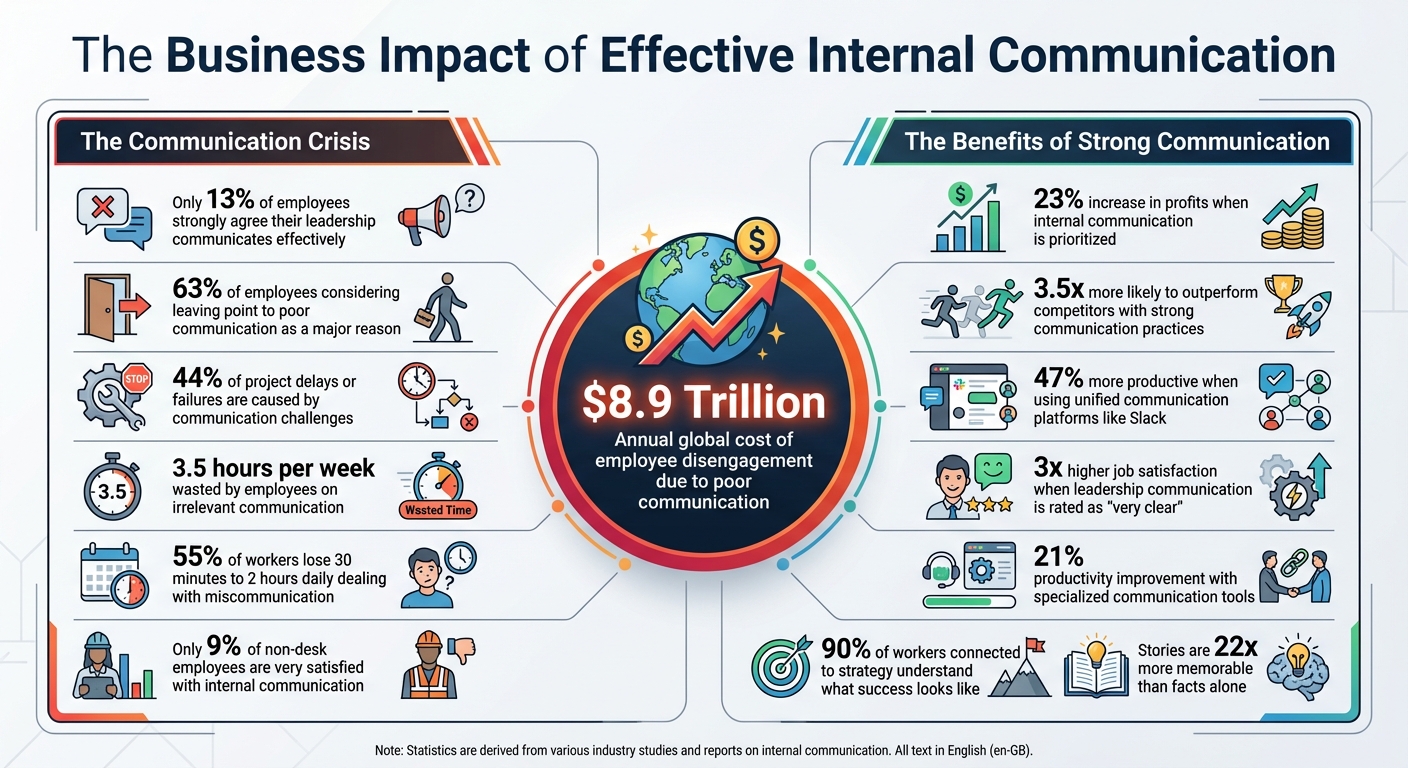
The Business Impact of Effective Internal Communication: Key Statistics
Clear Messaging: Communicating with Purpose
Using Plain Language to Prevent Confusion
Great leaders know that clear communication starts with plain language. When messages are bogged down with jargon or acronyms - think phrases like "full-court press" - teams are often left guessing what’s expected. This lack of clarity can be costly. On average, employees lose 3.5 hours each week to irrelevant communication, with 38% of workers saying they receive too many unhelpful messages.
Plain language isn’t about oversimplifying; it’s about being precise. It’s about choosing clear, direct words over abstract ones and being upfront about what’s known and what’s still uncertain. This approach reduces unnecessary speculation, especially during times of change. For example, instead of tossing around terms like "vision" or "accountability", effective leaders describe exactly what success looks like in practical terms. As Status.net puts it:
"Clarity stands at the core of leadership communication. Messages need to be simple, direct, and free from jargon".
Another key practice? Checking for understanding. Strong leaders don’t just assume their message has landed - they confirm it. Asking team members to summarise tasks or goals in their own words can quickly reveal whether everyone’s on the same page. This habit helps combat the "illusion of transparency", where leaders mistakenly believe their thoughts are clearer than they actually are.
When language is straightforward, it naturally paves the way for setting clear, measurable goals.
Setting Specific Goals and Priorities
Vague instructions lead to confusion and wasted effort. That’s why leaders benefit from using the SMART framework when setting goals: Specific, Measurable, Achievable, Relevant, and Time-bound. This method eliminates guesswork and ensures everyone knows exactly what’s expected. But clarity isn’t just about the "what"; it’s also about the "why." Explaining the reasoning behind decisions helps teams see how their efforts fit into the bigger picture.
Marc Bitzer, CEO of Whirlpool, highlights this point:
"I'm strongly convinced, if our employees understand the broader context of the entire company, it allows them to make better decisions in their respective work environments".
This clarity doesn’t just guide tasks; it fosters alignment. Workers who feel connected to their organisation’s strategy - 90% of them, in fact - are more likely to understand what success looks like.
A structured approach can make setting direction even easier. Leaders might follow a five-step template to outline plans:
- Situation: Describe the current state.
- Background: Share relevant context.
- Goal: Define the desired outcome.
- Connection: Link the goal to broader organisational priorities.
- Expectations: Clarify what success entails.
This method ensures teams aren’t just told what to do - they understand why it matters and how their contributions will be measured.
Adjusting Communication Styles for Different Audiences
Even with clear messaging and well-defined objectives, a one-size-fits-all approach doesn’t work. Different audiences require different communication styles. For example, senior leaders often need high-level insights and strategic implications, while frontline teams benefit more from actionable details and operational guidance. While the core message stays consistent, the way it’s delivered - and the examples used - should adapt to the audience.
The choice of communication channel is equally important. Deskless employees, like drivers or warehouse staff, might not check email regularly, so reaching them via SMS or system notifications can be more effective. Remote teams, on the other hand, might prefer video updates or digital hubs that allow them to access information on their own schedules. The goal is to use channels that align with how people work, rather than defaulting to what leadership finds convenient.
Authenticity also matters. Introverted leaders might shine in small, informal group discussions, while extroverts might excel in larger town halls. Regardless of the format, consistency is critical. The core message and organisational values should remain steady, even as delivery methods and examples shift. By equipping middle managers with a clear messaging framework, leaders can ensure that the substance of the message stays intact, while its relevance is tailored to specific teams and contexts.
Consistency Across Channels: Maintaining Alignment
Regular Updates and Unified Messaging
When leaders share conflicting messages across different platforms, it can create a ripple of confusion. Imagine an email conveying one thing, a team meeting suggesting another, and a Slack channel throwing in something entirely different. This inconsistency not only wastes time but also erodes trust. Research backs this up: 63% of employees considering leaving their jobs point to poor communication as a major reason, while 55% of workers lose between 30 minutes and two hours daily dealing with miscommunication fallout.
The solution? Stick to a single, consistent narrative across all channels. Whether the message is delivered via email, during a team meeting, or through digital platforms, the core content must align. This doesn’t mean copying and pasting the same text everywhere - it’s about ensuring the message’s substance, tone, and key points remain steady, even as the format adapts.
Leaders play a critical role in this. By owning the narrative, they can nip rumours in the bud. Documenting decisions in a centralised, searchable hub - complete with meeting notes and key takeaways - ensures everyone has access to the same information. With 80% of employees expressing a desire to understand how leaders make decisions, this level of transparency is crucial for fostering alignment.
Consistent messaging is just the first step. Using the right tools can solidify alignment even further.
Using Tools for Coordinated Communication
Unified messaging thrives when supported by the right tools. For instance, companies using platforms like Slack have reported being 47% more productive, as these tools help synchronise communication across teams and time zones. However, tools alone won’t work magic - they need to be implemented thoughtfully.
Start by standardising how communication channels are named and organised. Clear naming conventions, such as #help-finance or #help-benefits, make it easier for employees to locate the information they need. This approach avoids the chaos of overly complex folder systems, where critical details often get buried. Instead, topic-based, searchable channels keep knowledge accessible and easy to find.
Automation can also play a big role. Tools like Workflow Builder allow leaders to schedule routine updates, such as weekly summaries, automated check-ins, or announcements, without needing to manually intervene every time. This ensures updates are delivered on time, fostering a predictable rhythm of communication without overwhelming teams with excessive notifications.
It’s also important to address questions promptly, even if the full answer isn’t immediately available. A simple emoji reaction or a quick “working on it” message can reassure employees that their concerns are acknowledged. Pairing this with asynchronous tools like recorded video clips or shared documents ensures that communication remains clear and aligned, even across different time zones, without requiring everyone to join live meetings.
| Channel Type | Recommended Use | Benefit |
|---|---|---|
| Email/Newsletters | Strategic updates, formal announcements | Broad reach; serves as an official record |
| Messaging Apps (e.g. Slack/Teams) | Operational details, quick questions, social interaction | Real-time, searchable; breaks down silos |
| Meetings/AMAs | Complex changes, feedback, sensitive information | Encourages two-way dialogue; builds rapport |
| Digital Hubs/Canvases | Documentation, FAQs, project goals | Centralised "source of truth" to avoid lost context |
Building Trust Through Transparency and Feedback
Encouraging Open Dialogue and Active Listening
Trust thrives when leaders genuinely listen and respond to their teams. This means creating an environment where employees feel their voices matter. Open dialogue can help reduce stress and increase engagement. The key difference lies in leaders who actively seek input and show they’ve taken it on board.
Active listening is more than just nodding or waiting for your turn to speak. It involves setting aside preconceptions and fully understanding the message. As Michael C. Bush, CEO of Great Place to Work, explains:
"Listening is not just making sure you've accurately heard the words... It is choosing to empty your mind and set aside your opinions while someone else is talking".
This level of engagement signals respect and sets the tone for genuine trust-building. When employees see their input shaping decisions, they’re more likely to contribute again. This approach not only strengthens trust but also creates a safe space where everyone feels valued.
Creating Psychological Safety with Fair Treatment
Psychological safety - the assurance that speaking up won’t lead to negative consequences - is essential for open communication. Yet, many employees don’t feel their opinions are valued. Even within senior leadership teams, perceptions of safety vary significantly, with 62% experiencing inconsistent levels of comfort. These discrepancies often arise from unequal treatment.
Fairness begins with recognising where imbalances exist. Are remote workers less engaged in discussions than those in the office? Do some teams hesitate to challenge decisions? Leaders must observe these patterns and address them, fostering an environment where mistakes are seen as learning opportunities rather than failures. This doesn’t mean avoiding accountability. Instead, it involves establishing clear, consistent norms for handling setbacks and ensuring these apply equally to everyone. By prioritising fairness, leaders lay the groundwork for effective feedback systems that continuously improve team dynamics.
Using Feedback Loops to Improve Team Dynamics
Feedback only works when there’s follow-through. Leaders must acknowledge input, act on it, and demonstrate the changes it drives. Without this, even the best-intentioned initiatives can come across as performative. As Julia Markish, Director of Advisory Services at Lattice, points out:
"If your only vehicle for soliciting concerns from employees is five minutes at the end of an All-Hands where you read through a sanitised list of questions, then that's not two-way communication. That's performative".
Effective feedback systems make it easy for employees to contribute and ensure their input leads to visible outcomes. Strategies like Teodora Vassileva’s "What Matters Most?" approach and Marc Bitzer’s live-streamed updates show how timely, transparent feedback builds trust. Closing the feedback loop doesn’t just improve communication - it strengthens the trust that underpins successful leadership.
Authenticity and Visibility in Leadership Presence
Leading by Example with Integrity
Being authentic as a leader means consistently aligning actions with values and communicating openly. Authentic leadership is built on four key principles: self-awareness, relational transparency (explaining the reasoning behind decisions), having a clear moral compass, and balanced processing (actively considering differing viewpoints). As Ghassan Karian, Founder and Chairman of Ipsos Karian and Box, succinctly puts it:
"Authenticity isn't a vibe; it's a verifiable pattern of behaviour".
Research shows that trust in senior leadership is three times higher when communication is perceived as strong. This involves being upfront about compromises, acknowledging missteps with phrases like "we fell short" instead of deflecting blame, and welcoming alternative perspectives before finalising decisions. Such integrity lays the foundation for deeper, more meaningful connections with team members.
Building Rapport Through Personal Check-ins
Creating personal connections outside formal meetings can bridge the gap between leadership intentions and the day-to-day realities employees face. One-on-one check-ins are particularly valuable for those who may feel less comfortable speaking up in larger group settings, such as introverts. These interactions thrive when leaders practice relational transparency by sharing their own challenges openly. While these conversations may not always resolve every issue immediately, even a brief acknowledgment of concerns can leave employees feeling valued and heard.
Staying Visible and Accessible Across Teams
Visibility without accessibility falls short. Leaders must actively engage with their teams, creating opportunities for real-time interaction. Open digital forums, for instance, allow employees to observe decision-making processes as they unfold . Regular "Ask Me Anything" sessions, dedicated help channels like #help-finance, or weekly video updates can help leaders connect with distributed teams .
Modern leadership prioritises two-way dialogue over one-sided announcements. Whether through discussion threads, small-group chats over coffee, or larger town halls, these interactions show that leaders value open communication. By staying accessible and genuinely engaging, leaders not only build trust but also reinforce the transparent culture they aim to foster. More than anything, teams need leaders who are consistently honest - not performers putting on a show.
Internal Communications in 2025: Strategy Guide That Gets Results
Storytelling Tools and Methods for Leadership Communication
Storytelling has the power to elevate ordinary communication into narratives that inspire trust and align teams. While earlier sections focused on clarity and transparency, this one dives into how leaders can use storytelling techniques to make their messages more impactful.
Why Stories Matter in Leadership Communication
Stories turn dry updates and abstract goals into relatable narratives that connect emotionally with people. Facts alone rarely motivate action, but stories are up to 22 times more memorable. Sharing experiences of failure and perseverance, not just triumphs, helps leaders foster a deeper connection with their teams and the organisation. Nancy Duarte, CEO of Duarte, Inc., captures this idea perfectly:
"To tell a really good story, you have to say I tried and I failed and then I tried again... it's the most powerful device to build devotion to yourself and the brand".
Great leaders often keep a "story basket" with three essential narratives ready to share: an origin story, a personal account of why they joined the organisation, and a story about overcoming a professional challenge. These aren't rehearsed pitches - they’re genuine stories that make leaders more approachable. To craft meaningful stories, leaders should first conduct "listening tours" to understand employees’ concerns and priorities, then shape narratives that address those insights.
This approach highlights the clear difference between standard updates and storytelling-based communication.
Standard Updates vs. Story-Based Communication
| Feature | Standard Updates | Story-Based Communication |
|---|---|---|
| Primary Focus | Facts, data, and directives | Emotional connection and meaning |
| Retention | Low; often forgotten | High; up to 22 times more memorable |
| Leader's Role | Information provider | Visionary and possibility creator |
| Employee Role | Passive listener | The "Hero" of the story |
| Impact on Trust | Neutral; may feel authoritative | Builds trust and humanises leaders |
| Challenge | Risks "inbox fatigue" | Demands vulnerability and practice |
Leveraging Leadership Story Bank Resources
To take storytelling further, leaders can use tools like the Leadership Story Bank, which helps shift communication from information-sharing to sensemaking - explaining the "why" behind decisions, such as using stories in change management. This tool uses a six-part framework to structure stories:
- Context: The current situation
- Case for Change: Why action is needed now
- Vision: The desired future
- Pathway: How to achieve it
- Impact: What it means for people
- The Ask: Specific actions or behaviours needed
As Leadership Story Bank puts it:
"People don't engage with strategy slides. They engage with stories".
Before sharing a story, apply the "pub test" - if it doesn’t sound natural in casual conversation, it needs refining. Revisit and reinforce the narrative across multiple communication channels, rather than treating it as a one-off message. Leadership Story Bank also offers diagnostic tools to test stories with sceptical audiences before rolling them out widely.
Measuring Success: Indicators of Effective Internal Communication
Clear messaging and transparency are essential, but measuring success is where the impact of internal communication becomes evident. Effective communication doesn’t just inform - it drives measurable business results. Leaders who excel in this area focus on two types of metrics: operative metrics (how well channels and content perform) and strategic metrics (how communication contributes to business outcomes). This approach shifts the focus from surface-level statistics, like email volumes, to data that reflects real progress in areas like employee retention, decision-making speed, and overall performance.
Key Metrics for Communication Success
A structured framework, often referred to as a Measurement Ladder, helps track progress from basic activity to business outcomes. At the base level, reach metrics - such as Audience Coverage (the percentage of your intended audience reached) and Channel Delivery Rate - ensure the technical aspects of communication are functioning smoothly. Moving up, engagement metrics like Click-Through Rates, Read Time, and Reactions per 1,000 employees highlight whether people are actively interacting with your content.
However, engagement alone isn’t enough. To measure understanding, tools like micro-quizzes or pulse surveys conducted 24–72 hours after an announcement can assess recall and comprehension rates. At the top of the ladder are the most telling indicators: behavioural and business metrics. These include Task Completion Rates (e.g., policy acknowledgements or training completions), Employee Retention Rates, and Manager Cascade Effectiveness - the percentage of managers who successfully share key messages with their teams within 24–72 hours.
The impact of clear communication is tangible. Employees who rate leadership communication as "very clear" report job satisfaction levels three times higher than those who find it unclear. These metrics don’t just measure efficiency - they highlight the broader organisational benefits of effective communication.
Organisational Benefits of Better Communication
Clear, consistent communication has a direct impact on profitability, with organisations reporting a 23% boost in profits when internal communication is prioritised. Companies with strong internal communication practices are also 3.5 times more likely to outperform their competitors. Beyond financial gains, better communication helps projects move faster. In fact, communication challenges are responsible for delays or failures in 44% of cases.
To showcase the return on investment, track metrics like "Ticket Deflection" (a reduction in support tickets after major announcements) and Time Saved - calculated by multiplying the minutes saved per task by the number of employees and their hourly rate. Additionally, using specialised communication tools can improve productivity by 21% and retention rates by 14%. David Grossman, founder and CEO of The Grossman Group, highlights the importance of this:
"Measurement helps create credibility for communication among an organization's employees and leaders, and ensures that communication has a place at the table in any strategic business discussion".
To ensure fairness and inclusivity, segment your data by department, role, and location. This helps identify gaps - particularly for groups like non-desk employees, of whom only 9% report being "very satisfied" with internal communication. Establish benchmarks using 3–6 months of historical data before implementing new initiatives. Finally, close the feedback loop by sharing survey results and outlining next steps with employees, reinforcing trust and transparency. These practices not only strengthen communication but also contribute to an organisation’s overall success.
Conclusion
Internal communication isn't about bombarding employees with messages; it's about delivering the right ones - messages that are clear, consistent, and meaningful. When leadership gets this right, communication becomes the backbone of an organisation, aligning teams, building trust, and driving tangible business results.
Start by conducting anonymous surveys to identify communication gaps and ensure every message has a clear purpose. Alarmingly, only 13% of employees strongly agree that their leadership communicates effectively, highlighting the urgent need to create an environment where people feel safe to speak up and take risks without fear.
The stakes are high. Poor communication can lead to disengagement, which costs the global economy a staggering $8.9 trillion annually. On top of that, employees waste 3.5 hours each week sifting through irrelevant information. Trust is another casualty, with more than a quarter of workers feeling unsupported by their employers. As trust expert Rachel Botsman puts it:
"Trust enables us to feel confident enough to take risks and open ourselves up to being vulnerable".
The strategies outlined in this article - like using storytelling in updates or implementing clear measurement frameworks - are proven to work. Whether it's dedicating specific channels for routine queries or tailoring newsletters with leadership insights, these small steps can collectively transform the communication culture.
Start with manageable changes, measure your progress, and refine your approach yearly. Most importantly, close the loop by sharing the results of your efforts. Organisations that focus on improving internal communication not only strengthen their reputation but also create workplaces where employees are motivated to excel.
FAQs
How do I cut jargon without dumbing things down?
To make communication clear and relatable, stick to straightforward language that’s easy for everyone to grasp. Swap out overly technical or complicated terms for simpler ones when possible. The goal is to keep your message accessible, especially during times of change or uncertainty. This approach not only ensures understanding but also fosters trust and connection with your audience.
Which channels should we use for deskless staff?
For deskless employees, it’s crucial to use communication tools that fit their mobile and often offline work settings. Mobile apps and messaging platforms work well for delivering real-time updates and fostering engagement, as they’re easily accessible on smartphones or tablets. Traditional desk-based tools such as email or intranet portals are less effective for these fast-moving roles. Prioritise mobile-friendly, intuitive solutions that ensure staff stay connected and informed, no matter where they are.
What KPIs prove internal comms is working?
Key performance indicators (KPIs) that highlight the success of internal communication include employee engagement, message reach and comprehension, behavioural shifts, and impact on business outcomes like safety compliance or product adoption. These metrics offer a clear picture of how effectively internal communication efforts support organisational objectives.