
From Broadcast to Sensemaking: Rethinking Internal Communication
Move internal communication from one‑way broadcasts to sensemaking—foster two‑way dialogue, shared purpose and clearer leadership during change.

Internal communication has long been a one-way street - leaders announce decisions, employees listen, and feedback is rare. But this outdated model often leads to mistrust, disengagement, and costly misunderstandings. Research shows that only 51% of employees trust their leaders, and 60% don’t understand their organisation’s goals.
A better approach is sensemaking. This focuses on dialogue, clarity, and shared understanding, enabling employees to see the "why" behind decisions and actively contribute to organisational goals. Companies using sensemaking are up to seven times more successful in change initiatives and see significant boosts in engagement and retention.
Key takeaways:
- Broadcast communication: One-way, top-down, and often ineffective.
- Sensemaking: A collaborative process encouraging dialogue, alignment, and action.
- Benefits include stronger trust, better engagement, and clearer understanding of goals.
This article explores how leaders can shift to sensemaking, using strategies like two-way dialogue, clear vision, and shared values to create lasting impact.
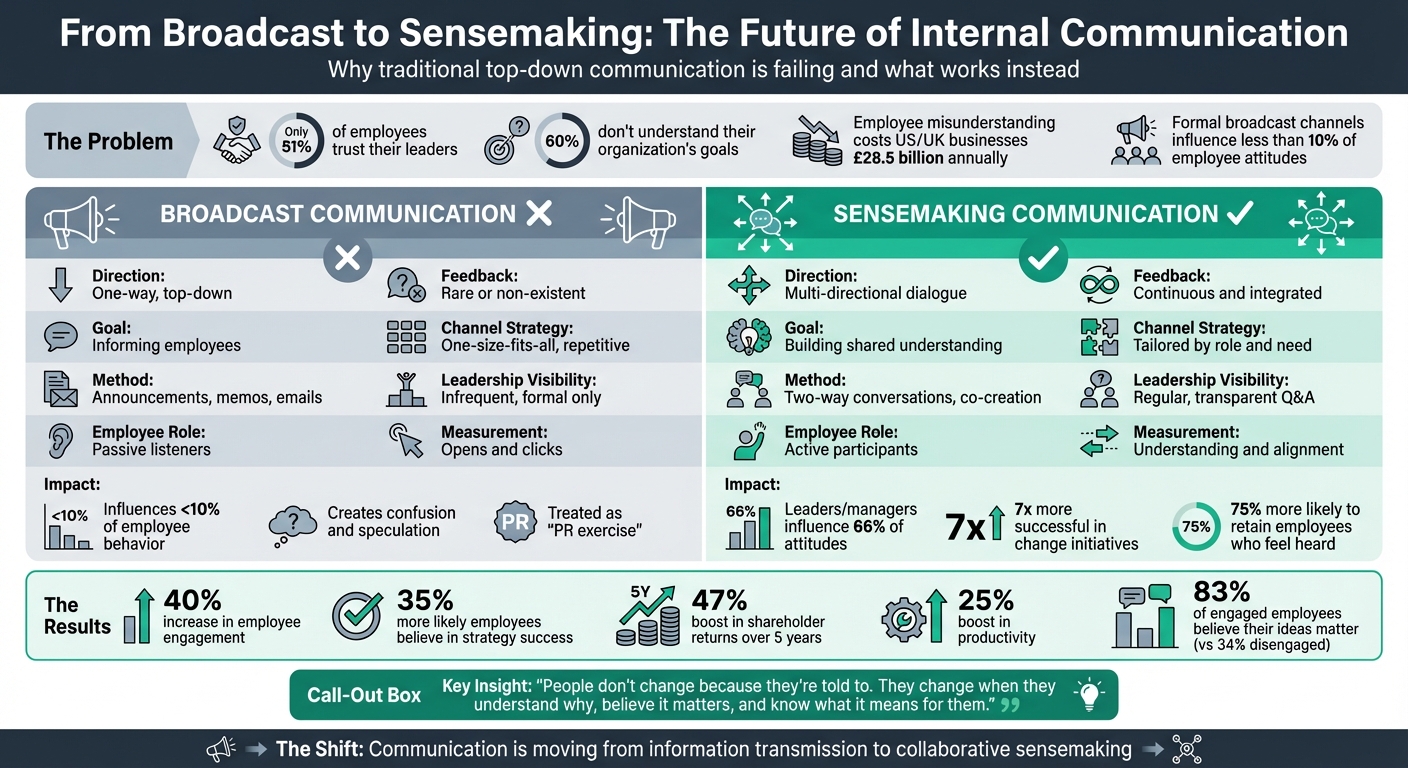
Broadcast vs Sensemaking Communication: Key Differences and Impact
Broadcast vs Sensemaking: What's the Difference?
What Broadcast Communication Looks Like
Broadcast communication works like a one-way loudspeaker: information flows from leadership to employees with no expectation of feedback. Think of the all-staff email announcing a restructure, a memo outlining a new policy, or a poster campaign promoting company values. The organisation speaks, employees listen, and that's the end of it.
This approach often reduces internal communication to a "PR exercise", focused on presenting management decisions in a polished format. As Bill Quirke explains:
Traditionally, internal communications has focused on the announcement of management conclusions and the packaging of management thinking into messages for mass distribution to the 'troops'.
Typically, this type of communication is tacked onto the tail end of decision-making, acting more as damage control than a tool for fostering alignment or engagement.
The downsides are clear. Formal broadcast channels influence less than 10% of employee attitudes and behaviours, while managers account for two-thirds of this impact. When employees don't understand the reasoning behind decisions, they often fill the gaps with fear and speculation. This confusion can have serious consequences: research shows that employee misunderstanding - actions based on misinformation or confusion - costs businesses in the US and UK around £28.5 billion annually.
In contrast, sensemaking shifts the focus from top-down announcements to creating meaningful dialogue that actively involves employees.
What Sensemaking Means for Internal Communication
Sensemaking offers a radically different approach, addressing the shortcomings of one-way communication. Instead of just delivering information, it creates opportunities for employees to interpret, question, and actively shape organisational narratives. Karl E. Weick describes sensemaking as the process of turning circumstances into actionable understanding.
This method treats change as an ongoing psychological adjustment rather than a simple event. While broadcast communication merely informs, sensemaking builds understanding and alignment by recognising that employees need varied forms of communication to truly engage.
The benefits are tangible. By explaining the "why" behind changes, sensemaking reduces speculation and encourages productive contributions from employees. Research shows that 75% of employees are more likely to stay with an organisation where they feel heard and their concerns are addressed. Furthermore, 83% of engaged employees believe their ideas and suggestions matter, compared to just 34% of disengaged employees. In workplaces where trust levels dictate the need for more or less communication, sensemaking prioritises meaningful dialogue over frequent, impersonal updates.
Leadership Is Sense-Making: How to Lead with Clarity and Purpose - Gihan Perera, Futurist Australia
Core Principles of Sensemaking for Leaders
Shifting from a top-down communication style to one that fosters shared understanding requires leaders to embrace strategies that promote dialogue, clarity, and shared values. These principles form the foundation of a more collaborative approach to organisational communication and decision-making.
Creating Two-Way Dialogue
Sensemaking thrives on interaction. Leaders need to cultivate environments where employees can question, interpret, and add to organisational narratives rather than merely absorb information. This goes beyond the traditional cascade model, where communication flows downwards and often ends at delivery.
Open dialogue brings measurable benefits: when employees feel genuinely heard, they’re more likely to stay engaged and contribute meaningfully to the organisation’s goals. To foster this, leaders must address the imbalance between what leadership knows and what teams understand. This can be achieved by carefully sequencing information and employing structured frameworks like the DAC Model. This model evaluates Direction (clarity of vision), Alignment (how work integrates), and Commitment (shared responsibility for outcomes). Additionally, adopting "both/and" thinking over "either/or" approaches helps leaders navigate complex challenges effectively.
Once dialogue is established, a clear and shared vision becomes essential to ground and guide the sensemaking process.
Communicating a Clear Leadership Vision
A well-defined vision serves as a guiding light, particularly during times of uncertainty or upheaval. It prevents speculation and ensures employees’ efforts are aligned with the organisation’s goals.
The statistics speak volumes: employees who understand the business strategy and their role in it are 35% more likely to believe in its success. Furthermore, organisations with "excellent" internal communication see a 40% increase in employee engagement.
"A well-crafted strategic narrative acts as a north star for the organisation and outlines the business strategy, which, in the tumultuous 2020s, will be in constant need of recalibration."
– Institute of Internal Communication
To communicate vision effectively, leaders should address the "4 Ps" of change: Picture (what success looks and feels like), Purpose (the reason behind the change), Plan (the roadmap to achieve it), and Part (the specific role of each employee). Importantly, this isn’t just an internal PR effort - it’s a leadership responsibility. Vision must be communicated early and consistently, shaping understanding rather than responding reactively to crises.
While vision provides direction, shared values offer the lens through which employees interpret and respond to change.
Building Shared Understanding of Organisational Values
Shared values are the foundation of sensemaking, especially during periods of uncertainty. When internal communication is rooted in these values, employees gain a framework to navigate ambiguity and make decisions that align with the organisation’s purpose.
For this to work, integrity is key. There must be no gap between what the organisation claims to value and how it behaves. Leaders play a critical role in demonstrating these values through daily decisions and actions, ensuring alignment between words and deeds.
Creating shared understanding also involves framing challenges, analysing issues, and generating solutions. Employees today are less likely to defer to authority blindly; instead, they trust genuine narratives and shared knowledge. This shift from "deference" to "reference" underscores the importance of authenticity and transparency in values-based communication.
Together, these principles - dialogue, vision, and values - mark a significant departure from traditional, one-way communication. They pave the way for a more collaborative and inclusive approach to organisational understanding.
How to Move from Broadcast to Sensemaking
Shifting from one-way communication to a more collaborative approach requires leaders to rethink how they engage with employees. This isn't just about adding new tools or channels; it's about redefining the relationship between leadership and the workforce. Research highlights that leaders and line managers influence 66% of employee attitudes, while traditional broadcast methods account for less than 10%. This underscores the need to move away from top-down communication models and towards meaningful dialogue.
The Sensemaking–Alignment–Activation Model offers a clear framework for this transformation. Leaders must first understand and explain the context behind changes (sensemaking), align their actions with their messaging, and then actively engage employees to encourage new behaviours. This order is key, as employees are often sceptical of traditional, top-down authority. As Kevin Ruck, Co-founder of PRAcademy, puts it:
The era of internal information transmission is coming to an end. Polished prose is seen as mere propaganda. Organisations that embrace the potential of giving employees a voice will see their culture energised.
This model lays the foundation for practical changes in leadership communication.
Explaining the 'Why' Behind Changes
Resistance to change often stems from a lack of clarity. When employees understand how their roles contribute to broader organisational goals, they are 54% more likely to support the change. Yet, only 13% of U.S. employees strongly agree that their leaders communicate effectively.
This disconnect can be partly attributed to what Satya Nadella, CEO of Microsoft, calls "information asymmetry" - leaders have access to far more context than their teams. Closing this gap requires frequent and transparent communication, even when all the answers aren't yet available. Silence leaves room for fear and speculation to take hold.
Clear communication transforms employees from passive observers to active participants. DBS Bank demonstrated this between 2023 and 2024 under Managing Director Yan Hong Lee. By rallying employees around the simple mission of "making banking joyful", the bank made complex strategies easier to grasp and connected employees to a shared purpose. The takeaway? A concise and meaningful narrative can make all the difference.
One effective method is the "Head-Heart-Hands" approach: explain what employees need to know (Head), what they need to believe (Heart), and what they need to do (Hands). This framework shifts communication from simply sharing information to genuinely persuading and inspiring action. Additionally, acknowledging potential losses during times of change can build trust and a sense of fairness.
Using High-Impact Communication Formats
The format of communication matters as much as the content. For complex changes, interactive formats like workshops or town halls are far more effective than static channels like emails or posters. These formats allow for real-time feedback and foster a shared understanding through open dialogue.
Town halls and Q&A sessions work best when they feel authentic rather than staged. Employees can easily spot the difference between genuine conversations and scripted performances. Creating an environment of psychological safety - where employees feel free to voice concerns without fear - is crucial.
Storytelling is another powerful tool. Studies show that people remember stories up to 22 times more than standalone facts. Stories provide emotional context, making abstract strategies relatable and memorable. They help employees see their role within the broader organisational narrative.
For particularly complex ideas, metaphors can make concepts more accessible and engaging. The chosen communication format should align with the complexity of the message and the level of interaction required.
These approaches set the stage for deeper involvement, which is the next critical step.
Involving Employees in Co-Creating Narratives
The most impactful shift occurs when employees actively participate in shaping organisational stories. As Rewired Work aptly notes:
Nobody supports what they've been excluded from.
The LEGO Group's "Leadership Playground" initiative is an excellent example. This model encourages everyone in the organisation to act as a leader, fostering a sense of shared responsibility rather than relying solely on executives for direction.
Two-way communication significantly improves employee retention. Anchor, a not-for-profit organisation, demonstrated this by involving employees in creating a "strategic narrative map" during a major growth initiative. Manager-led conversations helped double employees' understanding of the business strategy. Treating employees as collaborators, rather than passive recipients of information, was key to this success.
To make this work, line managers need to take the lead in sensemaking discussions. Given their substantial influence on employee attitudes, they are the most effective channel for these conversations. Tools like pulse surveys and interactive platforms can create feedback loops, helping identify and address misunderstandings in real time. Instead of simply transmitting information, leaders should focus on curating knowledge and fostering genuine employee input.
Using Storytelling for Sensemaking
Storytelling is a powerful way to make abstract strategies more relatable and actionable. While traditional communication methods often focus on delivering information, storytelling goes further by creating meaning. It helps people grasp not only what is happening but also why it matters and where they fit into the larger picture. Research highlights that stories are remembered up to 22 times more than standalone facts, making them a vital tool for leaders navigating change or fostering alignment.
A well-crafted strategic narrative acts as a guiding "North Star" for an organisation, connecting individual roles to broader objectives through what experts describe as a "golden thread". This isn’t about polished corporate messaging but about building a shared understanding that evolves through open dialogue. As storytelling expert Vikki Kirby points out:
The power of stories in organisations comes not from themselves, but from the capacity they have for people to make sense of the world and their part in it.
By using storytelling, leaders can bridge the gap between high-level strategies and day-to-day actions, creating a foundation for sharing personal stories that resonate deeply.
Sharing Leadership Stories
When leaders share personal stories, they build trust in ways that formal announcements simply cannot. Authentic experiences, including moments of struggle or failure, make leaders more relatable and human. Overly polished narratives can feel like marketing, so using natural, conversational language is crucial. A helpful structure for crafting these stories includes: Context → Conflict → Resolution → Outcome → Call to Action.
Encouraging Employee Stories
The real magic happens when employees themselves become storytellers. As Maya Angelou beautifully put it:
When the storyteller tells the truth, she reminds us that human beings are more alike than unalike.
Employee stories enrich the collective narrative, strengthening organisational culture and countering the exclusivity that can lead to disengagement. Leaders play a key role in creating safe spaces where employees feel confident sharing their experiences. This means fostering respect, ensuring confidentiality, and emphasising that participation is voluntary.
Reflective prompts like "What are you most proud of?", "What changed for you after this experience?", or "What would you want others to learn from this challenge?" can uncover stories that reveal the human impact of organisational efforts. Middle managers are especially important here, as they connect leadership narratives with the realities of the frontline, helping to create authentic storytelling across all levels.
Using Leadership Story Bank for Story Crafting
The Leadership Story Bank is a resource designed to help leaders develop storytelling skills that enhance sensemaking. It provides tools and frameworks for crafting core stories that clarify complex situations - whether guiding teams through change, influencing stakeholders, or aligning people around shared values. This approach moves away from generic corporate messaging, focusing instead on creating authentic and impactful narratives that truly resonate.
Beyond storytelling, leaders can develop their ability to "story-listen" by identifying and engaging with the narratives already present within their organisations. This collaborative approach helps build what experts call an "organisational StoryWorld" - a shared language of change that ensures everyone reaches the same understanding. By co-creating these narratives, organisations strengthen their collective sensemaking and alignment.
Implementing and Sustaining Sensemaking Approaches
Shifting from a broadcast approach to one rooted in sensemaking means weaving this practice into everyday communication. It's about creating a collaborative narrative that sticks. But this shift can only last if managers, communication channels, and feedback systems work in sync. Without this alignment, even the most compelling narratives risk fading over time. Let’s explore practical ways managers and communication channels can embed sensemaking into daily routines.
Creating Manager-Led Discussions
Managers hold a unique position of trust and influence. To move beyond simply relaying messages, they need to become facilitators of understanding. This requires giving them not just the "what" but the "why" behind decisions. Share the context - explain the alternatives that were considered, the trade-offs that were made, and the challenges leadership anticipates. When managers have this depth of understanding, they can tailor messages to resonate with their teams.
A practical framework for manager-led discussions includes three steps: Framing (clearly defining the issue), Assessing (examining the difficulties), and Generating (identifying actionable solutions and commitments). For instance, you might ask your internal communications team, "What would help you feel fully prepared to communicate this to your team?" This approach builds confidence, as managers can address questions with clarity rather than relying on memorised scripts.
Launching Multichannel Engagement Campaigns
For sensemaking to thrive, a well-thought-out channel strategy is essential. Each tool should have a specific purpose. Use email for formal updates, platforms like Slack or Microsoft Teams for quick, interactive discussions, and mobile apps to keep frontline staff informed. Avoid redundancy - repeating the same message across channels can dilute its impact.
Research shows that companies with strong internal communication experience a 25% boost in productivity. To achieve this, consider a "hub" model where a central platform connects all communication tools. This makes announcements easy to find and provides links to further context. For deskless employees, SMS alerts and digital signage with QR codes can ensure inclusivity. Establish feedback loops through "Ask Me Anything" sessions or dedicated help channels, allowing employees to voice concerns directly. When questions arise in public forums, acknowledge them promptly - even a quick emoji response can signal that their input matters. Commit to providing detailed answers within a set timeframe. These steps help demonstrate the tangible differences between broadcasting information and fostering sensemaking.
Broadcast vs Sensemaking: A Comparison
This table outlines the key distinctions between traditional broadcast communication and a sensemaking approach.
| Aspect | Broadcast Communication | Sensemaking Communication |
|---|---|---|
| Primary Goal | Informing: "Keep employees updated" | Aligning: "Build shared understanding and purpose" |
| Direction | Top-down; one-way | Multi-directional; two-way dialogue |
| Channel Use | Overloaded, repetitive, one-size-fits-all | Clear structure; tailored by role and location |
| Leadership Role | Infrequent, formal emails; limited visibility | Regular updates, video context, and active Q&A |
| Feedback | Annual surveys only | Continuous pulse checks, app polls, and live analytics |
| Measurement | Activity-based (opens and clicks) | Outcome-based (reach → engagement → alignment) |
The difference isn’t just theoretical - it has real-world consequences. Nearly 50% of employees who feel disconnected from their company’s goals plan to leave within two years. Additionally, 55% lose between 30 minutes and two hours daily due to poor communication. Sensemaking tackles these issues by treating communication as a skill to be honed, not just another task to check off the list.
Measuring the Impact of Sensemaking
Proving the effectiveness of sensemaking is essential, yet 72% of internal communications professionals cite measurement as their biggest hurdle. The challenge often lies in focusing on the right metrics. Traditional broadcast communication relies on activity metrics like opens and clicks, which only tell you what happened. Sensemaking, on the other hand, demands outcome metrics that explore why it happened and whether employees truly understand the message.
Using Pulse Surveys and Sentiment Tracking
Pulse surveys provide timely insights into how well employees grasp key messages. Unlike annual surveys that often surface issues too late, these frequent check-ins enable quick course corrections during times of change. For instance, measuring strategy recall rates - whether employees can articulate the reasoning behind decisions - can reveal if your communication fosters real understanding or merely adds to the noise.
A great example comes from King's College Hospital NHS Foundation Trust. In December 2025, they introduced a personalised onboarding homepage with mobile access for new staff. Within two weeks, a pulse survey showed a 75% positive rating and fewer support requests. This highlighted that employees were not just receiving information but genuinely making sense of it.
Sentiment analysis complements these efforts by diving deeper into employee feedback. AI tools can evaluate open-ended survey responses and internal platform comments to gauge emotional tone and the quality of conversations. Paired with quantitative data, this method uncovers not just engagement levels but the factors driving them - whether employees feel supported, trust leadership communication, or face lingering confusion.
Tracking Participation and Engagement Rates
Participation metrics offer another lens to measure sensemaking. Go beyond simple page views and examine the ratio of leadership posts to employee replies. A strong two-way dialogue should feature active peer-to-peer discussions, not just top-down updates. Similarly, a ratio of total visits to unique visitors between 2.3 and 3 suggests employees revisit content to fully process it, rather than skimming it once.
Segmenting data by department, region, or role can pinpoint areas where shared understanding is lacking. Another useful metric is the "successful search" rate on your intranet - the proportion of searches yielding useful results versus those abandoned. Behavioural indicators, such as policy adoption, participation in recommended actions, or a drop in support tickets post-communication, also signal successful sensemaking.
Using Feedback for Continuous Improvement
Continuous feedback is a critical element in evaluating sensemaking effectiveness. Closing the feedback loop is non-negotiable. When employees see that their input informs decisions, engagement naturally increases. Research shows that teams with managers who act on feedback see 30% less attrition, while employees are 24% more likely to speak up when they trust management will respond.
"Survey fatigue is a misnomer. Rather, employees experience 'inaction fatigue'..." – Ethan Burris, Professor, University of Texas at Austin
To maintain momentum, adopt a layered approach. Use sentiment analysis to track broad emotional trends, listening platforms for two-way dialogue, and pulse surveys to address specific concerns. Applying a simple 1-2-3 rule - focus on one topic, implement two solutions, and follow up three times - can make a big difference. Even when acting on feedback isn’t possible, explaining the rationale transparently helps build trust. This is crucial, especially when only 33% of employees feel their organisations consistently keep promises.
Conclusion
The move from traditional broadcasting to genuine sensemaking isn't just a better way to communicate - it's a leadership duty with real consequences for organisational success. Disengaged employees cost the global economy a staggering US$8.9 trillion in lost productivity, while businesses with strong communication practices enjoy a 47% boost in shareholder returns over five years. When employees grasp the "why" behind decisions and feel truly heard, it leads to improved profitability, stronger trust, and higher retention rates.
Shifting to sensemaking involves ditching corporate buzzwords in favour of honest conversations, equipping managers to guide discussions rather than simply pass on information, and inviting employees to co-create the organisation’s story. It also means communicating early, even when all the answers aren't clear, because silence often fuels unnecessary speculation and anxiety. The aim isn’t flawless messaging but ensuring alignment between leadership's words and actions.
"People don't change because they're told to. They change when they understand why, believe it matters, and know what it means for them." – Leadership Story Bank
This underscores that effective communication isn't just about what leaders say; it's about fostering collaborative, thoughtful dialogue. Successful organisations know that internal communication is too critical to leave to a single team. Instead, it requires a coordinated effort across HR, IT, and operations, with line managers taking the lead. Line managers alone account for 66% of the impact on employee attitudes, compared to formal broadcast channels, which influence less than 10%. Metrics should go beyond clicks and email opens to measure strategy recall, employee sentiment, and their role in shaping decisions.
FAQs
How can leaders shift from one-way communication to collaborative sensemaking?
Leaders aiming to move beyond one-way communication should prioritise two-way dialogue and actively involve employees in discussions. This means creating spaces where team members feel comfortable asking questions, offering their perspectives, and contributing to the organisation’s story. Such an approach fosters shared ownership and deeper engagement across the team.
Another key step is embracing collective sensemaking - working alongside teams to navigate complex situations, identify challenges, and maintain transparency. By truly listening, responding with care, and showing authentic concern, leaders can strengthen trust and bring clarity, particularly during times of change. These efforts help cultivate a workplace culture that feels more connected and aligned.
What are the practical benefits of using a sensemaking approach in internal communication?
Adopting a sensemaking approach in internal communication offers organisations several practical advantages. By helping employees grasp the context and reasoning behind decisions or changes, it reduces confusion and curbs unnecessary speculation. This shift from simply broadcasting information to fostering shared understanding ensures that messages are not only heard but also resonate on a deeper level.
This method also encourages alignment and engagement, as employees feel more connected and valued when they can actively participate in organisational conversations. Such involvement builds trust, lifts team morale, and reinforces a collective sense of purpose. By promoting two-way dialogue, leaders can directly address concerns and fine-tune their communication to better meet employees' expectations, cultivating an environment of openness and mutual respect.
In essence, this approach strengthens change management efforts, boosts motivation, and increases organisational resilience, equipping teams to handle challenges with greater confidence and cohesion.
How does storytelling support collaborative understanding within organisations?
Storytelling plays a key role in building collaborative understanding within organisations, especially during periods of change. Through stories, employees can link abstract ideas to tangible, real-world situations, making complex concepts easier to understand and more relatable. This shared narrative helps teams find common ground and minimises the risk of miscommunication.
Stories also tap into emotions, making information stick and keeping people engaged. When done well, storytelling can clarify organisational objectives, reinforce core values, and inspire employees to contribute to a shared vision. By turning communication into a two-way exchange, storytelling ensures that everyone feels heard and valued, fostering alignment and commitment throughout the organisation.