
Elon Musk: Leadership Style of the Richest Man in Tech
Analysis of Musk's leadership: bold vision, first-principles problem solving, direct communication, hands-on management and strict accountability.

Elon Musk’s leadership style is as unconventional as the industries he’s reshaped. From Tesla to SpaceX, his approach blends ambitious vision, hands-on management, and a relentless focus on solving big problems. Musk encourages direct communication, bypassing hierarchies to streamline problem-solving, and challenges his teams to aim for audacious goals, even if it means frequent setbacks. His "first-principles thinking" breaks problems into their simplest components, driving bold, often risky decisions.
Key takeaways include:
- Direct communication: Employees are encouraged to bypass traditional chains of command to resolve issues quickly.
- Vision-driven leadership: Musk connects daily tasks to larger missions, inspiring teams to work with purpose.
- Experimentation with accountability: Teams are given freedom to innovate but must meet high expectations.
- Hands-on problem-solving: Musk personally tackles challenges, often working directly on the factory floor.
While his methods deliver extraordinary results, they come with challenges, such as high executive turnover and intense workplace pressure. Musk’s leadership isn’t for everyone, but his principles - clear goals, open communication, and a focus on solving meaningful problems - offer lessons for anyone looking to lead with impact.
Why Elon Musk’s Leadership Style Works - Explained by Andrej Karpathy
Direct Communication: Removing Organisational Barriers
Elon Musk has reshaped the rules of workplace communication by challenging traditional management practices. He insists that information should take the most direct route to a solution. In his view, managers who enforce rigid chains of command are counterproductive and risk losing their positions. This straightforward approach aims to dismantle outdated organisational structures and streamline problem-solving.
Bypassing the Chain of Command
In June 2018, Tesla was grappling with production delays for the Model 3. Musk addressed the issue head-on by sending a bold, company-wide email introducing unconventional productivity rules. He urged employees to communicate directly with anyone necessary to resolve problems - whether that person was a colleague, a VP, or even Musk himself - without waiting for managerial approval.
Traditional hierarchies often slow progress as issues are passed up and down through multiple layers of management. Musk’s approach eliminates these bottlenecks, empowering employees to address challenges directly and efficiently.
As Musk explained:
"Communication should travel via the shortest path necessary to get the job done, not through the 'chain of command'." - Elon Musk, CEO, Tesla
This philosophy goes beyond bypassing hierarchical layers; it also tackles barriers between departments.
Breaking Down Departmental Silos
Musk actively works to dismantle the "us versus them" mindset that can form between different teams. He believes traditional hierarchies suppress creativity and obstruct valuable feedback. To ensure seamless collaboration, he advocates for dropping corporate jargon that often complicates communication between technical and non-technical teams.
Musk’s philosophy also extends to how meetings are conducted. Employees are encouraged to leave meetings or calls if they feel their presence isn’t adding value. As Musk has famously said:
"It is not rude to leave, it is rude to make someone stay and waste their time." - Elon Musk, CEO, Tesla
This approach prioritises the rapid exchange of ideas over rigid corporate formalities, ensuring that good ideas are acted upon without unnecessary delays.
Using Vision to Inspire Action
Elon Musk doesn’t create companies simply to address market needs - his focus is on solving what he calls "species-scale problems." His ventures tackle challenges that could shape humanity’s future: SpaceX works towards making humans a multi-planetary species, Tesla drives the transition to renewable energy, and Neuralink addresses the risks posed by artificial intelligence. This bold approach transforms business into a mission, instilling a sense of urgency and purpose that goes far beyond chasing quarterly profits - a rarity in the corporate world.
After streamlining internal communication, Musk uses his vision to energise and unify his teams. Let’s explore how he builds a compelling long-term vision and connects it to individual purpose, fostering both ambition and accountability.
Building a Clear Long-Term Vision
Musk has a knack for turning bold, future-focused ideas into tangible, actionable goals. For instance, in May 2012, SpaceX became the first private company to dock its Dragon spacecraft with the International Space Station. Achievements like these highlight Musk’s strategy of setting ambitious stretch goals, even if it means missing some along the way. Between 2015 and 2020, Tesla fell short of 20 targets, yet this relentless push led to Tesla’s valuation surpassing US$1 trillion in 2021.
His approach compels teams to move beyond incremental improvements, encouraging them to think bigger and aim for breakthroughs.
Connecting Vision to Individual Purpose
Musk bridges the gap between organisational goals and personal ambition by framing daily tasks as part of a larger, world-changing mission. During Tesla’s 2017–18 Model 3 production crisis, he relocated his office to the factory floor and even slept at the plant to tackle technical challenges alongside his team. This hands-on leadership sent a clear message: the mission of advancing sustainable energy was more important than personal comfort. His commitment inspired the workforce to rally and hit critical production targets.
Musk once explained:
"People work better when they know what the goal is and why. It is important that people look forward to coming to work in the morning and enjoy working."
This mindset not only attracts top talent but also creates an environment where employees feel they’re making a tangible impact on the world. It fosters a sense of ownership and shared dedication that drives extraordinary results.
Giving Teams Freedom and Responsibility
Elon Musk has a unique way of leading: he connects his grand vision with each individual's sense of purpose, then gives teams the freedom to pursue it. But this freedom comes with a catch - there’s no escaping accountability. Musk’s leadership style is all about breaking traditional hierarchies, creating an atmosphere where independence and high expectations coexist. This balance fosters an environment where creativity and innovation thrive, even if it means occasionally stumbling along the way. Let’s dive into how this mix of autonomy and accountability fuels rapid progress.
Encouraging Experimentation
At the heart of Musk’s philosophy is first-principles thinking - a problem-solving approach that strips challenges down to their core truths. He actively encourages teams to test bold, seemingly impossible ideas. His mindset is captured in his oft-quoted belief:
"Failure is an option here. If things are not failing, you are not innovating enough." - Elon Musk, CEO, Tesla and SpaceX
Take Tesla’s Model 3 production crisis in June 2018. Faced with mounting pressure, Musk didn’t stick to conventional methods. Instead, he approved the construction of a massive tent at the Fremont factory to house an additional manual assembly line. This unconventional move helped Tesla push through the crisis.
Musk also sets what he calls "stretch goals" - targets that seem out of reach. Between 2015 and 2020, Tesla missed several of these ambitious objectives. But instead of viewing these misses as failures, the company treated them as learning experiences that propelled future innovation.
Setting High Standards with Clear Accountability
While Musk champions experimentation, he ensures progress stays on track by demanding high standards and clear accountability. His attention to detail is legendary. In May 2018, for example, he personally addressed production bottlenecks at Tesla’s Gigafactory 1 in Nevada. By spending time on the factory floor and working directly with technicians, Musk resolved 80% of a worker's challenges in just 20 minutes. This hands-on problem-solving contributed to a record-breaking night for battery module production.
To maintain focus and urgency, Musk enforces what’s known as the "3-Action" rule. When he gives a directive, managers have three options: explain why he’s wrong, ask for clarification, or execute immediately. Doing nothing is not an option - it’s grounds for dismissal.
Gwynne Shotwell, SpaceX's President, summed up this approach:
"When Elon says something, you have to pause and not blurt out, 'Well, that's impossible.' You zip it, you think about it, and you find ways to get it done."
This mix of freedom and responsibility attracts people who thrive under pressure and are passionate about working on transformative projects. Musk personally approves every hire at Tesla, including contractors, to ensure they align with the company’s mission and high standards. The result? A team that feels empowered to innovate while staying laser-focused on ambitious goals.
Applying Musk's Leadership Methods
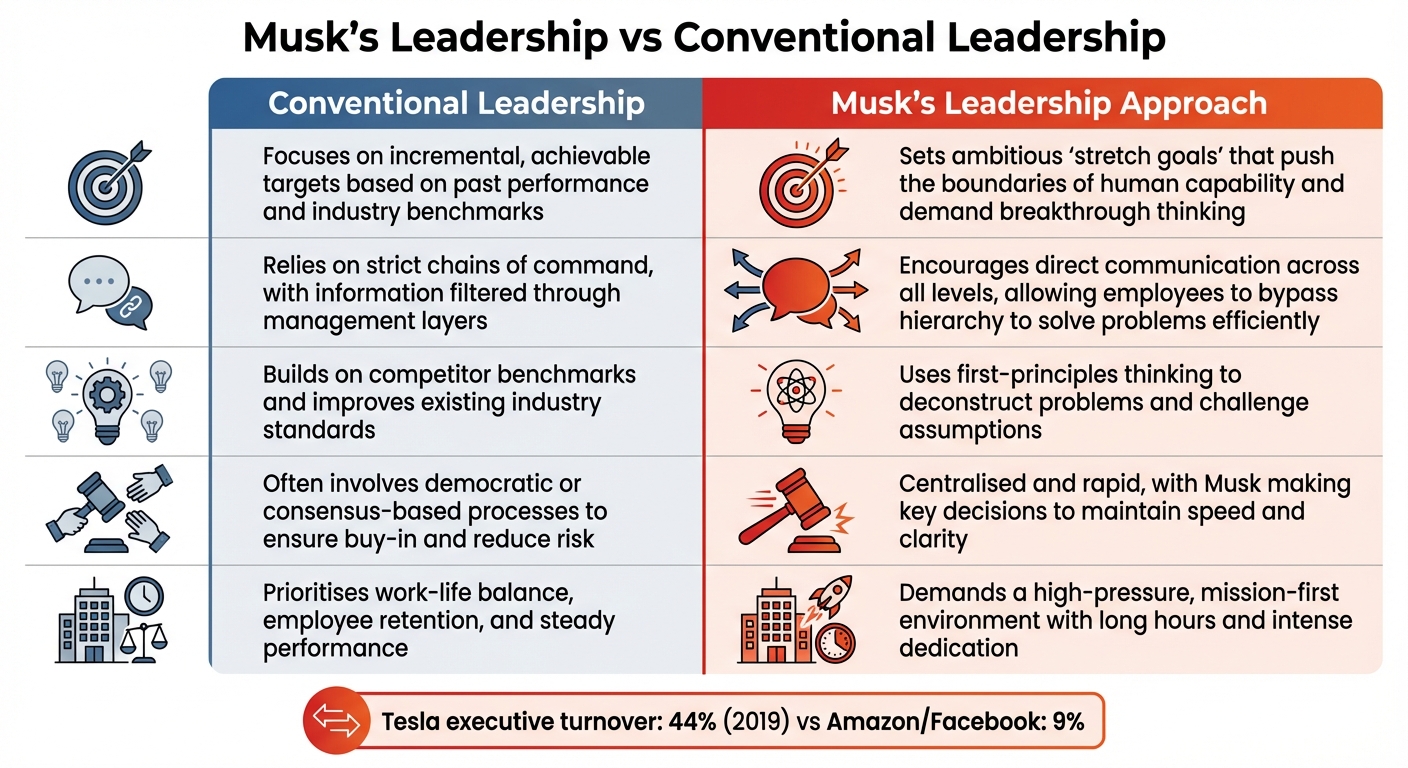
Elon Musk's Leadership Style vs Conventional Leadership Comparison
Core Leadership Lessons from Musk
Elon Musk's leadership style revolves around a few guiding principles that leaders in any field can learn from. First and foremost, always communicate the "why" behind every goal. When a team understands the deeper purpose behind their work, their focus and dedication naturally increase. Musk has consistently applied this across his ventures, ensuring his teams remain aligned and motivated.
Another hallmark of his approach is first-principles thinking. This method involves breaking problems down to their most basic components rather than relying on assumptions or improving existing systems. Musk himself has emphasised this, cautioning:
"Possibly the most common error of a smart engineer is to optimise a thing that should not exist." - Elon Musk, CEO, Tesla/SpaceX
Musk also believes in leading from the front. He’s not one to stay removed from the action. Whether it’s relocating his workspace to the factory floor during critical moments or tackling challenges head-on, Musk demonstrates his commitment and gains direct insight into operations.
Lastly, he champions the idea of normalising setbacks. For Musk, failures are not roadblocks but opportunities to learn. By fostering an environment where experimentation is encouraged, teams can treat mistakes as stepping stones to innovation.
These principles set Musk apart from more conventional management styles, as explored in the next section.
Comparison: Musk's Methods vs Conventional Leadership
The table below highlights how Musk's leadership style contrasts with traditional approaches, illustrating both the strengths and challenges of his methods:
| Leadership Aspect | Conventional Leadership | Musk's Leadership Approach |
|---|---|---|
| Goal Setting | Focuses on incremental, achievable targets based on past performance and industry benchmarks. | Sets ambitious "stretch goals" that push the boundaries of human capability and demand breakthrough thinking. |
| Communication | Relies on strict chains of command, with information filtered through management layers. | Encourages direct communication across all levels, allowing employees to bypass hierarchy to solve problems efficiently. |
| Problem Solving | Builds on competitor benchmarks and improves existing industry standards. | Uses first-principles thinking to deconstruct problems and challenge assumptions. |
| Decision Making | Often involves democratic or consensus-based processes to ensure buy-in and reduce risk. | Centralised and rapid, with Musk making key decisions to maintain speed and clarity. |
| Work Culture | Prioritises work–life balance, employee retention, and steady performance. | Demands a high-pressure, mission-first environment with long hours and intense dedication. |
While Musk's methods have driven extraordinary achievements, they come with costs. For instance, Tesla saw an annualised turnover rate of 44% for executives reporting directly to Musk over a nine-month period in 2019, compared to just 9% at companies like Amazon and Facebook. His approach often attracts individuals who thrive under pressure and are deeply committed to ambitious missions, but it’s not a one-size-fits-all model. Leaders should adapt these principles carefully, keeping in mind their organisation's unique dynamics and their team’s capacity for high-intensity work.
Conclusion: Using Musk's Leadership Principles
Elon Musk's leadership has driven remarkable achievements like Tesla's valuation exceeding £1 trillion and SpaceX's groundbreaking advancements in human spaceflight. His approach stands out for its clarity of vision, reliance on first-principles thinking to challenge norms, hands-on leadership, and a mindset that sees failure as a step towards progress.
While Musk's methods have proven transformative, they aren't a one-size-fits-all solution. Consider which elements align with your team and organisational goals. For instance, you might embrace his emphasis on open communication across departments to resolve issues faster or set ambitious targets that challenge your team without overreaching.
To foster engagement, ensure every major decision is tied to a clearly defined purpose. Tools like the "5 Whys" can help uncover root causes rather than settling for surface-level answers. And when things go wrong, frame setbacks as opportunities to learn rather than moments of defeat. Musk's own words capture this ethos:
"I think it is possible for ordinary people to choose to be extraordinary." - Elon Musk
Adapting Musk's principles requires balance. Aim for ambitious goals while prioritising your team's wellbeing. Pair high expectations with genuine recognition, and encourage innovation while providing the support your team needs to thrive. By integrating clear communication, creative problem-solving, and a strong sense of accountability, you can apply Musk's insights in a way that fits your unique leadership style and organisational context. This approach ensures that the lessons explored in this guide translate into actionable, sustainable leadership practices.
FAQs
How does Elon Musk's leadership style influence employee retention?
Elon Musk’s leadership style is often characterised by its intensity and high expectations. This approach can fuel rapid decision-making and push the boundaries of what’s possible. However, it can also create a workplace environment that some employees find overwhelming, contributing to higher staff turnover.
Reports suggest that burnout, coupled with Musk’s fast-moving decision-making process and occasionally controversial public actions, prompts many employees - especially senior figures - to leave. While his ambitious vision motivates and excites many, the demanding culture can make it difficult to retain talent, posing challenges for maintaining organisational stability and team unity over time.
What is first-principles thinking, and how does Elon Musk use it in his work?
First-principles thinking is all about breaking a problem down to its core elements, stripping away assumptions and preconceived notions. Instead of relying on established methods or conventional wisdom, this approach builds solutions from the ground up by focusing on the most basic and undeniable truths.
Elon Musk is a well-known advocate of this method, using it to challenge norms and rethink how industries operate. Take SpaceX, for instance. Musk examined the high cost of rockets and discovered that the raw materials - such as aluminium and carbon fibre - made up only a small portion of the overall expense. By sourcing these materials at commodity prices and redesigning the production process, he slashed the cost of rocket launches. The same principle applies at Tesla, where Musk views cars not as traditional vehicles but as integrated systems of batteries, motors, and software. This perspective has allowed Tesla to reimagine what a car can be, moving beyond the constraints of conventional automotive design.
Musk even applies this mindset to his personal ventures, constantly questioning assumptions and rebuilding ideas from scratch. It’s this relentless focus on fundamentals that enables him to disrupt industries and achieve transformative results.
How does Elon Musk combine innovation with accountability in his leadership style?
Elon Musk pushes for bold progress by setting clear, ambitious targets for his teams. Whether it’s Tesla’s accelerated production goals or SpaceX’s meticulously timed launch schedules, he turns big ideas into actionable objectives. Progress is closely monitored through data-driven assessments, keeping everyone aligned and moving forward. Musk also embraces failure as part of the process, treating setbacks as learning opportunities and encouraging quick iterations while ensuring lessons are thoroughly documented.
Musk’s leadership style is hands-on. He often delves into technical details and steps in directly when performance doesn’t meet expectations. He also emphasises the importance of on-site collaboration, believing it fosters faster decision-making and stronger teamwork. This combination of visionary goals and meticulous management enables his companies to push boundaries while staying focused and disciplined.