
Communicating Up, Down, and Across Teams
Practical strategies to improve upward, downward and cross-team communication: reduce silos, build trust, set clear objectives and standardise tools.

When communication breaks down in organisations, the impact is immediate - time wasted, productivity lost, and morale drained. Over half of employees spend 30 minutes to 2 hours daily dealing with poor communication, and only 14% feel fully aligned with company goals. This disconnect often leads to silos, confusion, and even higher turnover rates, particularly in remote or hybrid work environments.
To fix this, organisations need clear and effective communication at every level:
✓ Upward: Employees sharing ideas and feedback with leadership
✓ Downward: Leaders providing clarity and direction to teams
✓ Across: Departments collaborating without silos or friction
Key barriers include:
• Silos and fragmented tools that isolate teams
• Power dynamics that discourage employees from speaking up
• Jargon and unclear language that muddle messages
The solution? Focus on practical strategies, like framing messages around organisational goals, building trust through consistent communication, and using the right tools for the job. Leaders should encourage open dialogue, set clear objectives, and connect individual tasks to the bigger picture. Cross-team collaboration thrives when silos are dismantled, tools are streamlined, and communication norms are clear.
Strong communication isn’t just about avoiding mistakes - it’s about creating alignment, trust, and efficiency. By addressing these challenges head-on, you can transform how your teams work together.
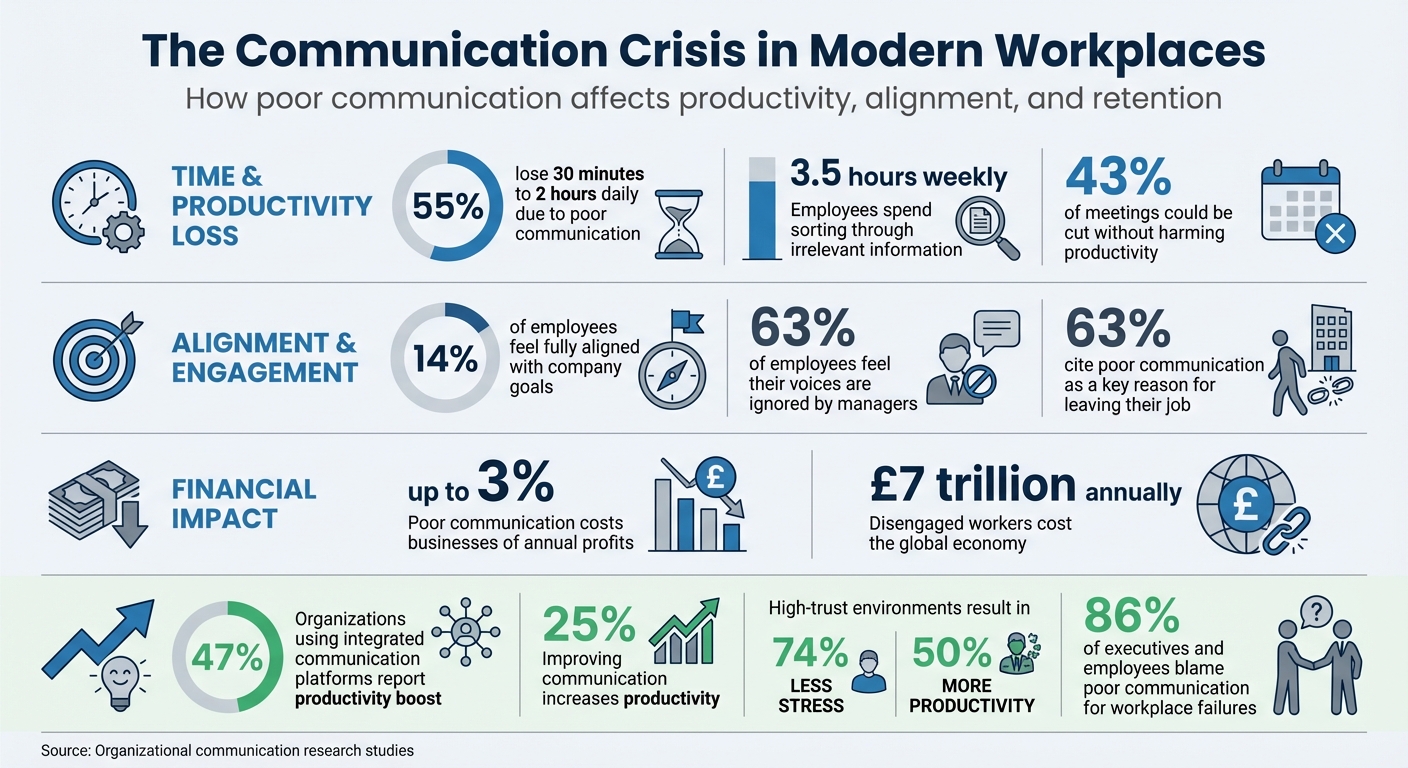
The Cost of Poor Communication in Organizations: Key Statistics
How to Influence Upward, Downward, and Cross Functionally at Work
Common Barriers to Cross-Level Communication
Even the most efficient organisations face challenges when it comes to maintaining clear communication. These obstacles might not always be obvious, but their impact is undeniable, making it essential to pinpoint and address them. Such barriers can disrupt communication across all levels of a company.
Silos and Fragmented Information
While departments tend to develop specialised expertise, this focus can sometimes lead to isolation. Teams may withhold information instead of sharing it freely, creating bottlenecks. For instance, imagine marketing launching a campaign without consulting customer service, or product development rolling out a new feature without informing the sales team. The result? Confusion, duplicated efforts, and wasted resources.
The issue worsens when communication tools proliferate. Employees often juggle emails, messaging apps, and project management platforms, leading to inefficiencies. On average, workers spend about 3.5 hours weekly sorting through irrelevant information. This fragmentation not only drains time but also disconnects employees from the organisation’s broader goals. When people can’t see how their tasks align with the company’s strategy, overall alignment suffers. Interestingly, organisations using integrated communication platforms report a 47% boost in productivity, underscoring the advantages of streamlined information sharing.
Power Dynamics and Fear of Speaking Up
Hierarchies often create subtle but powerful barriers. Engaging with senior leaders can trigger a "threat response", making employees acutely aware of their position and hesitant to speak openly. This isn’t unusual - it’s a natural reaction to hierarchical pressures.
The effects, however, can be severe. A 2021 survey of 4,000 employees revealed that 63% felt their voices were ignored by their managers or employers. In such environments, employees may filter their feedback to avoid upsetting leadership, while managers, often unintentionally, suppress input. This dynamic can distort the organisation’s understanding of its challenges, leaving problems to fester until they escalate into crises.
Jargon and Language Barriers
Technical language can be a double-edged sword. While it helps insiders communicate efficiently, it can alienate those unfamiliar with the terminology. Departments frequently develop their own shorthand - acronyms, abbreviations, and specialised terms - that work well internally but confuse others. For example, 55% of healthcare professionals reported difficulty understanding abbreviations used by colleagues, and in a survey of dental students and faculty, every participant admitted to using jargon, often relying on non-standard terms in case histories.
Regional differences can add another layer of complexity. Simple phrases like "first floor" can mean different things depending on the country, potentially causing workflow disruptions. Moreover, when over half (55.8%) of professionals admit they resort to jargon when pressed for time, it’s clear that the drive for speed often comes at the expense of clarity.
Next, we’ll dive into practical strategies for overcoming these challenges and improving upward communication.
How to Communicate Upward
Think of upward communication as a partnership rather than a hierarchy. Mary Abbajay, author of Managing Up, explains it well:
"If we reframe followership from a power construct into a relational construct, we open up a wide world of choice and agency".
This mindset shift changes the way you engage with leadership. You’re not just delivering updates - you’re actively collaborating.
Framing Messages for Impact
Senior leaders juggle countless priorities, so your updates need to grab their attention. Start by tying your message to organisational goals. For example, instead of saying your project is "on track", explain how it’s improving customer satisfaction, contributing to revenue growth, or advancing other key objectives.
Timing is just as critical as content. Sharing an idea when your manager is overwhelmed by deadlines might mean it gets overlooked. Be mindful of their workload and pick a moment when they’re more likely to listen. And skip the jargon - phrases like "changing direction" are far clearer than "pivoting strategy". Simple, direct language ensures your message hits home.
Building Trust and Credibility
Trust takes time, but consistent communication can help build it faster. Studies show that employees in high-trust environments experience 74% less stress and are 50% more productive. One key strategy is to adapt to your manager’s preferred communication style. Do they like detailed reports or quick summaries? Are they more responsive to emails or phone calls? As Shabnam Banerjee-McFarland from Berrett-Koehler Publishers points out:
"Upward communication that's informed by your manager's style puts you on the same page and can abate the jitters you might feel".
Being proactive also strengthens your credibility. If a meeting is cancelled, suggest alternative times yourself. When you bring solutions instead of just pointing out problems, you position yourself as a valuable partner. Honesty matters too - share both successes and challenges. Nonverbal cues, like maintaining eye contact and using open body language, make up 55% of communication, while vocal tone accounts for 38%. These small actions reinforce your sincerity during important discussions.
Using Communication Tools Effectively
Once you’ve built trust and crafted a strong message, the right tools can amplify your communication. For sensitive or complex topics, one-on-one conversations are best. Quick updates? Messaging platforms like Slack work well. For formal records, email remains the go-to. Choosing the right medium avoids confusion and ensures your message is clear.
Keep your updates structured and easy to digest. Weekly summaries with clear headings, bullet points for decisions, and links to supporting materials help leaders stay informed without feeling overwhelmed. Record meeting outcomes in a central location for easy access. When presenting data, use visuals like charts to highlight key points - don’t drown your audience in spreadsheets. The aim is clarity, giving leaders the information they need to make decisions efficiently.
How to Communicate Downward
Effective downward communication is about more than just giving instructions - it's about creating alignment. When leaders clearly share their vision and expectations, teams can see how their contributions fit into the bigger picture. Without this alignment, time is wasted, and morale takes a hit. To avoid these pitfalls, leaders must focus on setting clear objectives and delivering their messages with precision.
Setting Clear Objectives
Before you communicate, make sure you fully understand the message yourself. Diana Ramos from Smartsheet puts it well:
"Downward communication needs to be clear and concise so that companies can provide important guidance, feedback, and information".
Ambiguity leads to confusion, so clarity is key.
The SSG model offers a practical guide for crafting messages: be Succinct (keep it brief to avoid overwhelming your audience), Specific (include concrete details to create a clear picture), and Generous (consider the listener's perspective). For instance, instead of saying, "We need to improve customer satisfaction", try, "Our goal is to reduce customer complaint resolution time from 48 hours to 24 hours by the end of March." This approach makes the goal measurable and easy to understand. Specificity like this helps eliminate silos and ensures everyone is on the same page.
Also, choose the right medium for your message. For sensitive or complex topics, opt for face-to-face meetings or video calls to convey tone and body language effectively - these non-verbal cues account for more than half of communication. For simpler updates, email works well. End meetings by summarising key decisions and action items, and clearly document who is responsible for what. This habit reduces misunderstandings and ensures accountability.
Encouraging Feedback and Dialogue
Communication isn’t a one-way street. To foster genuine engagement, leaders need to create an environment where employees feel safe sharing their ideas and concerns without fear of judgement. Julia Markish, Director of Advisory Services at Lattice, highlights this:
"Employees disengage when their viewpoints are ignored".
Active listening is at the heart of this process. Make eye contact, ask meaningful follow-up questions, and paraphrase what you’ve heard to confirm understanding. Regular one-on-one meetings are a great way to check in on employees’ well-being and clarify any uncertainties. During team discussions, set aside time for open dialogue - even a quick check-in where everyone shares one word to describe how they’re feeling can reveal underlying issues.
To encourage diverse viewpoints, assign a rotating "devil’s advocate" role in meetings. This not only challenges ideas constructively but also signals that differing opinions are welcome. Pay attention to the volume of feedback - if it drops, it might indicate disengagement more than the actual content of the feedback. As Markish points out:
"Unless you engage in active listening back, you'll never actually know whether the message that landed was the message that you intended".
When open dialogue is combined with a sense of ownership, it creates a powerful foundation for achieving organisational goals.
Promoting Ownership and Accountability
People are more likely to take ownership when they see how their work contributes to the organisation’s success. Help them connect the dots. For example, explain how completing a report by Friday will provide critical insights for the executive team’s decision on expanding into the European market. This transforms a routine task into something meaningful and motivating.
Clear decision-making authority is also essential. Specify who has the freedom to execute tasks and who holds final approval over budgets or external communications. Involve team members in brainstorming how to achieve goals - this not only sparks creativity but also deepens their commitment to the outcome. Be upfront about what you know and what you don’t. Transparency builds trust, which is essential for employees to step up and take responsibility, especially during times of change.
After meetings, summarise key decisions and individual responsibilities, and follow up with written documentation to ensure nothing is overlooked. Establish clear communication norms, such as responding to emails within 24 hours, to align expectations and avoid misunderstandings. Finally, frame instructions in a positive way - this fosters clarity and trust. When employees understand their role and feel trusted to deliver, accountability becomes a natural part of the process rather than something imposed.
How to Communicate Across Teams
When teams operate in isolation, it can seriously harm an organisation's success. In fact, 86% of executives and employees blame poor communication for workplace failures. Silos and ineffective decision-making can cost businesses up to 3% of their annual profits, while improving communication has been shown to increase productivity by 25%. To address this, it’s crucial to align departments around a unified vision and dismantle silos effectively.
Breaking Down Silos
Once internal barriers are tackled, the next challenge is bridging the gaps between departments. Silos often develop as organisations grow and specialise, but they can - and should - be broken down. A shared "North Star" vision is key, aligning team objectives with the broader organisational strategy. As Nora Fleischhut, a New Work and Transformation Consultant, puts it:
"When people row in opposite directions, they're expending a lot of energy but going nowhere fast. When people row in the same direction, that's when progress is made".
Encourage collaboration by making it a measurable goal for team leaders, particularly for cross-department problem-solving. Celebrate these successes publicly to reinforce their value. Consider initiatives like cross-department placements or buddy systems to build empathy and foster a better understanding of different functions. Hosting learning sessions where teams explain their workflows can also help eliminate jargon and reduce friction caused by miscommunication.
Standardising Communication Tools and Protocols
Using too many disconnected apps can overwhelm employees and waste valuable time. Consolidating communication into a single, searchable platform can significantly ease this burden. For example, companies that use tools like Slack report being 47% more productive, while 55% of employees lose between 30 minutes and two hours daily due to communication breakdowns.
Start by auditing your current tools to identify and eliminate overlaps that cause confusion. Assign specific platforms for specific purposes - Slack for real-time collaboration, email for formal updates, for instance. Adopt consistent naming conventions for channels (e.g. #company-announcements or #project-name) to improve clarity and transparency. Developing a "collaboration contract" can also help. This document outlines the sequencing and timing of tasks across teams, ensuring everyone knows what’s needed and when. Organisational expert Ron Ashkenas explains:
"When people know what's needed, in what form, and by when, they can then tell you whether it's possible or not, and then you can have a real dialogue about what can be done".
Streamline routine tasks like IT support requests or cross-department approvals by using automated workflows. Training sessions on standardised tools can bridge knowledge gaps and ensure everyone feels confident using them. Once these tools are in place, maintaining regular communication ensures teams stay on the same page.
Facilitating Cross-Functional Dialogue
Open, structured dialogue is essential for aligning teams and avoiding missteps. Start projects with formal kickoff meetings to explain the purpose behind the work. Clearly differentiate between meetings meant for sharing information and those intended for decision-making to keep discussions focused. Studies show that 43% of meetings could be cut without harming productivity if teams use a mix of real-time and asynchronous communication effectively.
Encourage transparency by holding project discussions in public channels by default. Document decisions in a central, searchable location so teams can easily revisit the reasoning behind past actions. At the same time, respect each team's autonomy by allowing them to maintain control over their specific areas - this prevents defensive behaviours that can lead to further siloing. Empower frontline managers to translate high-level goals into actionable tasks and provide feedback on any challenges that arise. When cross-functional dialogue becomes a regular part of operations, collaboration shifts from being an extra effort to simply how work gets done.
Building a Culture of Transparent Communication
Creating a transparent workplace culture goes beyond tools and systems - it’s about embedding clarity and openness into every level of communication. Without this foundation, even the best tools fall short. Alarmingly, over a quarter of employees report feeling distrusted by their employers, and disengaged workers are estimated to cost the global economy around £7 trillion annually.
Leadership as Role Models
Leaders play a crucial role in shaping how information moves within an organisation. When executives share significant updates - like mergers, restructures, or leadership changes - directly with employees before or shortly after public announcements, it helps curb speculation and fosters trust. Amanda Atkins, Head of Internal Communications at Slack, highlights the risks of neglecting transparency:
"When companies don't keep up with new communication norms, the conversation doesn't stop - it just happens without you".
Transparency doesn’t mean sharing everything - it means being clear about what can’t be disclosed and why. This approach minimises unnecessary guesswork. Leaders can also set an example by “working in public,” using open, searchable channels for project updates instead of private messages. Even small gestures, like emoji reactions or brief updates, show employees that their contributions and questions matter. Tackling difficult or controversial topics early on also helps normalise open dialogue. These leadership behaviours naturally encourage employees to develop their own communication skills.
Training and Skill Development
While one in three managers feel unprepared to lead important conversations, 43% of employees still look to them for critical information. This gap presents an opportunity to strengthen communication skills across the board. Effective training focuses on three key areas: clarity (avoiding jargon), empathy (understanding the audience), and strategic listening (listening to understand, not just to respond).
Frameworks like BLUF (Bottom Line Up Front) for concise communication and STAR (Situation, Task, Action, Result) for clear, evidence-based messaging can be particularly useful. Training should also address digital literacy, teaching employees how to communicate effectively in asynchronous settings and interpret “digital body language”. For example, in 2022, Trane Technologies launched a programme called "What Matters Most?" where employees identified their top three personal values through an automated survey. Managers then held one-on-one meetings within 30 days to discuss these responses, focusing on individual needs instead of assumptions. Regular anti-bias and cross-cultural training sessions, led by experts, further equip teams to navigate generational and cultural differences in communication. These efforts enhance communication across all levels of the organisation.
Recognising Communication Successes
Celebrating effective communication is vital to reinforcing its importance. Publicly acknowledging when cross-functional collaboration leads to impressive results demonstrates that transparent communication isn’t just encouraged - it’s valued.
Linjuan Rita Men, Associate Professor at the University of Florida, emphasises:
"A favourable and enduring organisational reputation is built from within".
Recognising employees for clear communication, asking insightful questions, or bridging gaps between departments creates a ripple effect. Recognition doesn’t have to be extravagant. A quick shout-out in a team meeting or a mention in an internal newsletter can significantly impact behaviour, encouraging others to follow suit and strengthening the organisation’s commitment to transparency.
Conclusion
Effective communication has the power to reshape organisations at every level. With only 14% of employees fully aligned with their company’s goals and 63% pointing to poor communication as a key reason for leaving, the impact of miscommunication is hard to ignore. The encouraging news? These issues can be addressed through intentional effort, self-awareness, and a dedication to openness.
The strategies discussed - ranging from crafting meaningful messages to streamlining communication tools - are at the heart of successful organisations. Strengthening communication across all levels - upward, downward, and laterally - creates trust, dismantles silos, and ensures everyone understands their role. When leaders prioritise transparency and foster an environment where employees feel comfortable speaking up, organisations become more adaptable, aligned, and forward-thinking.
Leaders who focus on self-awareness, paying attention to tone, body language, and word choices, can bridge gaps between complexity and clarity. Storytelling, in particular, is a powerful tool. Whether you’re proposing an idea to senior management, rallying your team behind a new project, or collaborating across departments, stories bring data to life. They create connection, foster understanding, and make your message stick.
Start small: practise active listening, share a story of success, and invite feedback. These seemingly simple actions can ripple outward, transforming not only how you lead but how your organisation functions as a whole.
FAQs
How can organisations break down silos to improve communication across teams?
Breaking down silos starts with establishing a clear, shared purpose that brings all teams together. When leaders articulate a common mission and tie it to specific, measurable objectives - like quarterly targets - it helps employees understand how their roles contribute to the organisation’s overall success. This clarity can reduce the tendency for departments to hold onto information unnecessarily. Leaders play a crucial role here by modelling open communication, ensuring that information flows freely across the organisation, not just in a top-down or bottom-up manner.
Practical measures can make a big difference. Encouraging collaboration across levels and departments is key. For instance, creating projects that bring together team members from different areas can cut through hierarchical barriers. Collaborative platforms can also play a vital role by centralising conversations and making updates easily accessible, so knowledge doesn’t get stuck in silos. Additionally, HR or dedicated teams can be empowered to monitor communication, tackle bottlenecks, and coach managers on fostering cross-functional teamwork. By aligning a shared mission with strong leadership and effective tools, organisations can build a more connected and productive workplace.
How can leaders encourage employees to share ideas and feedback with senior management?
Encouraging employees to share their ideas, feedback, and concerns with senior management plays a key role in sparking new ideas, uncovering hidden problems, and improving engagement. Leaders can nurture an open and welcoming atmosphere by prioritising psychological safety - actively inviting contributions, valuing input, and taking meaningful action on feedback.
Here are some practical ways to make this happen:
- ✓ Hold regular forums like team Q&A sessions or listening meetings to create space for open conversations.
- ✓ Offer anonymous channels, such as online forms, so employees can share sensitive issues without hesitation.
- ✓ Respond quickly to feedback, acknowledge submissions, and communicate outcomes to build trust and show accountability.
- ✓ Equip middle managers with the tools to gather insights and lead by example in fostering open communication.
When these practices become part of the organisation's culture, employees feel empowered to speak up, engagement levels rise, and the risk of disengagement decreases. Leadership Story Bank provides resources to help leaders sharpen their communication skills, build stronger connections, and encourage team members to share openly.
How does clear communication help employees align with company goals?
Clear and focused communication helps employees see how their efforts align with the company’s goals. When leaders break down objectives into straightforward, jargon-free language and explain why they matter, it builds a shared sense of purpose, boosts morale, and reduces confusion.
Consistent messaging is another key element. It avoids mixed signals and helps employees focus on what truly matters. Encouraging open dialogue, where feedback and questions are welcomed, ensures that goals remain practical and any obstacles are tackled early. By linking everyday tasks to the organisation’s larger mission, leaders can spark engagement and foster alignment across teams.
For those aiming to sharpen their communication skills, Leadership Story Bank provides resources to craft genuine, meaningful messages that connect with teams and promote clarity and cohesion throughout the organisation.