
Communicating Change in Complex Organisations: What Actually Works
Practical steps for communicating change in complex organisations: use the 4 Ps, lead with empathy, tell stories, equip managers and use multiple channels.

When organisations undergo major changes, poor communication is often the culprit behind confusion, resistance, and failure. Research shows that 70% of change initiatives fail, with only 32% of leaders achieving strong employee buy-in. The stakes are high - not just for morale but for finances, as ineffective employee engagement costs the UK economy up to £430 billion annually.
So, what actually works? It's all about clarity, empathy, and relevance. Employees need simple, consistent messaging, transparency about challenges, and a clear understanding of how changes will impact them personally. Leaders must step up as trusted messengers, using stories and dialogue to build trust and address resistance.
Key takeaways:
✓ Use the 4 Ps Framework: Purpose (why), Picture (future), Plan (how), and Part (role).
✓ Communicate early, often, and through multiple channels like face-to-face meetings, emails, and collaborative tools.
✓ Equip managers with clear talking points and involve employees in shaping the narrative.
✓ Stories resonate more than data - show the human side of change to inspire action.
Change communication isn't just about announcements - it's about creating understanding, trust, and alignment. When done right, it transforms resistance into progress and drives success.
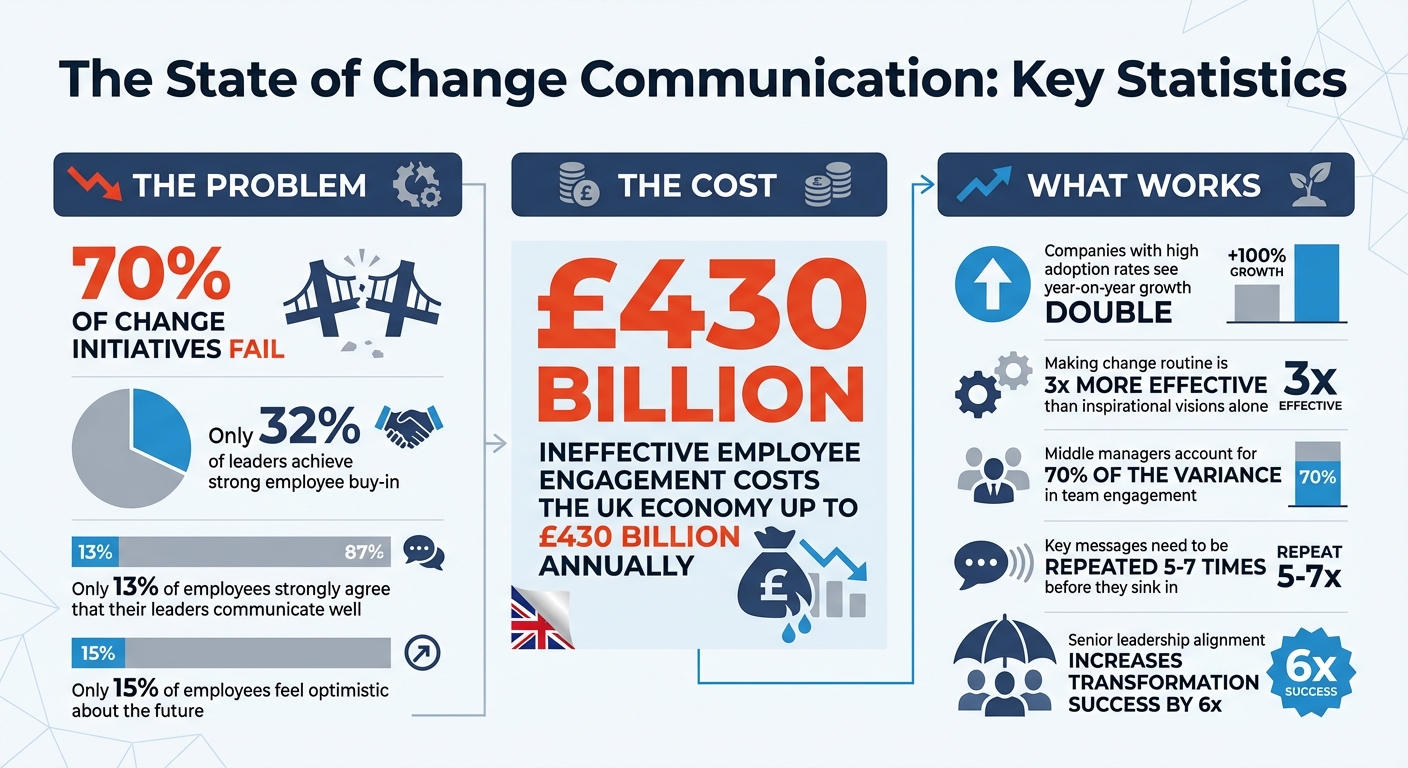
Change Communication Statistics: Failure Rates, Costs, and Success Factors
How Great Leaders Communicate Change (Most Miss This Crucial Step)
Core Principles of Effective Change Communication
When change programmes stumble, it’s often not the strategy but the communication that’s to blame. To cut through the noise and get people on board, focus on three key principles: clarity, empathy, and relevance. Nail these, and you’ll significantly boost your chances of success.
Clarity: Keep Messages Simple and Consistent
Confusion breeds resistance. When employees don’t understand what’s happening or why, they fill in the blanks with fear and speculation. The antidote? Clear communication. The 4 Ps Framework offers a practical way to structure your messaging:
- Purpose: Why is this change happening?
- Picture: What will the future look and feel like?
- Plan: How will we get there?
- Part: What’s my role in making this happen?.
This isn’t about creating flawless slide decks - it’s about helping people make sense of the change, so anxiety doesn’t take over. Leaders often underestimate the need for repetition. Research shows that key messages need to be repeated five to seven times before they truly sink in, especially in a diverse workforce juggling daily responsibilities alongside the change.
It’s also essential to pick the right messenger. Employees want the business rationale ("why") from senior leaders but look to their immediate managers for the personal impact ("What’s in it for me?").
Once the message is clear, the focus shifts to handling the emotional side of change.
Empathy: Address Concerns and Build Trust
Change unsettles people. Even when it’s necessary, it disrupts routines, challenges identities, and sparks fears about job security. Ignoring these emotional realities can damage trust and intensify resistance. Empathy - the ability to see and feel things from others’ perspectives - turns a corporate statement into a meaningful conversation.
Start by being transparent. Share what you know, and be upfront about what’s still uncertain. Avoid sugar-coating the situation with overly optimistic language, especially when challenges are on the horizon.
Empathy also means creating opportunities for two-way dialogue. Town halls, one-on-one meetings, and anonymous feedback channels show you’re genuinely listening, not just broadcasting. People need time to digest new information. Demanding immediate action - say, through late-night emails with tight deadlines - can erode trust instead of building it.
Relevance: Focus on 'What’s In It For Me' (WIIFM)
Clarity and empathy set the stage, but relevance ensures the message hits home. People are far more likely to embrace change when they see how it benefits them personally. While a corporate vision might inspire leadership, frontline employees need to understand how the change will affect their daily tasks, team dynamics, and career progression.
In large organisations, a one-size-fits-all approach rarely works. Different teams face unique challenges, so it’s crucial to tailor messages to their specific needs. Enlist change champions or early adopters to help adapt and localise communication for different groups. Use the 4 Ps framework to clarify individual roles and responsibilities, making the change feel manageable and relevant.
Timing and tone also matter. Research from Gartner suggests that embedding change into daily routines is three times more effective than relying on sweeping, inspirational visions. Focus on immediate, actionable steps that connect with employees’ current work. When people see how change aligns with their everyday tasks, it feels less like an external demand and more like a natural shift.
Practical Strategies for Communicating Change
Effectively communicating change requires a thoughtful approach that combines early engagement, diverse channels, and trusted leadership. Below are practical strategies to ensure your message resonates.
Communicate Early and Often
When leadership remains silent, uncertainty and fear can quickly take hold. To counter this, start communicating as soon as possible - even if you don’t have all the answers yet. Sharing what you do know, while being upfront about areas of uncertainty, helps prevent anxiety from escalating.
This isn’t a one-time task. Consistent communication is essential. Set aside time daily - whether for staff check-ins, updates to key messages, or progress notes. These smaller, ongoing efforts are far more effective than occasional large announcements.
Repetition also plays a key role. Regular updates give people the opportunity to process information at their own pace, helping to shift their mindset from worry to understanding. Coupled with this, using multiple communication channels ensures your message reaches everyone in the organisation.
Use Multiple Communication Channels
To maximise reach and impact, it’s important to use a mix of communication methods. Different people absorb information in different ways, so relying on a single channel - like email - could leave parts of your audience out. Blending high-interactivity options, such as face-to-face meetings or video calls, with lower-interactivity tools, like newsletters or intranet posts, ensures you cover all bases.
The right channel depends on the nature of the message:
- Sensitive or complex updates: Face-to-face conversations or video calls allow for real-time questions and a more personal touch.
- Broader organisational updates: Town halls or webinars work well for sharing vision and direction.
- Detailed timelines and resources: Emails or FAQ portals provide a reliable reference point.
- Real-time updates and collaboration: Tools like Slack or Microsoft Teams facilitate two-way communication and transparency.
A study of two manufacturing plants during a merger highlights the importance of this approach. One plant received vague, infrequent updates, while the other implemented a detailed communication plan using multiple channels. Employees at the latter reported feeling more secure, less stressed, and showed improved performance and commitment.
| Communication Channel | Best For | Interactivity |
|---|---|---|
| Face-to-Face / Video Calls | Sensitive issues, complex questions, personal impact | High |
| Collaborative Tools (Slack/Teams) | Real-time updates, two-way dialogue, peer support | High |
| Town Halls / Roadshows | Sharing vision, direct access to senior leaders | Medium |
| Email / Newsletters | Formal announcements, timelines, "paper trail" | Low |
| Intranet / FAQ Portals | Centralised resources, self-service details | Low |
Engage Leaders as Trusted Messengers
Who delivers the message can be just as important as the message itself. Leaders at all levels must actively participate in communication, rather than leaving it solely to project teams or communications departments.
Start by briefing managers before rolling out messages to the wider organisation. This gives them time to understand the information, address their own concerns, and build the confidence needed to guide their teams. Equip them with talking points that explain the rationale behind the change, how it aligns with organisational values, and its impact on employees. Coaching them on tone and delivery is equally important - authenticity matters more than sticking to a script.
"One of the biggest and most common mistakes you can make is to have your project team sending all the communications." – Tim Creasey, Chief Innovation Officer, Prosci
Face-to-face interaction remains one of the most effective ways to build trust. Encourage leaders to visit teams in person or, if that’s not possible, use video to convey sincerity and energy. Communication should also be a two-way street. Create opportunities for feedback through Q&A sessions, skip-level meetings, and open dialogue channels.
Using Stories to Drive Change
Data might explain, but stories stick. When leaders rely solely on spreadsheets or strategy slides, they risk missing the emotional connection that inspires action. A well-told story takes abstract ideas and turns them into something people can relate to.
By focusing on clear, empathetic communication, storytelling helps make change feel more human and approachable.
Create a Clear Change Narrative
A strong change narrative should cover the essentials: explain the context, outline why change is necessary, paint a picture of the future, map out the steps to get there, show how it affects individuals, and make a specific request of your audience.
Amazon’s approach offers a great example. Instead of PowerPoint slides, leaders use a "six-page memo" format to lay out a detailed, logical case for change. This forces clarity and ensures the story is easy to follow. Similarly, a European heavy goods manufacturer used a structured process - aligning priorities, engaging leaders, and crafting a clear narrative - to energise its workforce. Within two years, this approach boosted organisational effectiveness, increased sales growth, and reduced safety incidents.
"Stories constitute the single most powerful weapon in a leader's arsenal." - Howard Gardner, Professor, Harvard University
Your narrative should have a modular structure - a consistent core message that departments can adapt to their specific needs. Avoid corporate jargon to keep it real. It’s also important to acknowledge your organisation's history while explaining why the future needs to look different. This balance helps build trust and reassures people that the change isn’t dismissing past achievements.
When done right, a compelling narrative supports earlier principles of clarity and empathy, embedding change into the organisation’s daily mindset.
Use Stories to Address Resistance
Stories are also a powerful tool for overcoming resistance to change.
Resistance often comes from fear of the unknown. Stories can ease this fear by offering social proof - showing how others have successfully embraced the change. For instance, "Employee Spotlights" that highlight how colleagues have adapted to new ways of working can make change feel less intimidating and more relatable.
Another technique is the "Before and After" approach. Use it to contrast current challenges - like inefficient processes or siloed teams - with the benefits of the future state. The CATS Framework can also help craft effective stories by focusing on four key elements: Characters (real people), Actions (steps they took), Time (the journey), and Setting (the context). Stories that resonate on three levels - individual, team, and organisational - are more likely to connect with diverse audiences.
When senior leadership aligns on a shared story, the chances of a successful transformation increase dramatically - by up to six times. Yet, only 13% of employees strongly agree that their leaders communicate well, and just 15% feel optimistic about the future. This gap highlights the importance of honest, relatable narratives that acknowledge challenges rather than glossing over them. Involve employees early through workshops or focus groups - people are far more likely to support something they’ve helped create.
Overcoming Common Challenges in Change Communication
Even the most carefully planned change initiatives can encounter obstacles. Resistance and inconsistent messaging are two of the most common issues that can derail progress. Addressing these challenges head-on is essential for success.
Manage Resistance with Transparency
Resistance to change often stems from employees not understanding the business rationale behind it. Many are left wondering, "What’s in it for me?". Leaders sometimes assume their reasoning is self-evident, but this assumption can backfire. A study illustrating the "curse of knowledge" found that participants tapping out rhythms of songs believed others would identify the tune 50% of the time, yet the actual recognition rate was under 5%. This gap underscores how what’s clear to leadership may not resonate with employees.
Transparency is key to rebuilding trust. A great example comes from a BBC department that, in November 2025, used a "Transition Monitoring Team" during a major organisational change. This team tested communications before rolling them out more widely, ensuring the programme stayed on schedule, achieved financial goals, and maintained staff morale.
It’s crucial not to sugarcoat challenges or gloss over difficult realities. Doing so can undermine credibility. Instead, acknowledge risks, the effort required, and emotions like fear or scepticism - even if all the answers aren’t yet available. Silence often leads to speculation and rumours. Tools like the ADKAR model can help pinpoint the root causes of resistance, whether they stem from gaps in Awareness, Desire, Knowledge, Ability, or Reinforcement.
Once resistance is addressed through honest and open communication, the next step is ensuring leadership delivers a unified message.
Align Leadership for Consistent Messaging
Transparent communication lays the groundwork, but consistency in leadership messaging is what reinforces trust. Mixed signals from leadership can erode confidence. For example, if senior executives advocate for change while middle managers express doubt or confusion, employees are likely to disengage. Consistency requires alignment across leadership behaviours, messaging, priorities, and decisions.
Middle managers play a pivotal role here, as they account for 70% of the variance in team engagement. However, many lack the tools or confidence to translate high-level goals into practical, everyday actions. Providing them with clear talking points and adaptable messaging early in the process can make a big difference . Additionally, enlisting "change ambassadors" - influential employees who can champion the initiative within their teams - helps to amplify the message.
Senior leaders must also lead by example. A case in point is IBM’s 2006 "jam sessions", two 72-hour events held on its intranet. These sessions invited employees and stakeholders to contribute to the company’s strategic direction. The initiative attracted 150,000 participants from 104 countries and 67 companies, generating 46,000 posts. This approach allowed employees to feel directly involved in shaping the transformation.
Research shows that successful transformations often hinge on four factors: fostering understanding, reinforcing formal mechanisms, developing talent, and role modelling. Consistency isn’t just about repeating the same message - it’s about ensuring that every leader’s actions align with their words. This alignment is what truly builds trust and drives change forward.
Conclusion: Applying These Change Communication Principles
Communicating change effectively isn’t just a nice-to-have - it’s what builds trust, fosters understanding, and encourages new behaviours across teams and organisations.
The statistics speak for themselves: global adoption rates for change initiatives remain low. Yet, companies with high adoption rates see their year-on-year growth double. The difference isn’t necessarily about having better strategies; it’s about how well those strategies are communicated.
One practical step is to make change feel routine. Research highlights that normalising change as part of daily operations is three times more effective than relying on grand, inspirational visions alone. This means focusing on consistent, small actions - like spending just 30 minutes each day on change communication. That could involve sending updates, checking in with team members, or resharing key messages. Using the '4 Ps' framework - Purpose, Picture, Plan, Part - can help ensure your messages are clear and actionable.
Middle managers play a key role here. They’re often the bridge between leadership and the wider team, but they need the right tools to succeed. Equip them early with clear talking points, Q&A templates, and regular updates. You might even consider creating Transition Monitoring Teams to test your messaging before rolling it out on a larger scale.
At its core, successful change hinges on genuine understanding:
"People don't change because they're told to. They change when they understand why, believe it matters, and know what it means for them."
– Leadership Story Bank
FAQs
How does the 4 Ps Framework help in communicating organisational change effectively?
The 4 Ps Framework - purpose, picture, plan, and part - offers a straightforward way for leaders to communicate change effectively. It ensures messages are not only clear but also motivating and actionable.
Starting with purpose, leaders articulate why the change is happening. This step builds understanding and sparks emotional connection. The picture paints a vivid vision of the future, helping teams grasp the overall goal and feel more secure about the direction. The plan lays out the steps and timelines, easing uncertainty and making the process feel achievable. Lastly, part focuses on individual roles, encouraging ownership and active involvement.
By applying this framework, organisations can minimise resistance, align their teams, and create communication that genuinely engages people throughout periods of change.
Why is empathy important for overcoming resistance to organisational change?
Empathy is a key element in easing resistance to organisational change, as it allows leaders to genuinely connect with the concerns and emotions of their teams. Change often brings feelings of uncertainty or fear, but when leaders show understanding, they can build trust and create an environment where employees feel psychologically safe.
When people feel listened to and supported, they are far more likely to engage with the change process and align themselves with its objectives. By fostering open communication, addressing misunderstandings, and promoting a shared sense of purpose, empathy helps to lower resistance. This approach, centred on human connection, leads to smoother transitions and stronger team unity during times of change.
How can storytelling help leaders communicate change effectively?
Storytelling offers leaders a compelling way to communicate change within organisations. By turning complex or abstract concepts into relatable and emotionally engaging narratives, it helps explain what’s changing, why it matters, and how success will be achieved. This approach allows employees to connect with the change on a personal level, improving understanding and easing resistance.
Stories also address emotional reactions like fear or uncertainty, fostering empathy and a shared sense of purpose. They can inspire action, encourage engagement, and ensure the message resonates across varied teams. At its core, storytelling isn’t just about passing on information - it’s about shaping perspectives and building connections that drive alignment and commitment during times of organisational change.