
Calm vs. Chaos: Leadership Communication in Crisis
Calm, consistent leadership communication steadies teams in crisis, reduces confusion and improves decision-making with practical tips to shift from reactive to deliberate messaging.

When a crisis hits, how you communicate can either stabilise your team or create confusion. Calm communication - clear, steady, and transparent - builds trust and keeps teams focused. In contrast, chaotic communication - erratic, inconsistent, and reactive - undermines morale and productivity.
Key takeaways:
- Calm leaders stay composed, share regular updates, and encourage questions.
- Chaotic leaders react impulsively, send mixed messages, and spread anxiety.
- Calm communication improves decision-making and team efficiency by up to 25%.
- Poor communication causes 56% of team failures during crises.
Quick Tips for Calm Leadership:
- Use clear, concise updates with consistent messaging.
- Acknowledge uncertainty honestly but confidently.
- Stay composed, manage your emotions, and avoid panic.
Mastering calm communication isn’t just about sounding in control - it’s about creating an environment where your team can think clearly and act decisively. Read on for practical strategies to lead with clarity and confidence when it matters most.
Calm Leadership Communication: What It Is and Why It Works
Core Features of Calm Communication
Calm leadership rests on four main principles. First, emotional control is about leading with steadiness, even when chaos looms. By pausing before reacting, you demonstrate that stress can be channelled into thoughtful action rather than panic. This measured approach not only steadies you but also encourages resilience within your team.
Next is transparency, which calls for regular, open updates - even when the news isn't good. When leaders fail to communicate, uncertainty grows, and rumours fill the gaps. A study by the Project Management Institute found that 56% of team failures during crises stem from poor communication. Transparency helps to counter this, ensuring everyone stays informed.
Consistent messaging is equally vital. By delivering the same clear information across reliable channels, you prevent confusion and ensure your team hears a unified message rather than conflicting directives. Finally, there’s realistic optimism, which balances confidence with honesty. This isn’t about sugar-coating the truth; it’s about acknowledging challenges while showing belief in the team’s ability to overcome them.
Together, these elements create a framework for effective communication during tough times, fostering better decisions and boosting team morale.
How Calm Leadership Affects Teams and Operations
When leaders communicate calmly, the ripple effects are profound. First, it builds trust. A composed leader who shows genuine concern earns respect without resorting to heavy-handed control.
Calm communication also sharpens operational focus. Teams that perform well under pressure - 67% of them, according to Harvard Business Review - excel by honing in on priorities and delegating effectively. A steady voice and clear direction help filter out distractions, allowing teams to concentrate on what truly matters. For example, during the 2020 COVID-19 crisis, Tesco’s leadership in the UK provided regular, transparent updates about supply chain issues and safety protocols. They combined this with a measured optimism, reassuring staff and customers alike. This approach not only built trust but also kept operations steady during a period of intense uncertainty.
The result? Teams feel secure, stay productive, and develop the resilience needed for future challenges. Data shows that making decisions based on clear communication can boost team efficiency by 25% in high-pressure situations. This edge often separates organisations that falter from those that emerge stronger.
Chaotic Communication: What It Looks Like and What It Costs
Typical Behaviours in Chaotic Communication
Chaotic communication often manifests through four damaging patterns, each with its own ripple effects. First, there are emotional outbursts - leaders who yell, show visible frustration, or panic during high-stress moments. Instead of calming the situation, this amplifies stress. Research reveals that people naturally mirror their leader’s emotions, meaning a panicked leader can spread anxiety across the entire team.
Next is inconsistent messaging, which breeds confusion and uncertainty. One day, a leader issues a directive, only to contradict it the next without any explanation. Updates are sporadic - or worse, non-existent - forcing team members to rely on speculation and rumours to fill the gaps. This aligns with earlier findings linking poor communication to dysfunction.
Information hoarding is another hallmark of chaotic communication. Some leaders mistakenly think withholding details will prevent panic, but it often has the opposite effect. In critical situations, even small pieces of missing information can jeopardise success. Finally, there's reactive blame - shifting responsibility onto others rather than focusing on solutions. This scapegoating not only escalates stress but also signals a lack of control from the leader.
Together, these behaviours create a toxic environment that can lead to serious organisational consequences.
The Damage Chaotic Leadership Causes
The fallout from chaotic communication is both immediate and long-lasting. It undermines morale, weakens decision-making, and creates a pervasive sense of instability. When leaders respond with panic, their teams lose the sense of safety and psychological security that’s essential for high performance. By contrast, teams led by calm leaders report feeling 70% more empowered and focused.
This heightened anxiety disrupts decision-making processes, leading to snap judgements, overreactions, and reliance on cognitive biases. Chaotic leaders often lean on quick fixes or overly simplistic solutions, which stifle creativity and block more effective approaches. In stark contrast, 67% of high-performing teams excel by maintaining clarity and focus under pressure - something chaotic communication actively undermines. Without clear guidance, teams can become 25% less efficient in high-stakes situations.
Over time, the damage compounds. Trust and credibility erode as leaders make false promises or frequently change direction. Team confidence plummets, productivity declines, and employee retention becomes a serious issue. The command-and-control approach that often accompanies chaotic leadership stifles open dialogue and adaptability, leaving organisations rigid and vulnerable when flexibility is most needed.
From Fear to Confidence: Crisis Communication Tips Every Leader Should Know
Calm vs. Chaos: A Direct Comparison
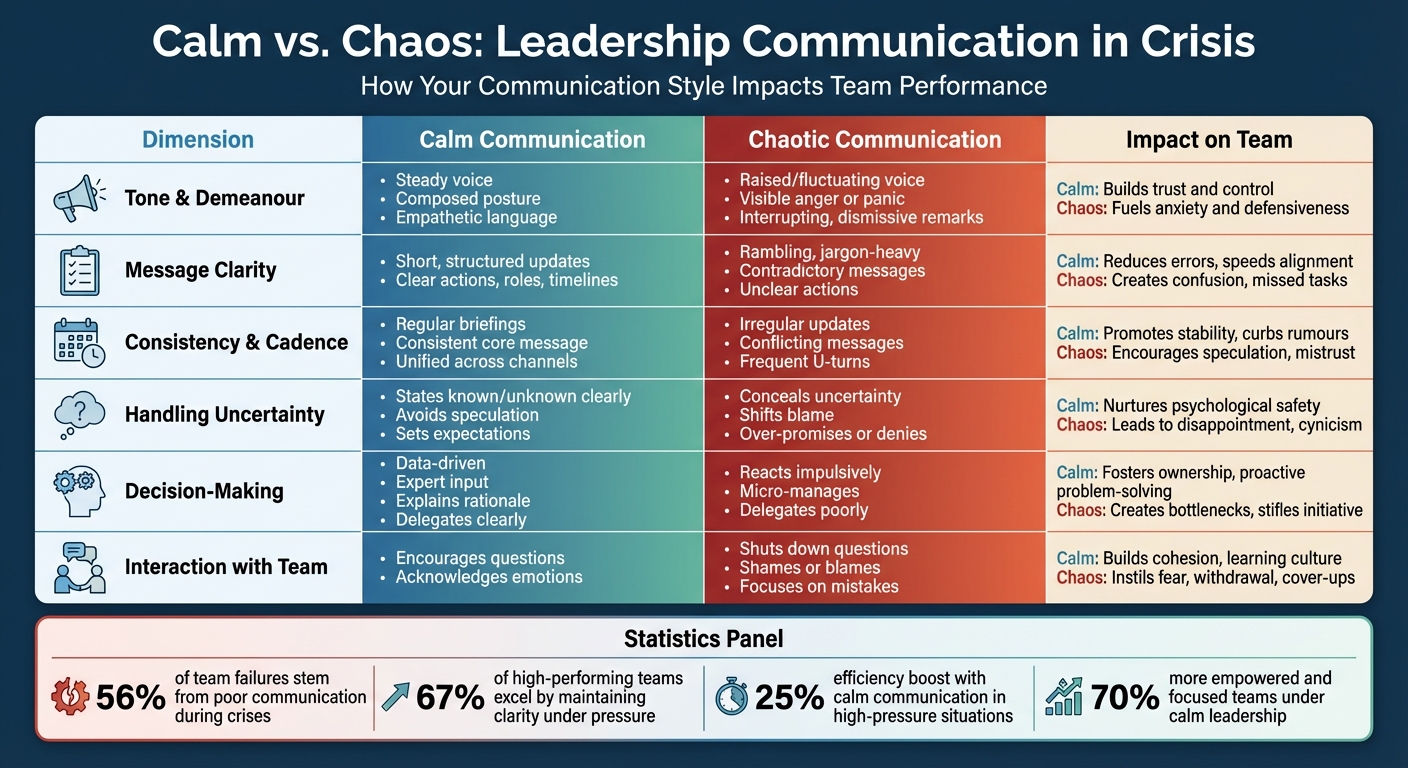
Calm vs Chaotic Leadership Communication: Impact on Team Performance
Comparison Table: Calm vs. Chaotic Communication
When you compare calm and chaotic communication side by side, the differences become striking - not just in how leaders behave, but in the outcomes their actions create. The table below highlights six key dimensions, revealing how each approach shapes the team’s experience and performance.
| Dimension | Calm Communication | Chaotic Communication | Impact on Team |
|---|---|---|---|
| Tone & Demeanour | Steady voice, composed posture, empathetic language | Raised or fluctuating voice, visible anger or panic, interrupting, dismissive remarks | Calm: builds trust and a sense of control; Chaos: fuels anxiety and defensiveness |
| Message Clarity | Short, structured updates; clear actions, roles, and timelines | Rambling, jargon-heavy, or contradictory messages; unclear actions | Calm: reduces errors and speeds alignment; Chaos: creates confusion, duplication, and missed tasks |
| Consistency & Cadence | Regular briefings with a consistent core message across channels | Irregular updates; conflicting messages from leaders; frequent U-turns | Calm: promotes stability and curbs rumours; Chaos: encourages speculation and mistrust |
| Handling Uncertainty | Clearly states what is known and unknown; avoids speculation; sets expectations | Conceals uncertainty, shifts blame, over-promises, or denies issues | Calm: nurtures psychological safety and realistic expectations; Chaos: leads to disappointment and cynicism |
| Decision‑Making | Relies on data and expert input; explains rationale; delegates clearly | Reacts impulsively or politically; micro-manages; delegates poorly | Calm: fosters ownership and proactive problem-solving; Chaos: creates bottlenecks and stifles initiative |
| Interaction with Team | Encourages questions and acknowledges emotions | Shuts down questions; shames or blames; focuses solely on mistakes | Calm: builds cohesion and a learning culture; Chaos: instils fear, withdrawal, and cover-ups |
Calm communication sets the stage for effective teamwork, while chaotic communication systematically erodes trust and performance. As the Center for Creative Leadership points out, leaders who appear "calm, concerned, knowledgeable and in charge" inspire confidence that things are under control. These contrasting styles directly influence how teams respond and make decisions under pressure.
Effects on Team Morale and Decision‑Making
Team morale is immediately influenced by the leader’s communication style. Research shows that calm leadership boosts focus and fosters a sense of security. Emotions are contagious - whether it’s composure or chaos, a leader’s demeanour ripples through the team. McKinsey’s studies on crisis leadership confirm that a leader’s emotional tone profoundly affects employees’ psychological safety. Negative emotions like impatience, fear, or frustration undermine this safety, while calm and optimistic leadership encourages creative problem-solving.
Decision-making quality mirrors this dynamic. Calm leaders prioritise effectively, base decisions on data, and explain their reasoning clearly, helping teams grasp the rationale behind each choice. High-performing teams thrive on this clarity and focus, even under stress. In contrast, chaotic communication fosters reactive, fear-driven decisions that are difficult for teams to execute. According to the Project Management Institute, 56% of team failures stem from poor communication during crises.
In the UK workplace - where clear communication and fairness are highly valued - chaotic leadership can be especially damaging. It undermines expectations of transparency and responsibility, eroding trust and potentially increasing employee turnover. The Center for Creative Leadership highlights that emotionally resilient leaders are 22% more likely to guide their teams successfully through crises. This underscores the importance of choosing calm over chaos, not just for effective leadership but for the survival of the organisation. Up next, discover actionable steps to transition from chaotic to calm communication.
How to Move from Chaotic to Calm Communication
Shifting from impulsive reactions to measured, intentional responses is a skill that can be developed through preparation, self-awareness, and structured approaches. This discipline, often referred to as "deliberate calm" by McKinsey, involves stepping back, gathering information, and choosing a thoughtful response rather than reacting on instinct. Leaders who embrace this mindset not only reduce confusion but also build trust and guide their teams more effectively during uncertain times.
The foundation of calm communication lies in preparation. Leaders who invest time in creating crisis playbooks, practising scenarios, and establishing clear communication frameworks are better equipped to handle unexpected challenges. Below are practical strategies to make calm communication your default approach.
Preparing for Crisis Communication
A well-constructed crisis playbook acts as a safeguard against chaos. It should include:
- An escalation map: Outlines who needs to be informed and when.
- Pre-approved message templates: Reduces the need for on-the-spot decisions.
- A channel plan: Specifies how to communicate (e.g., email, Teams, town halls, WhatsApp).
Clearly defining roles is equally important. Assign responsibilities in advance, such as who will handle external communication, approve messages, and liaise with different stakeholder groups. This clarity prevents duplication and miscommunication, which can exacerbate a crisis.
Message templates are particularly useful for maintaining consistency and reducing the emotional burden of crafting updates under pressure. A simple structure - What we know / What we don’t know yet / What we’re doing now / What you can do / When you’ll hear from us next - helps keep messages concise, actionable, and reassuring. Research shows that such clarity reduces anxiety and fosters trust during crises. For UK organisations, it’s vital to include local details like regulatory contacts, trade union protocols, and timings in 24-hour format to ensure messages are both operationally and culturally relevant.
Rehearsals are another key element. Table-top exercises, such as simulated media interviews and time-pressured scenarios, allow leaders to practise handling high-stakes situations in a controlled environment. These might involve scenarios like regulatory changes, data breaches, or supply chain disruptions. The goal isn’t just operational readiness but also evaluating how leaders communicate under pressure. Debriefs should focus on clarity, calmness, and effectiveness.
However, preparation is only half the battle. Managing your emotional state is equally critical.
Managing Your Emotions and Presence
Your emotional state sets the tone for your team. Research from the Centre for Creative Leadership highlights that when leaders remain calm, concerned, and composed, it reassures employees, helping them stay focused and productive. On the flip side, visible panic or frustration can undermine psychological safety, leading to poor decisions and mistakes. Managing your presence isn’t about putting on a show - it’s about creating an environment where others can think clearly and act effectively.
Start by recognising your own stress responses. When a crisis arises, take a deliberate pause - just one or two minutes can make a difference. Practise controlled breathing (four to six breaths per minute), ground yourself by feeling your feet on the floor, and label your emotions: “I notice I’m feeling anxious and rushed”. According to McKinsey’s research on "integrative awareness", treating stress as useful information rather than something to suppress allows leaders to step back, reframe situations, and respond more thoughtfully.
Micro-pauses are also effective. Before answering tough questions or making decisions, take a moment to gather your thoughts. Agreeing on a team “pause word” (e.g., “Let’s step back for 60 seconds”) can help everyone reset and avoid reactive behaviours.
When addressing your team, balance honesty with measured optimism. Acknowledge the challenges and uncertainties, but express confidence in your team’s ability to navigate them. Avoid overly upbeat statements that might feel out of touch with reality, as they can erode trust. Use a calm tone, slow and clear speech, open body language, and concise sentences to maintain composure. Protecting your own well-being - through adequate sleep and energy management - is also crucial, as exhaustion can lead to erratic communication.
Once your presence is steady, focus on delivering clear and consistent updates.
Creating Clear and Consistent Messages
The cornerstone of effective crisis communication is clarity. Every update should follow a straightforward structure: who is affected, what has happened (in plain terms), the impact, what actions are being taken, and what is needed from others. Use simple, jargon-free language with UK spelling (e.g., ‘prioritise’, ‘organise’) to ensure accessibility.
Consistency is equally important. Establish a predictable schedule for updates - such as briefings at 09:00, 13:00, and 17:00 - even if there’s little new information to share. For example: “No major changes; here’s what we’re still working on. We’ll update you again at 15:00.” This approach reduces speculation and anxiety, as teams know when to expect the next update. Research shows that transparent communication, even when incomplete, helps curb rumours and operational errors during crises.
To ensure alignment, provide written key points to managers immediately after central updates. This allows them to cascade consistent messages to their teams. Limit external communication to a small group of approved spokespeople to avoid conflicting statements. Encourage two-way feedback by inviting questions through structured channels like moderated Q&A sessions or anonymous forms, and visibly address recurring themes. Direct people to a single source of truth, such as an intranet hub, to minimise confusion.
The Leadership Story Bank is another valuable tool. It helps leaders refine personal and organisational narratives that demonstrate calm and thoughtful communication. In moments of pressure, these stories can anchor your message and reinforce a sense of control and agency. Additionally, practising these stories enhances self-awareness and emotional honesty - qualities that are consistently linked to effective crisis leadership and stronger team trust.
Conclusion: Making Calm Communication Your Default
Main Points on Calm vs. Chaotic Leadership Communication
The way leaders communicate - whether calmly or chaotically - has a direct impact on how teams perform, make decisions, and maintain trust. Calm communication acts as a performance booster. Leaders who remain composed and articulate under pressure enable their teams to think clearly, make sound decisions, and stay productive, even in challenging circumstances. Research supports this, showing that calm and informed leadership not only stabilises morale but also improves decision-making. On the other hand, chaotic communication breeds confusion, undermines trust, and increases the likelihood of errors - especially in situations where information is already uncertain. The numbers are telling: 56% of team failures stem from poor communication, particularly during crises.
Maintaining calm is a conscious choice. Effective leaders adopt a measured approach, pausing to reflect and grounding their responses in facts. How you communicate - your tone, pacing, and transparency - can be as impactful as the decisions you make. These elements are key to sustaining team morale and building stakeholder confidence. The good news? Calm communication is a skill you can develop. Strategies like preparing scripted messages and holding regular briefings can help instil a habit of responding calmly. This isn’t about masking emotions or pretending all is well. Instead, it’s about creating an environment where others can think clearly, take action, and recover effectively. Alongside these techniques, crafting your leadership narrative plays an essential role.
How Leadership Story Bank Helps You Communicate with Calm
To consistently lead with calm, your narrative must reflect your core principles. Developing a steady and credible communication style doesn’t happen by chance - it requires deliberate reflection, practice, and clarity about your identity as a leader. This is where the Leadership Story Bank comes in. It helps you identify and shape key stories from your own experiences - stories that highlight your values, judgement, and ability to handle pressure. By doing this work ahead of time, you won’t find yourself scrambling to define your leadership style in the heat of a crisis. Instead, you’ll have a repertoire of stories that demonstrate how you’ve navigated uncertainty, made tough decisions, and shown care for your team. This approach resonates with UK audiences, who tend to value pragmatism and genuine learning over polished spin.
Through structured reflection, you can refine these stories into clear, relatable narratives that align with the calm and grounded presence you aim to project. Practising them aloud allows you to fine-tune your tone, pacing, and body language, ensuring you communicate with clarity and confidence in high-pressure moments. This process makes calm communication feel natural because it’s built on your authentic experiences and values. Over time, each challenging situation becomes an opportunity to strengthen your communication skills, creating a positive cycle. Every crisis you face enhances your ability to speak with composure, honesty, and conviction when it matters most.
FAQs
How can I stay calm and communicate effectively during a crisis?
To maintain calm communication during a crisis, it’s essential to start with self-awareness and build on your emotional intelligence. Take a breath before responding - this pause helps you keep your tone steady and reassuring. Prioritise active listening to truly understand the concerns being raised, allowing you to respond thoughtfully and effectively.
Craft messages that are clear and to the point, steering away from reactive or overly emotional language. Regularly reflecting on how you communicate and welcoming constructive feedback can help refine your approach over time. Incorporating storytelling techniques, often used in leadership training, can also add clarity and presence to your communication, even in high-pressure situations.
How does chaotic communication affect a team's performance?
Chaotic communication can wreak havoc on team dynamics, leading to confusion, diminished morale, and a breakdown in trust. When messages lack clarity or consistency, team members often find it challenging to coordinate their efforts effectively. The result? Poor decisions, slipping deadlines, and a general sense of disarray.
This kind of reactive communication also has a personal impact. Employees may feel overlooked or undervalued, which can chip away at their confidence and dampen their motivation. Left unchecked, these challenges can stifle collaboration and stall progress towards the team's objectives.
Why is transparent communication crucial for decision-making during a crisis?
Transparent communication plays a key role during a crisis, serving as the foundation for trust and clarity. When leaders are open and straightforward, it helps to minimise uncertainty, keeping teams focused on addressing the problem instead of getting caught up in speculation or guesswork.
Providing accurate and timely updates encourages collaboration, giving team members the confidence to engage and contribute meaningfully. This approach not only streamlines decision-making but also leads to faster, more informed actions, even in the toughest of situations.