
How to Align Teams Across Departments
Practical steps to align cross-department teams: set shared goals, improve communication, use collaboration tools, build trust and measure progress.

When teams across departments don’t work together, it leads to wasted resources, frustrated employees, and poor results. Misalignment and poor collaboration are common challenges, with 97% of employees saying it impacts outcomes negatively. However, organisations that prioritise alignment see faster revenue growth and higher profitability.
To align teams effectively:
✓ Set clear goals: Use frameworks like SMART goals or OKRs to ensure everyone understands their role in achieving shared objectives.
✓ Improve communication: Establish open channels, assign liaisons, and hold regular cross-department meetings to keep everyone informed.
✓ Use the right tools: Platforms like Slack or Asana centralise information and streamline collaboration.
✓ Build trust: Create opportunities for teams to understand each other’s work and challenges, and share successes to strengthen relationships.
✓ Measure progress: Track KPIs and regularly check alignment to ensure teams stay on track.
Alignment isn’t a one-time effort. It requires consistent communication, leadership involvement, and regular reviews to maintain. When done right, it boosts employee engagement, productivity, and overall results.
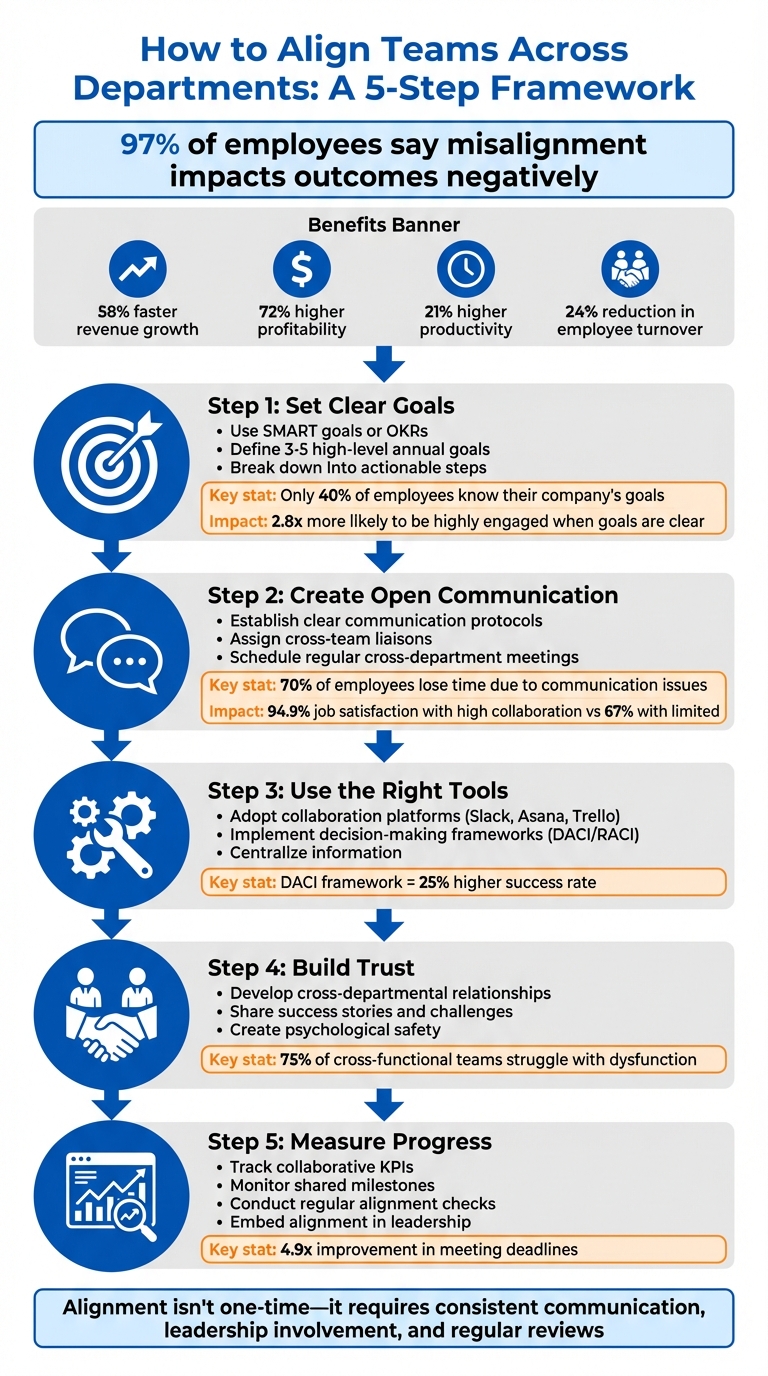
5-Step Framework for Aligning Teams Across Departments
How to Create Alignment Within and Across Teams
Step 1: Set Clear Goals That All Teams Understand
Without shared goals, teams can lose focus and drift apart. The numbers paint a sobering picture: only 40% of employees across organisations say they know their company’s goals. Yet, when goals and accountabilities are clear, employees are 2.8 times more likely to be highly engaged. Aligned companies also enjoy a significant edge, growing revenue 58% faster and achieving 72% higher profitability compared to unaligned ones.
The foundation of alignment lies in what John Doerr, author of Measure What Matters, calls the "North Star" - a clear, concise vision that translates into measurable objectives. Start by defining 3–5 high-level annual goals that every department can support. Then, break these down into actionable steps so teams and individuals see how their daily efforts contribute to the broader mission.
Use SMART Goals and OKRs
Shared goals are the backbone of effective collaboration across an organisation.
Frameworks like SMART goals (Specific, Measurable, Achievable, Relevant, Time-bound) and OKRs (Objectives and Key Results) provide a common language for goal setting, helping shift the focus from simply tracking activities to measuring outcomes.
OKRs are particularly useful for fostering cross-departmental alignment. Leadership sets ambitious objectives, while teams define the key results needed to achieve them, leveraging their expertise. For instance, instead of a vague objective like "improve customer satisfaction", a stronger goal might be "Deliver exceptional customer experiences across all touchpoints." Key results could include reducing average response times to under two hours or achieving a Net Promoter Score above 50. Success is often defined as hitting 70% of a key result, which reflects appropriately ambitious targets.
When setting key results, prioritise leading indicators that can be measured regularly - weekly or monthly - over lagging indicators that only show progress after a year. Keep objectives manageable by linking each one to two to five key results.
Break Down Goals Across All Levels
High-level objectives are meaningless if they don’t translate into actionable targets for teams and individuals. Effective goal-setting blends top-down direction with bottom-up input. Leadership defines the overarching mission and high-level OKRs, while teams craft specific objectives that align with and support these goals.
Crucially, departmental objectives should go beyond mirroring the company’s broader goal. They need to outline distinct, actionable steps. For example, if the organisational objective is "Expand market presence in the North", marketing might commit to "Generate 500 qualified leads from targeted regions", while product development works on "Launching localised features for Northern markets by Q3." These tailored goals ensure every department contributes meaningfully to the larger strategy.
Tools like Gantt charts or Kanban boards can help map dependencies and assign clear responsibilities. Kickoff meetings are another effective way to ensure everyone understands their role. Most importantly, always explain the "why" behind each goal. When employees understand how their work impacts the business, they are nearly five times more likely to increase their productivity.
Once clear, cascading goals are in place, the next step is to establish seamless communication channels between departments.
Step 2: Create Open Communication Channels Between Departments
Even the clearest goals can crumble without effective communication. The numbers speak for themselves: 70% of employees report losing valuable time due to communication issues, while 55% have missed critical messages because of miscommunication in their workplace. On the other hand, when collaboration flows properly, the benefits are undeniable - employees who experience high levels of collaboration report a 94.9% job satisfaction rate, compared to just 67% for those with limited collaboration.
The problem is that 75% of cross-functional teams struggle with inefficiency or dysfunction. Breaking down these barriers requires intentional systems that make sharing information the norm rather than the exception. Start by setting clear communication protocols - establish guidelines for how and when teams should communicate. For instance, you could create email subject line standards, such as adding "IMMEDIATE ACTION REQUIRED" for urgent interdepartmental requests, to ensure key messages don’t get buried in crowded inboxes. Communication is the essential link between clear goals and coordinated action.
Assigning cross-team liaisons can help bridge gaps between departments. These individuals act as interpreters, ensuring objectives align and heading off misunderstandings before they escalate. For more complex coordination, you might want to set up a Portfolio Governance Team (PGT). This leadership group can oversee decisions for projects that span multiple departments, ensuring alignment across the board.
Schedule Regular Cross-Department Meetings
Frequent touchpoints are crucial for keeping teams aligned and preventing silos. Be clear about the purpose of each meeting. For instance, meetings meant for sharing information should be distinct from those aimed at making decisions - mixing the two can waste time and lead to confusion. Before any cross-departmental project kicks off, hold a kickoff meeting to ensure everyone understands the project’s purpose, individual responsibilities, and the metrics for success.
"Map out the end-to-end work that you think will be needed to get the outcome you want... create an explicit framework that will serve as a collaboration contract." – Ron Ashkenas, Organisational Expert
This "collaboration contract" ensures that everyone is clear on sequencing, timelines, and dependencies before the work begins. For ongoing projects, set up weekly or fortnightly syncs to share updates, address challenges, and keep priorities aligned. Provide pre-meeting materials - such as videos or documents - so participants can come prepared, allowing for more effective discussions during live sessions.
Check-ins on assigned action items should happen at regular intervals to prevent tasks from slipping through the cracks. To keep engagement high, consider hosting informal sessions like "show and tell" presentations or brown bag lunches. Tools like the RACI matrix can also clarify roles and responsibilities for team members.
Once structured meetings are in place, the focus should shift to fostering an environment where open dialogue thrives.
Encourage Open Dialogue and Feedback
Meetings alone won’t achieve much if employees don’t feel comfortable speaking up. Building psychological safety - a workplace environment where people feel safe sharing ideas, asking for help, and expressing opinions - is key to creating trust and strengthening collaboration across departments. Without this, small concerns can snowball into major issues because no one feels able to address them early on.
Make public communication channels your default. Platforms like Slack, when used with open and transparent channels, encourage inclusivity and ensure everyone can stay informed. This approach allows teams to monitor project progress and jump into discussions when needed, avoiding the inefficiencies of forwarded emails or delayed updates. Visibility like this prevents situations where one department’s decisions inadvertently disrupt another’s work.
Two-way feedback loops are also essential for real-time input. Eliminate implicit communication and jargon that can alienate team members. Brief sessions to standardise terminology - along with consistent language in meeting agendas and decision-making processes - can ensure all departments are speaking the same "language."
With open communication channels firmly in place, the next step is selecting the right tools and frameworks to enable seamless collaboration.
Step 3: Use Tools and Frameworks to Support Collaboration
Effective collaboration thrives on the right systems. Without supportive tools and frameworks, even the most well-meaning teams can find themselves out of sync. A striking example is NASA's $125 million (£100 million) Mars Climate Orbiter loss in 1999. The failure occurred because one engineering team used metric units while another used imperial measurements - a mistake that could have been avoided with standardised tools and protocols.
To ensure smooth collaboration, it's essential to combine tools that centralise information with frameworks that clarify decision-making and accountability.
Adopt Collaboration Tools
A centralised platform is key for teams to access shared information, track progress, and coordinate without endless email threads or missed updates. Tools like Trello, Asana, and Airtable provide a unified space to assign roles and monitor tasks.
Instant messaging apps, such as Slack, create dedicated channels that eliminate delays caused by email. For example, in 2024, Missouri-based digital product agency Crema used Slack Connect to collaborate with external clients during mobile app and website development. This approach sped up decision-making and execution. For teams working across different time zones, asynchronous tools like Loom allow members to share screen recordings and provide context without the need for live meetings.
Integration is another key factor. Tools that work seamlessly with your existing tech stack help reduce the hassle of switching between apps. Automation features, like Slack's Workflow Builder, can handle repetitive tasks, freeing up time for more strategic efforts. Additionally, digital whiteboards and shared canvases act as central hubs for project materials, ensuring everyone can easily access key documents and project details.
While tools streamline communication and organisation, decision-making frameworks ensure clarity and accountability.
Implement Decision-Making Frameworks
Collaboration tools alone aren't enough - clear decision-making authority is equally important. Frameworks like DACI (Driver, Approver, Contributors, Informed) or RACI (Responsible, Accountable, Consulted, Informed) help define roles and prevent the chaos of too many people trying to steer the ship.
Projects using the DACI framework see a 25% higher success rate in meeting objectives and deadlines. This framework assigns specific roles: the Driver coordinates stakeholders and ensures decisions are made on time; the Approver has the final say; Contributors share their expertise; and the Informed are kept updated on outcomes. Crucially, there should only be one Approver, ensuring clear ownership of decisions.
While DACI focuses on decision-making, RACI is often better suited for general task assignments. Choosing the right framework depends on your project's complexity. For high-stakes, cross-functional projects with multiple stakeholders, DACI tends to be more effective. By establishing a shared language and perspective, these frameworks help teams understand how their actions contribute to the organisation's broader goals.
Step 4: Build Trust and Understanding Between Departments
Once communication channels and collaborative tools are in place, the next step is to nurture genuine trust between departments.
While tools provide the framework, trust is what truly drives collaboration. Departments often develop their own languages, priorities, and ways of working, which can lead to silos and defensive habits. Research shows that 75% of cross-functional teams struggle with dysfunction or inefficiency.
Building trust takes intentional effort and relies on creating a sense of psychological safety. Leaders must also respect the unique identity of each team. As Lisa B. Kwan wrote in Harvard Business Review:
In mandating and planning for collaborative initiatives, leaders... forget to consider how the groups they're asking to work together might experience the request - especially when those groups are being told to break down walls, divulge information, sacrifice autonomy, share resources or even cede responsibilities.
Trust reinforces the foundation that clear communication and effective tools establish.
Develop Cross-Departmental Relationships
Personal connections can break through formal barriers. One way to encourage this is through informal gatherings, such as brown bag lunches, where teams can share their roles, workflows, and challenges. These sessions help decode department-specific jargon and foster empathy.
Another approach is to organise sessions where departments explain their day-to-day operations to others. By understanding the challenges and pressures other teams face, collaboration becomes more natural. Some organisations even arrange "blind date" pairings, where colleagues from different departments shadow each other’s work. This not only humanises different functions but also builds personal relationships.
Physical proximity can also play a role. Removing cubicles, creating shared spaces, or relocating departments that frequently interact to the same floor can reduce friction. The idea is to create opportunities for what experts call "trust deposits" - acts of support, recognition, or camaraderie across teams without expecting anything in return.
Share Success Stories and Challenges
Transparency is key to building credibility. Use shared digital platforms to celebrate achievements in real time, ensuring that all teams receive recognition for their contributions. Publicly acknowledging successes reinforces the value of each department and helps break down siloed thinking.
Equally important is sharing challenges and lessons learned. Retrospectives after project milestones provide an opportunity to reflect on what went wrong and why. When mistakes are treated as shared learning experiences, they prevent repeated errors and spread valuable insights across the organisation. With nearly 60% of the global workforce reportedly disengaged from their work, open communication is essential for fostering a sense of shared purpose. Addressing conflicts quickly - especially between department leaders - can also prevent tensions from affecting front-line employees and undermining trust.
Step 5: Measure and Maintain Alignment Over Time
Once you've laid the groundwork with clear goals, open communication, and trust, the next challenge is ensuring alignment sticks. Without regular checks, teams can easily slip back into silos. To keep everyone on the same page, alignment must be measured consistently and woven into everyday leadership practices.
Start by defining clear metrics to evaluate collaboration across departments. Use these metrics to assess both performance and engagement, ensuring alignment becomes an integral part of how your organisation operates.
Track Collaborative Metrics
Shared KPIs are a powerful way to gauge cross-department collaboration. Keep an eye on metrics tied to objectives that require teamwork across teams, such as deployment frequency or the percentage of shared milestones hit on schedule. These KPIs - like OKR progress, on-time milestone delivery, and employee engagement - offer a window into whether collaboration is truly happening.
The impact of alignment is striking: organisations with strong alignment report 58% faster revenue growth, 72% higher profitability, a 4.9x improvement in meeting deadlines, and customer satisfaction rates as high as 97%.
Employee engagement metrics can also uncover hidden gaps. For instance, while 93% of executives express confidence in project clarity, only 74% of employees share this sentiment - a disconnect that signals misalignment. Regular surveys can help identify and address such issues early. Companies with highly aligned teams see a 24% reduction in employee turnover and enjoy 21% higher profitability.
But metrics alone aren’t enough. Leadership must actively champion alignment.
Embed Alignment in Leadership
Sustaining alignment requires leaders to model collaboration at every turn. One effective strategy is forming a Portfolio Governance Team, where leaders from different functions come together to make joint decisions on multi-department projects. This not only reinforces unified leadership but also helps avoid siloed decision-making.
A centralised, real-time dashboard can further support alignment by keeping shared goals, dependencies, and timelines visible to everyone. Weekly check-ins with key stakeholders help maintain momentum, while cross-team retrospectives at the end of cycles can uncover friction points and guide improvements.
Anu Bharadwaj, President of Atlassian, underscores the importance of visibility:
"Goals are our North Star. Making our individual, team, and company goals visible to everyone is the first step in working in sync".
Conclusion
Creating alignment within an organisation is an ongoing journey. It demands clear objectives, open channels of communication, robust collaboration tools, mutual trust, and regular progress checks. When leaders prioritise alignment, they can unlock impressive gains in both revenue and profitability.
At its core, alignment starts with leadership. As LHH aptly noted, "If the leadership team is not aligned on the directional strategy of the organisation, how can everyone else be?" Leaders set the tone by rallying around a shared vision and weaving it into a narrative that ties each team member’s daily efforts to the organisation’s overarching goals. Storytelling becomes a key tool - not just to inspire, but to foster a collective sense of purpose and direction.
Tools like the Leadership Story Bank help leaders craft compelling narratives that connect strategy to everyday actions. By sharpening their communication skills, leaders can articulate their vision clearly, celebrate cross-departmental successes, and make progress feel tangible. When teams grasp the "why" behind their collaboration, their engagement and productivity rise significantly.
Alignment doesn’t require perfection - it thrives on consistency. Small, regular practices like brief weekly check-ins, ongoing feedback loops, and transparent dashboards keep teams on track and energised. Leaders who view alignment as a shared responsibility cultivate stronger, more resilient teams. The results speak for themselves: such teams are 21% more productive and see a 24% drop in employee turnover.
The key is to start with manageable steps and maintain consistency, allowing alignment to become second nature within the organisation.
FAQs
How can we maintain alignment between teams across departments?
Maintaining alignment across departments hinges on a clear vision, open communication, and a shared purpose. It starts with senior leaders being on the same page about the organisation's priorities and regularly sharing these with all teams. Leaders also need to create an environment of psychological safety, where openness and collaboration thrive, preventing the rise of departmental silos.
To ensure teams stay aligned over time, set clear, measurable goals that everyone can see, and assign responsibility for achieving key results. Regular check-ins, like monthly alignment meetings, are crucial. These sessions allow teams to share progress, tackle challenges, and recalibrate priorities when necessary. Collaborative tools, such as shared dashboards, can also be invaluable for tracking progress in real time and ensuring resources are used wisely.
Storytelling and coaching play a vital role in reinforcing alignment. A compelling shared narrative can energise teams and keep them focused on the broader mission. Tools like Leadership Story Bank help leaders refine their storytelling skills, enabling them to communicate with clarity and influence across teams. By combining these approaches, organisations can build lasting alignment and foster stronger collaboration.
What are the most effective tools for improving communication between departments?
Effective communication across departments thrives on tools that make collaboration smoother and ensure everyone stays on the same page. Slack stands out for real-time messaging, searchable channels, and integrations that cut through silos and keep teams informed. When it comes to managing projects, the Atlassian suite offers a robust set of options: Jira for tracking tasks, Confluence for organising documentation, and Trello for visually planning workflows. These tools help teams stay coordinated and focused on shared goals.
For more creative and visual collaboration, Mural offers digital whiteboards that allow teams to brainstorm and develop ideas together in real time, encouraging better understanding and fresh perspectives. On the leadership front, the Leadership Story Bank supports leaders in crafting engaging narratives that bring teams together, ensuring everyone connects to a shared vision and purpose. By leveraging these tools effectively, teams can align more closely, make smarter decisions, and work towards collective achievements.
How can we measure the success of aligning teams across departments?
Measuring the success of cross-departmental alignment starts with breaking down broad goals into specific, measurable metrics. Begin by setting shared objectives, such as OKRs (Objectives and Key Results) or SMART goals, and focus on tracking both process and outcome metrics. Process metrics - like cycle times or delays during handovers - can reveal inefficiencies and bottlenecks. On the other hand, outcome metrics, such as customer satisfaction scores or error rates, help determine whether the collaboration is achieving its desired results.
It’s also essential to assess team dynamics. Collect feedback on areas like the effectiveness of meetings, how conflicts are resolved, and overall team morale. A well-rounded approach combines quantitative data - such as the percentage of milestones reached or reductions in duplicated work - with qualitative insights, like survey responses rating the clarity of objectives. Together, these provide a fuller picture of alignment success.
To keep efforts on track, use regular reviews and a centralised dashboard displaying these metrics. This ensures progress is visible and allows for timely course corrections. Evaluating efficiency, quality, and team satisfaction not only highlights the impact of alignment but also showcases a leader’s ability to drive meaningful collaboration.