
Action Learning for Change Management
How action learning uses small, facilitated groups to solve real organisational problems, build leadership skills and embed lasting change.

Action learning is a practical, group-based approach to solving organisational challenges while developing leadership and problem-solving skills. Originating in the 1950s, it focuses on questioning and collaboration rather than advice or traditional training. This method is increasingly used in the UK by organisations like the NHS and Ernst & Young to address complex issues, improve decision-making, and drive progress.
Key highlights:
- How it works: Action learning sets tackle real challenges through structured sessions, focusing on questions, reflection, and action.
- Why it’s effective: Combines immediate problem-solving with skill-building in areas like critical thinking and communication.
- Real-world results: Examples include a 30% boost in customer satisfaction for a retailer and improved remote work engagement by 20% in a financial firm.
- Implementation tips: Success relies on clear goals, skilled facilitation, and regular accountability.
This approach transforms problem-solving into a learning opportunity, helping organisations address challenges while preparing for future changes.
How does action learning build a learning organization? by Michael Marquardt
How Action Learning Drives Change
Action learning follows what Reg Revans described as a "dual mission" - achieving measurable business outcomes while simultaneously developing leadership skills essential for sustaining change. It blends problem-solving with leadership growth. When teams tackle real organisational challenges, they don't just solve immediate problems; they also refine critical skills like questioning, listening, and decision-making. These skills, in turn, make future change efforts more effective. The examples below illustrate how this approach delivers meaningful results.
Benefits of Action Learning in Change Management
The impact of action learning goes beyond theoretical skill-building. For instance, a retail company struggling with declining customer satisfaction used this method to address checkout delays. By identifying staffing inefficiencies and introducing flexible rotas alongside self-checkout stations, they improved customer satisfaction scores by 30% and reduced wait times by 25% in just four months.
In another example, a financial services firm faced resistance to remote working. Action learning groups gathered employee feedback and crafted tailored communication strategies, resulting in a 20% rise in engagement scores within three months.
A key feature of action learning is the use of "wicked questions" - open-ended queries that challenge assumptions. For example, a public sector organisation encountering resistance to digital tools discovered that the real issue wasn’t the technology itself but poor communication and insufficient training. By rolling out a detailed communication plan and interactive workshops, they increased adoption rates by 40% in six months. These examples highlight how action learning not only addresses immediate concerns but also builds the capacity for future change.
Tackling Common Change Challenges
Traditional change initiatives often fail because they treat symptoms rather than root causes. Action learning takes a different approach. It creates a safe, collaborative environment where leaders feel encouraged to ask difficult questions and work across departments. This process helps uncover hidden issues and develop more effective solutions, whether dealing with misaligned goals, unclear expectations, or a lack of support.
Participants are tasked with specific actions between sessions and return to share their progress. This cycle of accountability and reflection strengthens their ability to maintain momentum, even when challenges arise.
Change Training vs Action Learning
The following comparison highlights how action learning outperforms traditional change training methods:
| Feature | Traditional Change Training | Action Learning |
|---|---|---|
| Focus | Static theory and hypothetical scenarios | Immediate, real-world organisational priorities |
| Activities | Classroom lectures and case studies | Questioning, reflection, and implementation |
| Outcomes | Knowledge acquisition and certification | Measurable business results and ongoing change readiness |
| Behavioural Impact | Passive information absorption | Active skill-building in listening, questioning, and empathy |
| Resource Needs | Often requires specialised tools or facilities | Minimal; relies on a diverse group and a skilled facilitator |
"There can be no learning without action, and no action without learning. Wicked questions drive us to reflect, to act, and to grow".
Designing Action Learning Projects
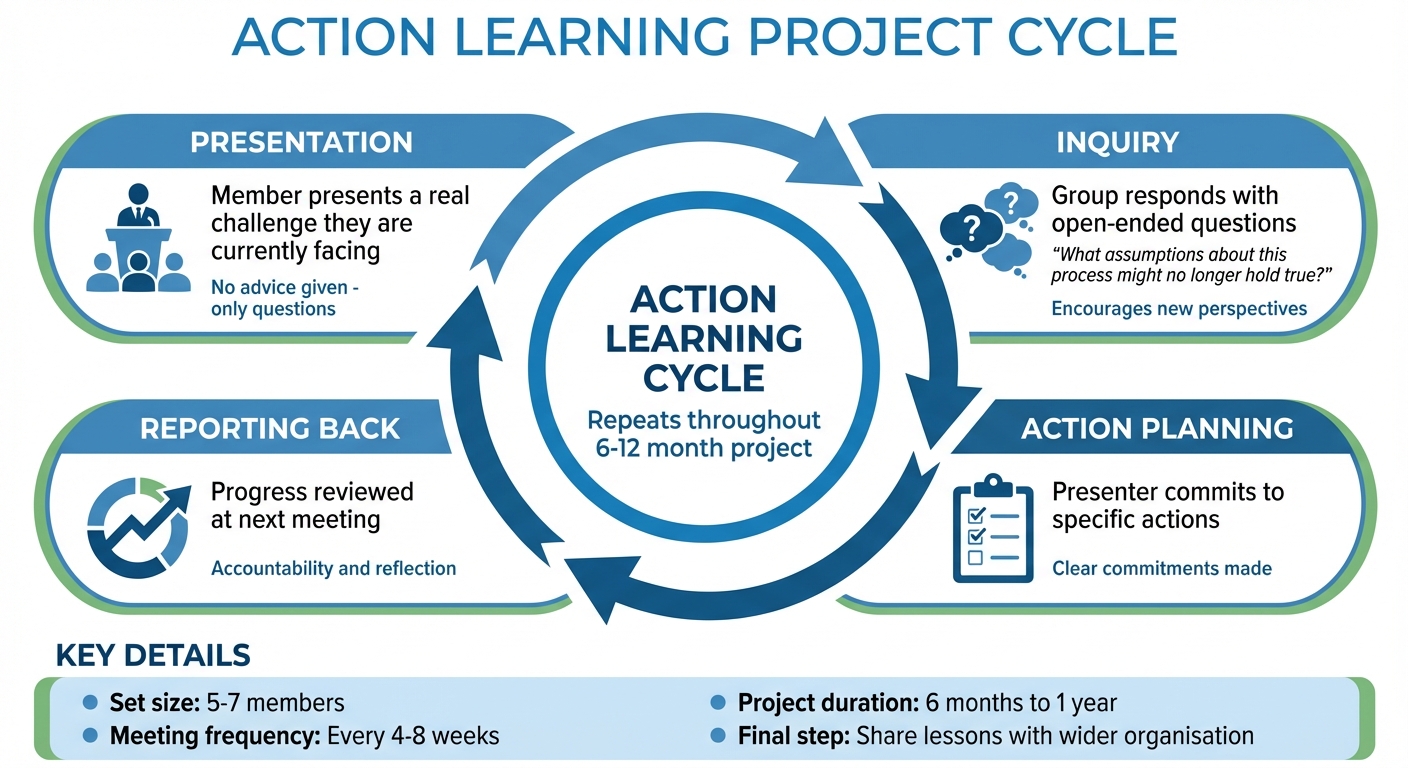
Action Learning Cycle: From Problem to Solution in 4 Steps
To achieve meaningful change management outcomes, the design of action learning projects is critical. Success relies on thoughtful planning. Without a clear framework, even the most enthusiastic teams can lose focus. The secret lies in tackling significant challenges, bringing together the right mix of people, and maintaining a balance between action and reflection.
Selecting the Right Change Projects
Not all organisational challenges are suitable for action learning. The most effective projects focus on real, pressing issues that lack straightforward solutions - those complex problems where analysis has hit a wall, and decisive action is required. The best projects are engaging because they address urgent, cross-departmental issues. They also bridge the gap between leadership strategies and the realities of everyday operations. Cross-departmental challenges are particularly effective because they draw on diverse perspectives and help dismantle organisational silos. Asking questions like, "What assumptions about this process might no longer hold true?" can help uncover core issues rather than just treating symptoms.
Structuring the Action Learning Set
An action learning set typically includes 5 to 7 members who meet every 4 to 8 weeks over a period of 6 months to a year. These groups work best when composed of peers with similar levels of responsibility, ensuring balanced dynamics where everyone feels comfortable sharing [18, 19]. Including members from different departments encourages fresh thinking and reduces the risk of groupthink.
Key roles include the facilitator, who steers the process without dominating it, and the set members, who commit to questioning, reflecting, and taking action [9, 19]. The facilitator ensures that ground rules are respected and fosters a safe environment, encouraging participants to share bold ideas without fear of judgement [9, 19]. As Tracey Faraday-Drake, Programme Director at Action Learning Associates, explained:
Gained a huge amount from the support of colleagues. Powerful, brings together relationships, you learn as much from listening as you do from talking.
When the right mix of people comes together in a supportive atmosphere, these sets can turn ideas into tangible progress.
The Project Process and Cycle
Action learning sessions follow a structured format. A member presents a real challenge they are currently facing, and the group responds - not with advice but with open-ended questions that encourage the presenter to see the problem from new angles [9, 19]. After this inquiry, the presenter commits to specific actions, and progress is reviewed during the next meeting, creating an ongoing cycle of accountability [9, 18].
This cycle - presentation, inquiry, action planning, and reporting - repeats throughout the project [9, 18]. Between sessions, participants implement their plans and gather insights from their experiences. At the end of the project, the group consolidates the lessons learned and shares them with the wider organisation, ensuring the impact goes beyond the immediate team.
For example, this approach has helped financial services organisations address resistance to remote working, demonstrating its effectiveness in tackling complex, real-world challenges.
Leadership, Communication, and Storytelling
Action learning has a transformative impact on leadership communication, especially during times of change. It naturally fosters the ability to craft clear, relatable stories that tie strategy to human experiences. By moving beyond abstract theories and addressing real-world challenges, leaders can make their messages more engaging and persuasive.
The Facilitator's Role in Supporting Change
Facilitators play a critical role in creating an environment where honest communication thrives. They establish psychological safety - an atmosphere where participants feel free to share raw ideas and personal stories without fear of judgment. Through strategic questioning, such as "What assumptions about this process no longer hold?", facilitators encourage reflection and growth. This approach aligns with Reg Revans' belief that asking the right questions is key to driving meaningful progress.
Facilitators also emphasise the importance of listening as much as speaking. By managing group dynamics and focusing on practical challenges, they help participants connect their personal experiences with broader organisational goals. Once this foundation of open inquiry is established, leaders can use storytelling to strengthen stakeholder engagement.
Using Storytelling to Navigate Change
Building on the groundwork laid by facilitators, leaders use storytelling to bridge the gap between strategy and lived experience. Action learning equips leaders to craft core stories that bring organisational strategies to life, particularly during periods of transition. These narratives, grounded in real challenges, go beyond simply explaining "what" is happening - they also delve into the "why" and "how", making the message more impactful.
Storytelling in this context often shifts from "restitution" narratives, which focus on fixing problems, to "quest" narratives that frame change as a journey of discovery and growth. This reframing can boost morale and foster engagement. For instance, a UK financial services firm facing employee disengagement over its remote work policy used action learning to address the issue. By conducting interviews and focus groups and refining their communication strategies, they improved engagement scores by 20% within three months.
Leaders in action learning groups also refine their narratives with feedback from peers. This iterative process of presenting, questioning, and reflecting helps transform individual insights into compelling stories that resonate across the organisation. A nonprofit, for example, used action learning to tackle inconsistent messaging and saw a 30% increase in donor retention as a result.
Implementation in UK Organisations
Action learning projects thrive on careful planning and a structured approach to governance. UK organisations often choose between internal sets - where all participants are from the same company - or cross-organisation sets, which bring together professionals from various industries. Internal sets are ideal for targeting company-specific objectives and fostering in-house collaboration, while cross-organisation sets bring in diverse perspectives that can challenge ingrained ways of thinking. Regardless of the approach, success hinges on senior leadership support and cooperation at all organisational levels to ensure that changes are implemented in a systematic and effective manner. This alignment ensures projects contribute meaningfully to strategic goals.
Implementation Models and Governance
As previously highlighted, skilled facilitation and practical insights are essential to action learning. Equally important is a robust governance framework that defines roles and responsibilities. Governance structures should outline who sponsors the initiative - typically senior leaders or HR and organisational development teams. These sponsors play a key role in ensuring the programme aligns with the organisation's broader strategic objectives and that participants have the authority to act on their solutions. For particularly sensitive initiatives, such as restructuring or redundancy planning, external facilitators can provide a neutral, confidential space where participants feel comfortable sharing their thoughts without fear of internal repercussions. This aligns with Revans' Law:
For an organisation to survive, its rate of learning must be at least equal to the rate of change in its external environment.
This principle highlights the importance of treating learning not just as an operational function but as a strategic priority.
Logistics and Budgeting
Practical details, such as the format and scheduling of sessions, are key to successful implementation. Sessions can be structured as full-day workshops, half-day meetings, or shorter sessions to accommodate demanding schedules. Hybrid and online formats are particularly effective for geographically dispersed teams, as they reduce travel expenses while still fostering connections among participants. Budget planning should include costs for facilitators, meeting spaces, digital tools, and materials like flip charts. Transparent scheduling is essential to avoid conflicts and secure consistent participation. Once logistics are settled, attention must turn to evaluating outcomes to ensure the programme’s effectiveness.
Evaluating Success and Managing Risks
The success of action learning is assessed through measurable outcomes, such as individual growth (e.g., increased confidence and better goal-setting) and organisational improvements (e.g., enhanced adaptability and cross-disciplinary collaboration). These results build on the benefits discussed in the How Action Learning Drives Change section, demonstrating how action learning creates tangible, lasting impact. Continuous feedback mechanisms are crucial for refining the process as it unfolds. As Jo Lopes Da Silva from the University of Salford explains:
Action Learning is an excellent development option that positively impacts on an individual and organisational level.
| Benefit | Risk | Mitigation |
|---|---|---|
| Actionable Solutions: Tackles real-world issues with concrete plans. | Lack of Action: Participants may not follow through on plans. | Reporting Back: Require updates on progress during each session. |
| Skill Development: Enhances active listening and questioning skills. | Advice-Giving: Members might focus on solving problems rather than asking questions. | Facilitator Role: Use skilled facilitators to guide the process. |
| Organisational Agility: Encourages flexible, adaptive thinking. | Inconsistent Attendance: Long-term projects may face drop-outs. | Agreed Commitment: Set clear schedules and expectations from the start. |
| Interdisciplinary Working: Strengthens collaboration across different fields. | Power Imbalance: Hierarchies may hinder open communication. | Equality of Membership: Foster a culture of equal participation among members. |
Establishing clear ground rules - such as maintaining confidentiality, ensuring equal participation, and focusing on questioning over advice - helps prevent issues with group dynamics. Teams can use the "Plan, Do, Check, Act" cycle to test new ideas, evaluate their outcomes, and integrate successful changes into organisational processes systematically.
Conclusion
Action learning reshapes the way organisations approach change, turning it into a collaborative effort where teams tackle challenges head-on. By blending decisive action with thoughtful reflection, it demonstrates that learning and doing are inseparable. This method develops crucial leadership skills, such as active listening, critical thinking, and the ability to pose "wicked questions" - those that challenge deep-seated assumptions rather than settling for surface-level solutions.
The impact of action learning is evident in real-world results. For example, a retail company reported a 30% boost in customer satisfaction and a 20% rise in employee engagement. Additionally, digital transformation efforts saw adoption rates climb by 40% within just six months. These outcomes highlight how action learning not only addresses immediate business challenges but also builds the leadership capabilities needed to navigate future uncertainties.
What makes this approach particularly effective for UK organisations is its straightforward nature. There’s no need for costly software, specialised facilities, or complex tools. Instead, it thrives on assembling diverse teams who regularly come together to tackle real-world problems through open, accountable discussions. This method breaks down departmental silos and creates a sense of psychological safety - an essential element discussed earlier - allowing participants to take risks and explore complex issues without fear of criticism. This simplicity is at the heart of the transformative outcomes described throughout.
The real key to success is making learning a strategic priority rather than just an operational task. By gaining senior leadership buy-in, training skilled facilitators, and embedding reflection as a regular organisational habit, teams can take an active role in shaping meaningful change.
FAQs
What makes action learning unique compared to traditional change management approaches?
Action learning takes a hands-on approach to tackling real organisational challenges. It brings together small, diverse teams to collaborate through questioning, reflection, and the immediate application of ideas. Instead of dealing with hypothetical scenarios, participants engage with genuine issues, allowing them to learn by doing. This not only helps in crafting practical solutions but also strengthens the team's skills for the long haul.
In contrast, traditional change management often leans on fixed methods like delivering set training programmes or rolling out top-down strategies. These can sometimes feel out of touch with the actual experience of navigating change. Action learning flips the script by blending problem-solving with personal growth. It encourages teamwork and ongoing learning, ensuring that new insights are put into practice straightaway. This flexible, real-time approach makes it particularly effective for handling complex and ever-changing situations.
What are the key factors for successfully using action learning to drive organisational change?
Successfully embedding action learning within an organisation hinges on several key elements working together to drive meaningful change.
To begin with, the process must centre around a genuine and clearly defined business challenge. Addressing real issues ensures that the learning remains relevant and directly contributes to organisational needs. Bringing together a group of individuals with varied roles and perspectives is equally important, as this diversity sparks creativity and fresh approaches to tackling complex problems.
At the core of action learning are structured questioning and regular reflection. These practices encourage participants to challenge existing assumptions and deepen their understanding of the issue at hand. To translate insights into results, clear action planning is essential - turning ideas into specific steps that can be tested and reviewed for effectiveness. Skilled facilitation plays a vital role here, ensuring discussions remain productive and that participants feel safe to engage in open, honest dialogue.
Lastly, visible backing from senior leaders is crucial. Their support aligns the programme with broader organisational goals and motivates others to engage with the process.
When these components come together, action learning becomes a dynamic approach to navigating change and strengthening an organisation’s long-term capabilities.
How does Action Learning help leaders manage organisational change effectively?
Action Learning offers a hands-on way to tackle real organisational challenges while fostering growth through reflection and collaboration. By working on pressing issues - like navigating a digital transformation - leaders get the chance to test out solutions, evaluate their impact, and adjust their strategies. This ongoing cycle of action, reflection, and learning sharpens critical thinking, hones decision-making skills, and builds resilience in the face of change.
These sessions typically involve small, cross-functional groups of 4–8 participants, creating a supportive environment for developing leadership abilities. Skills such as influencing others, active listening, and crafting persuasive narratives are practised as participants work together to find solutions. This collaborative process not only boosts confidence and self-awareness but also equips leaders to steer their teams through uncertainty, delivering meaningful outcomes in the dynamic UK workplace.